


Contents: Arrangement of elements ⇩ Review ⇩
Arrangement of elements
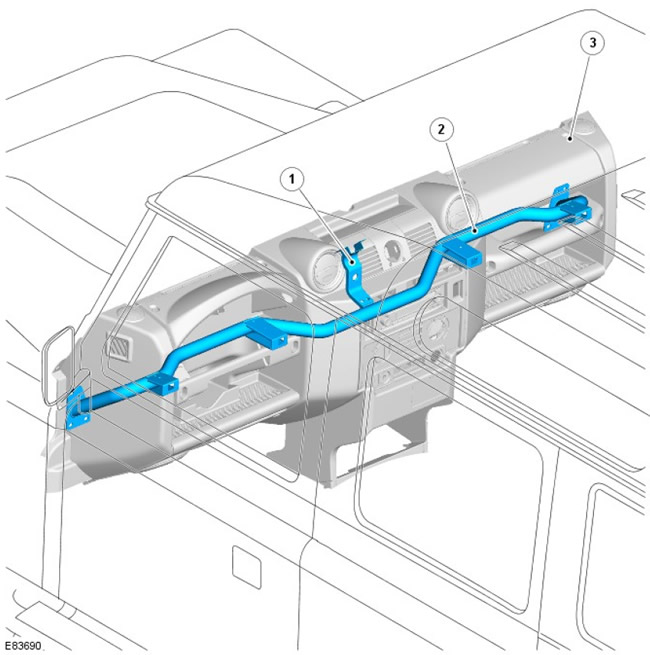
| Pos. | Spare part number | Name |
| 1 | - | Central support |
| 2 | - | Cross beam |
| 3 | - | Instrument panel |
Review
All 2007 model year vehicles have a new instrument cluster. In addition to the various switches and controls, the instrument cluster also contains a completely new instrument cluster and climate control system. For more information, see the chapter: Instrument Cluster (413-01 Instrument cluster, Description and operating principle), Microclimate control system (412-00 Climate control system - General information, Description and operating principle), Air distribution and purification (412-01 Air distribution and purification, Description and operating principle).
A tubular steel crossmember is installed behind the instrument panel. Three welded bolts are installed at each end of the interior bulkhead to provide mounting points for the crossmember. When the crossmember is removed, the nuts securing it must be discarded and replaced with new ones.
The cross beam is non-directional, meaning the same beam fits both left-hand drive (LHD) and right-hand drive (RHD) vehicles.
The crossmember has 4 support brackets. The driver side brackets provide mounting points for the instrument panel trim, and the passenger side brackets provide mounting points for the instrument panel grab handle. The support brackets contain expandable nuts that must be replaced each time the instrument panel is removed.
The center support bracket is secured to the crossmember with two plastic threaded rivets. Another plastic threaded rivet secures the top of the bracket to the bulkhead. The center support bracket provides mounting for the audio system head unit and supports the inner ends of the climate control ducts. The ducts are secured to the center support bracket with two more plastic threaded rivets. Any plastic threaded rivets that are removed from the structure should be discarded and replaced with new ones.
(The original article is located on: «lrman.ru»)
Comments on this article