- Check the tire pressure. For more information, refer to the chapter: Specifications (204-04 Wheels and Tyres, Specifications).
- Check the condition of the tires.
- Check the front wheel alignment angles. For more information, refer to the chapter: Front Wheel Alignment (204-00 Suspension - General Information, General Procedures).
- Check wheel balancing.
NOTE: When any obvious vibration is not eliminated at this stage.
NOTE: When any obvious vibration is not eliminated at this stage, go to the section " Diagnostics of steering malfunctions, Signs of malfunction (vibration in steering, angular oscillation of steering wheels)".
For more information, refer to the chapter: Steering system (211-00 Steering system - General information, Diagnostics and tests).
NOTE: Radial tires have elastic sidewalls that bulge, causing the tire to appear underinflated. This is a normal condition for radial tires. Do not attempt to reduce this bulge by inflating the tire to higher pressures.
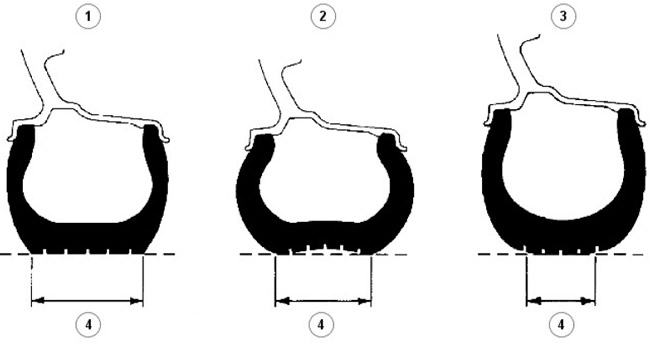
| Pos. | Spare part number | Name |
| 1. | - | Correct tire pressure. |
| 2. | - | Insufficient tire pressure |
| 3. | - | Excessive tire pressure. |
| 4. | - | Contact of the tread with the road. |
Tire Tread Wear Chart
CAUTION: This chart is intended as a general guide only and does not necessarily include all causes of abnormal tread wear.
| Malfunction | Cause | Method of elimination |
| Rapid wear of tire shoulders | Insufficient tire pressure | Inflate the tire to the correct pressure |
| Worn suspension components such as ball joints, diagonal rod bushings, steering damper | Replace worn out parts | |
| Rapid wear in the center of the tread | High tire pressure | Inflate the tire to the correct pressure |
| Wear of one shoulder of the tire | The track alignment is broken | Adjust the track to normal. |
| The diagonal bar is deformed (panhard bar) | Check and replace worn or damaged components | |
| "Bald" spots or "cupping" of the tire | Wheel imbalance | Balance the wheel and tire assembly |
| Increased radial runout | Check the runout and replace the tire if necessary | |
| The shock absorber is worn out | Replace the shock absorber | |
| Excessive braking | ||
| Protruding areas on the tire profile | The track alignment is out of adjustment | Adjust the track to normal. |
| Wear of suspension components | Check and replace worn or damaged parts and replace the tire | |
| High speed cornering |
Comments on this article