Contents: Elements of the DPF system ⇩ Diesel particulate filter ⇩ Passive regeneration ⇩ Active regeneration ⇩ Diesel Particulate Filter Control…⇩ DPF Fuel Management Module ⇩ DPF Air Flow Control Module ⇩ DPF matching module ⇩ Differential pressure sensor ⇩ DPF Temperature Sensors ⇩ Instrument cluster indication ⇩ Side effects of diesel particulate…⇩ Fuel consumption ⇩
On vehicles starting with the 2008 model year, a diesel particulate filter (DPF) is available as an option.
NOTE: The DPF-free exhaust system is also available on vehicles from model year 2008 onwards.
The DPF system reduces diesel particulate emissions to negligible levels.
Elements of the DPF system
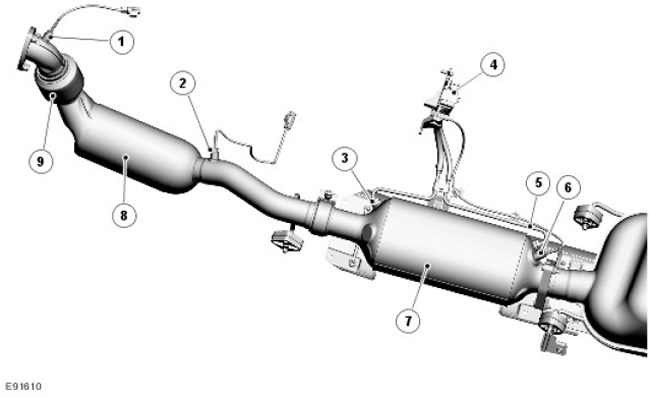
| Item name | Spare part catalog number | Description |
| 1 | Exhaust gas temperature sensor (before the catalyst) | |
| 2 | Exhaust gas temperature sensor (after catalyst) | |
| 3 | High pressure sensor tube | |
| 4 | Differential pressure sensor | |
| 5 | Low pressure sensor tube | |
| 6 | Exhaust gas temperature sensor (after DPF) | |
| 7 | Diesel particulate filter | |
| 8 | Catalytic converter |
Particulate matter emissions occur in the form of black smoke emitted by a diesel engine under certain load conditions. Exhaust gases are a complex mixture of solid and liquid elements, with particulate matter being primarily carbon microspheres on which hydrocarbons released from the fuel and engine lubricants condense.
The DPF system consists of the following elements:
- Diesel particulate filter
- DPF control software integrated into the Engine Control Module (ECM)
- Differential pressure sensor
Diesel particulate filter
The DPF is located in the exhaust system, behind the catalytic converter. The main characteristic of the DPF is its ability to regenerate. Regeneration is the combustion of solid particles captured by the filter, which prevents the filter from clogging and ensures the free passage of exhaust gases. The regeneration process occurs at calculated intervals and is not noticeable to the driver of the car.
Regeneration is very important because overfilling the filter can cause engine damage due to excessive exhaust back pressure, and the filter itself can also break or be destroyed. The products trapped by the filter are mainly carbon particles with absorbed hydrocarbons.
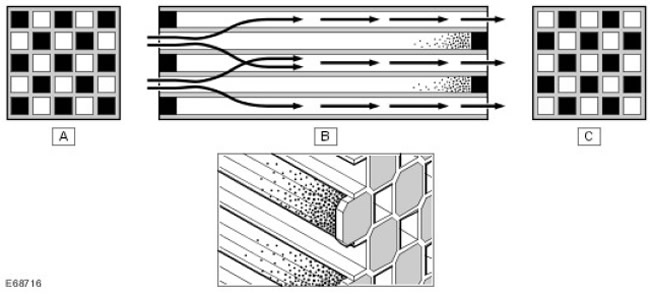
| Item name | Spare part catalog number | Description |
| A | Front side with alternating closed cells | |
| B | Side view showing exhaust gas flow through the filter and particulate matter collecting in the filter | |
| C | Back side with alternating closed cells |
The DPF uses catalytic coated filter technology. The DPF is made of silicon carbide enclosed in a steel container, which has excellent thermal shock resistance and thermal conductivity characteristics. The DPF is designed to meet operational needs to maintain optimum back pressure.
The porous surface of the filter consists of many small parallel channels arranged longitudinally with respect to the exhaust system. Adjacent channels in the filter are alternately closed at the ends. This design forces the exhaust gases to pass through the porous walls of the filter, which act as a filter medium. Solid products that are too large to pass through the porous surface are collected and stored in the channels.
If the solids collected on the filter are not removed, the flow of exhaust gases may be obstructed. The process of regeneration, in which the solids are oxidized, serves to remove the solids.
The DPF regeneration is controlled by the exhaust gas and DPF temperature. The DPF has a filter surface with a "wash coat" treatment, which includes platinum and other active components and is similar to the treatment of a catalytic converter. At a certain exhaust gas and DPF temperature, the "wash coat" activates the combustion of particulate matter in addition to the oxidation of carbon monoxide and hydrocarbons.
The exhaust gas and DPF temperatures are monitored by the DPF software in the ECM. The DPF software monitors the DPF load based on driving style, distance travelled and signals from differential pressure and temperature sensors. When a predetermined particulate matter level is reached, active regeneration of the DPF occurs. This is carried out in cooperation with the ECM by regulating various engine management functions such as:
- fuel injection
- regulation of intake air flow using a throttle
- exhaust gas recirculation system
- boost pressure control
To regenerate the DPF, two filters are used - active and passive.
Passive regeneration
Passive regeneration does not require any special intervention from the engine management system and occurs during normal engine operation. Passive regeneration slowly converts solid particles deposited in the DPF into carbon dioxide. This process is active when the DPF temperature reaches 250°C (482°F). At high speeds and high engine loads, this process becomes continuous.
During passive regeneration, only a portion of the particulate matter is converted to carbon dioxide. This is because the chemical reaction process is only effective within the normal operating temperature range of 250°C to 500°C (482°F to 932°F).
Above this temperature range, the efficiency of converting particulate matter into carbon dioxide increases with increasing DPF temperature. Such temperatures can only be achieved through an active regeneration process.
Active regeneration
Active regeneration begins when the amount of particulate matter in the DPF reaches a threshold level, which is monitored or determined by the DPF control software. The threshold calculation takes into account the vehicle's driving style, the distance traveled and the backpressure signals from the differential pressure sensor.
Active regeneration typically occurs every 725 km, but the frequency of regeneration is highly dependent on the vehicle's driving conditions. For example, when driving a vehicle with a light load in city traffic, active regeneration will occur more frequently. This is due to the faster accumulation of solid particles in the DPF compared to when the vehicle is driven at high speed and passive regeneration occurs.
The DPF software contains a mileage counter that initiates regeneration and serves as a backup for active regeneration. Regeneration is requested based on the distance traveled, unless it has been initiated by a backpressure signal from the differential pressure sensor.
Active DPF regeneration begins when the DPF temperature rises to the combustion temperature of the particulate matter. The DPF temperature is increased by increasing the exhaust gas temperature. This is achieved by introducing an additional injection after the pilot and main injection.
The DPF software monitors signals from two DPF temperature sensors to determine the DPF temperature. Depending on the DPF temperature, the DPF software requests the ECM to perform one or two post-injection cycles:
- The first additional fuel injection slows down combustion inside the cylinder, which increases the exhaust gas temperature.
- A second additional injection of fuel occurs later in the power stroke cycle. The fuel is partially burned in the cylinder; some of the unburned fuel enters the exhaust system where it initiates an exothermic reaction in the catalytic converter, further increasing the DPF temperature.
The DPF active regeneration temperature is closely monitored by the DPF software to maintain the required temperature of 600°C (1112°F) at the DPF inlet. The temperature management system ensures that the operating temperature limits of the turbocharger and catalytic converter are not exceeded. The turbocharger inlet temperature must not exceed 830°C (1526TF), the catalytic converter temperature must not exceed 800°C (1472TF) and the outlet temperature must remain below 750°C (1382°F).
During active regeneration, the following processes occur, controlled by the ECM:
- The turbocharger is kept in a fully open position. This minimises heat transfer from the exhaust gas to the turbocharger and reduces the exhaust gas flow rate, allowing optimum heating of the DPF. If the driver wishes to increase torque, the turbocharger blades can be closed if necessary.
- The throttle valve closes as this helps to increase the exhaust gas temperature and reduces the exhaust gas flow rate, which reduces the time it takes for the DPF to warm up to optimum temperature.
- The exhaust gas recirculation (EGR) valve closes. Using EGR reduces the exhaust gas temperature and therefore does not allow the DPF to reach its optimum temperature.
Diesel Particulate Filter Control System
To ensure optimum DPF efficiency and prevent clogging, the DPF must be continuously monitored. The ECM contains the DPF software, which controls the monitoring and operation of the DPF system and also monitors other vehicle data to determine regeneration periods and maintenance intervals.
The DPF software can be divided into three separate software control modules: the DPF Monitoring Module, the DPF Fuel Management Module and the DPF Air Management Module.
These three modules are controlled by a fourth software module called the DPF Matching Module. The Matching Module controls the operation of the other modules when an active regeneration request is received. The DPF Control Module is a subsystem of the DPF Matching Module.
DPF Fuel Management Module
The DPF fuel management module controls the following functions:
- Synchronization of four separate injections per working stroke and the amount of fuel injected (preliminary, main and two additional injections).
- Injection pressure and switching between three different injection calibration levels.
In addition to measuring the activity of the catalytic converter and DPF, the controlled injection determines the required injection level. The fuel management system calculates the amount of fuel and the timing of the four separate injections for each of the three injection pressure calibration levels, and also controls the switching between the levels.
Two additional injections are required to separate the functions of increasing the temperature of the gases in the cylinder and the production of hydrocarbons. The first additional injection is used to generate a higher temperature of the gases in the cylinders at the same time as maintaining the same engine torque as under normal (not during regeneration) engine operation. The second additional injection is used to produce hydrocarbons by directing unburned fuel to the catalytic converter without increasing engine torque.
DPF Air Flow Control Module
The DPF air flow control module controls the following functions:
- EGR control system
- Boost pressure control system
- Intake air temperature and pressure control system
The module controls the intake air temperature, actuating the EGR throttle valve and regulating the boost pressure.
DPF matching module
The DPF matching module, upon receiving a regeneration request from the control module, initiates and matches the following DPF regeneration requests:
- Disabling EGR
- Boost pressure control
- Increased engine load
- Control of air pressure and temperature in the intake manifold
- Fuel injection control
When the EGR valve closes, the matching module initiates a request to increase engine load by controlling intake air temperature and pressure.
After receiving confirmation that the intake conditions are under control or that the calibration time has expired, the matching module goes into a waiting state when the driver releases the accelerator pedal. If this happens or the calibration time has expired, the matching module generates a request to control the fuel injection to increase the exhaust gas temperature.
Differential pressure sensor
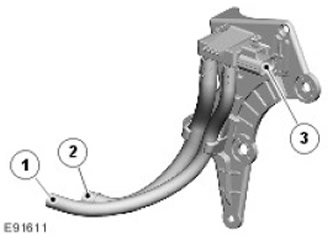
| Item name | Spare part catalog number | Description |
| 1 | Low pressure branch pipe | |
| 2 | High pressure pipe | |
| 3 | Electrical connector |
The differential pressure sensor is mounted on a bracket attached to the transfer case.
The differential pressure sensor is used by the software to monitor the health of the DPF. Two ports on the sensor are connected by tubes to the inlet and outlet side of the DPF. The tubes allow the sensor to measure the DPF pressure at the inlet and outlet.
As the amount of particulate matter captured by the DPF increases, the pressure on the inlet side of the DPF increases compared to the outlet side. The DPF software uses this comparison in combination with other data to calculate the accumulated amount of particulate matter captured.
By measuring the pressure difference between the DPF inlet and outlet and the DPF temperature, the DPF software can determine if the DPF is clogged and requires regeneration.
DPF Temperature Sensors
The DPF system uses three temperature sensors. The first sensor is installed immediately after the turbocharger in the inlet pipe of the catalytic converter, the second is installed in the outlet pipe of the catalytic converter, and the third sensor in the outlet cone pipe of the DPF.
The sensors measure the exhaust gas temperature at the turbocharger outlet, after the catalytic converter and after passing through the DPF and provide the information needed to calculate the DPF temperature.
This information is used in combination with other data to calculate the amount of accumulated particulate matter and to control the DPF temperature.
Instrument cluster indication
If the vehicle is regularly driven short distances at low speeds, effective DPF regeneration may not be possible.
In this case, the DPF software determines that the DPF is clogged based on signals from the differential pressure sensor and issues the following warnings to the driver:
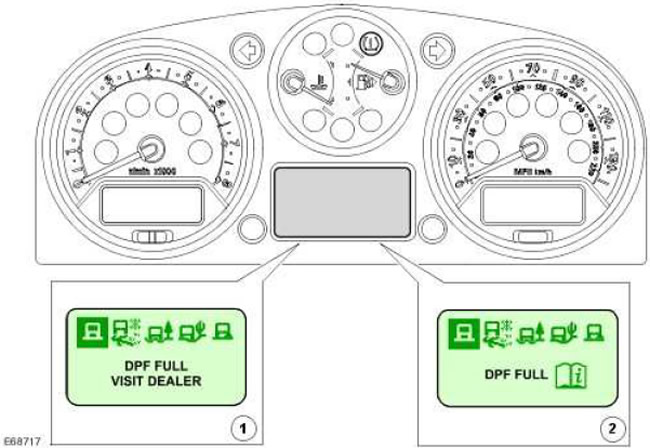
| Item name | Spare part catalog number | Description |
| 1 | 'DPF FULL VISIT DEALER' (DPF FULL, VISIT DEALER) | |
| 2 | 'DPF FULL' (DPF FULL) |
Vehicles equipped with a DPF and a high-level instrument cluster use messages in the message center display to alert the driver to the DPF status.
When the DPF is full, the driver will be informed by the message "DPF FULL" accompanied by the reference symbol. As described in the Owner's Manual, the driver should drive the vehicle until the engine has warmed up to normal operating temperature and then continue driving at a speed of at least 30 mph (48 km/h) for 20 minutes. Once the DPF regeneration has been successfully completed, the message "DPF FULL" will no longer be displayed.
If the DPF software determines that the DPF is still clogged, a message will be displayed "DPF FULL VISIT DEALER". The driver should visit an authorized dealer to perform a forced DPF regeneration.
Side effects of diesel particulate filter (DPF)
The following section describes some of the side effects caused by the active regeneration process.
Dilution of motor oil
Dilution of the engine oil can occur due to small amounts of fuel entering the engine crankcase during the post-injection phase. For this reason, calculations based on driving style have been implemented to reduce oil change service intervals if necessary. The driver is notified of the need for an oil change by a message on the instrument panel.
The DPF software monitors the vehicle's driving style, frequency and duration of active regeneration. Using this information, calculations can be made about engine oil dilution. When the DPF software calculates that engine oil dilution has reached a preset threshold (fuel is 7% of the oil volume), a service message is displayed on the instrument cluster.
Depending on your driving style, some vehicles may require an oil change earlier than the scheduled interval. If a service message is displayed, your vehicle should be serviced before the scheduled service interval is reset.
Fuel consumption
During the active DPF regeneration process, fuel consumption increases. However, since active regeneration occurs infrequently and for a limited period of time, overall fuel consumption increases by approximately 2%. The additional fuel used during the active regeneration process is included in the instantaneous fuel consumption and the average fuel consumption is displayed on the instrument cluster.
Comments on this article