Contents: Location of exhaust system…⇩ Exhaust system layout for TdV6…⇩ Review ⇩ Front section ⇩ Rear section ⇩ Catalytic converter ⇩
Location of exhaust system components of the TdV6 engine - without a particulate filter
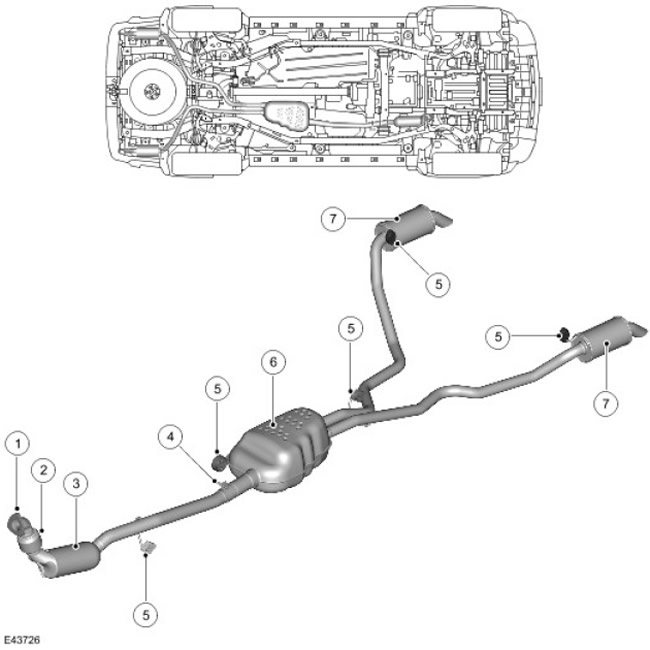
| Item name | Spare part catalog number | Description |
| 1 | - | Inlet flange |
| 2 | - | Flexible coupling |
| 3 | - | Catalytic converter |
| 4 | - | Clamp |
| 5 | - | Rubber support (5 pcs.) |
| 6 | - | Central muffler |
| 7 | - | Rear muffler |
Exhaust system layout for TdV6 engine - with additional particulate filter - from model year 2008 (if available)
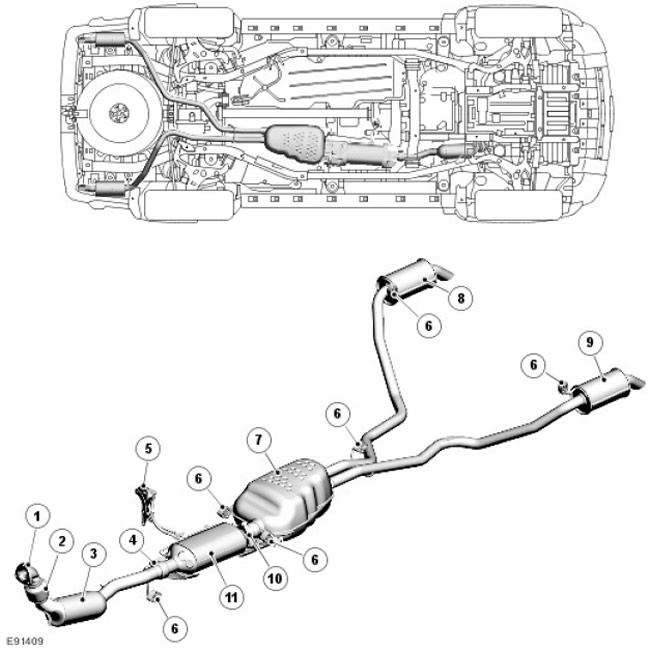
| Item name | Spare part catalog number | Description |
| 1 | - | Inlet flange |
| 2 | - | Flexible coupling |
| 3 | - | Catalytic converter |
| 4 | Clamp | |
| 5 | Differential pressure sensor | |
| 6 | - | Rubber support (6 pcs.) |
| 7 | Central muffler | |
| 8 | - | Rear left muffler (LH) |
| 9 | - | Rear right muffler (RH) |
| 10 | - | Flange connection and gasket |
| 11 | DPF |
Review
The TdV6 exhaust system is made from stainless steel and comes as two separate units. The front section contains the catalytic converter, while the rear section contains the central silencer and two rear silencers.
The system is secured to the underbody by five rubber mounts which are mounted on mild steel suspension brackets welded to the system. The rubber mounts are mounted on corresponding suspension supports which are welded to the underbody.
Spare parts are supplied for repair of the exhaust system. The recesses on the rear section between the central and rear mufflers indicate the cutting point for replacing the rear mufflers or the front section. The spare section is attached to the cutting point using a bushing and two clamps.
A diesel particulate filter (DPF) is available as an option on vehicles from model year 2008 onwards. An exhaust system without DPF is also available on vehicles from model year 2008 onwards, as the DPF is not required to comply with the EU4 emission standard.
CAUTION: Using biofuels can seriously contaminate and damage the coating of the catalytic converter. If unspecified oils or fuels are used, the DPF and catalytic converter may become irreparably contaminated. As a result, the vehicle will not be able to regenerate the DPF, which will result in non-compliance with exhaust emission standards and the need to replace the catalytic converter and DPF.
CAUTION: If the engine is stopped during deep fording and the exhaust pipes are under water, water may enter the system, which may also contaminate the DPF and catalytic converter. This may also result in damage to the catalytic converter and the inability to regenerate the DPF, which will require replacement of both elements.
Front section
A flange with three holes for three turbine studs is welded to the front section. A metal gasket is used to seal the flange. The front section is secured to the turbine studs with three nuts.
The flange is welded to the elbow, which in turn is welded to the coupling. Stamped exhaust system elements are welded between the coupling and the catalytic converter housing. The neutralizer outlet pipe is a 60 mm diameter pipe with a wall thickness of 2.0 mm, welded to the catalytic converter housing. The outlet pipe has a suspension bracket for installing a rubber support.
Cars without DPF
The rear of the catalytic converter outlet pipe is inserted into the rear section. A clamp is used to compress the joint of the front section to the flared end of the rear section.
[Information obtained from the website lrman.ru]
Vehicles with additional DPF - From model year 2008
The rear outlet pipe of the catalytic converter has a flared end that slides onto the inlet pipe of the DPF and is secured with a clamp. The outlet pipe of the DPF has a triangular flange that mates with a similar flange on the rear section of the exhaust system. The 2 flanges are sealed with a metal gasket and are secured with three lock nuts that are screwed onto captive studs on the DPF flange.
Rear section
Cars without DPF
On vehicles without DPF, the rear section has a short pipe with a diameter of 70 mm and a wall thickness of 1.5 mm, which is designed to connect to the front section, as discussed above. The pipe is welded to the housing of the central silencer assembly.
Vehicles with additional DPF - From model year 2008
On 2008 model year vehicles equipped with an additional DPF, the rear section has a short 70mm pipe with a triangular flange that mates with a similar flange on the front section, as discussed above.
All cars
The center muffler has two stamped stainless steel shells that are welded together to create a volume of 25.2 liters. (1537 inches³). Inside the muffler there are partitions and perforated pipes that reduce noise when exhaust gases pass through the muffler. Suspension brackets for installing rubber supports are welded to the front right and left parts of the muffler.
The muffler has two outlet pipes with a diameter of 50 mm and a wall thickness of 1.5 mm, profiled to bend around the components of the rear suspension.
Each of the exhaust pipes is welded to the rear mufflers. The exhaust pipes have hanging brackets for installing rubber supports.
Welded to the front of each rear muffler is a hanger bracket for mounting a rubber mount. The rear muffler is a ring design with a reflective tube surrounded by fiberglass for additional noise reduction. Each muffler has a capacity of 2.7 liters (165 inches³).
Each muffler has a 55mm diameter outlet pipe with a wall thickness of 1.2mm. Each outlet pipe is curved downwards to direct exhaust gases away from the rear of the vehicle.
Catalytic converter
The engine management system provides precise metering of fuel supply to the combustion chambers, which ensures the most efficient use of fuel and reduces toxic emissions.
To further reduce the content of carbon monoxide and hydrocarbons in the exhaust gases, a catalytic converter is built into the front exhaust pipe. (Diesel Oxidation Catalyst). In a catalytic converter, exhaust gases pass through cellular ceramic elements with a special surface treatment ("washcoat"). The "washcoat" layer increases the surface area of the ceramic element walls by approximately 7,000 times. A coating containing platinum is applied over the "washcoat" (on cars without DPF) or platinum and palladium (on vehicles with DPF), is an active component that serves to convert harmful exhaust products into inert substances. Platinum and palladium oxidize carbon monoxides and hydrocarbons in exhaust gases and thus convert them into carbon dioxide and water.
Comments on this article