Contents: Pipelines and couplings ⇩ Power Steering Pipes and Connections ⇩ Engine, gearbox, transfer case and…⇩ Exhaust system ⇩ Steering housing and suspension ⇩ Steering ball joints ⇩ Shock absorbers ⇩ Towing bracket ⇩ Engine and gearbox mounts ⇩
Pipelines and couplings
1. Check the clutch hydraulic system lines and connections for wear from friction, leaks and corrosion.
Power Steering Pipes and Connections
1. Check the clutch hydraulic system lines and connections for wear from friction, leaks and corrosion.
Engine, gearbox, transfer case and axles
1. Check for oil leaks from the engine, transmission, transfer case and axles. Pay particular attention to the areas around the oil seals.
Exhaust system
1. Visually inspect the exhaust system for signs of damage.
2. Check the condition of the exhaust system heat shields.
3. Check the reliability of the exhaust system fastening and the condition of its rubber supports, clamps and brackets.
Steering housing and suspension
1. Check the fastening elements of the steering gear housing.
For more information, please refer to the chapter: Specifications (204-00 Suspension - General Information, Specifications).
2. Check the fastening elements of the left and right front trailing arms. Tighten if necessary.
For more information, please refer to the chapter: Specifications (204-00 Suspension - General Information, Specifications).
3. Check the Panhard rod fastening elements. Tighten if necessary.
For more information, please refer to the chapter: Specifications (204-00 Suspension - General Information, Specifications).
4. Check all rear axle fastening elements. Tighten if necessary.
For more information, please refer to the chapter: Specifications (205-02 Rear Drive Axle/Differential, Specifications).
Steering ball joints
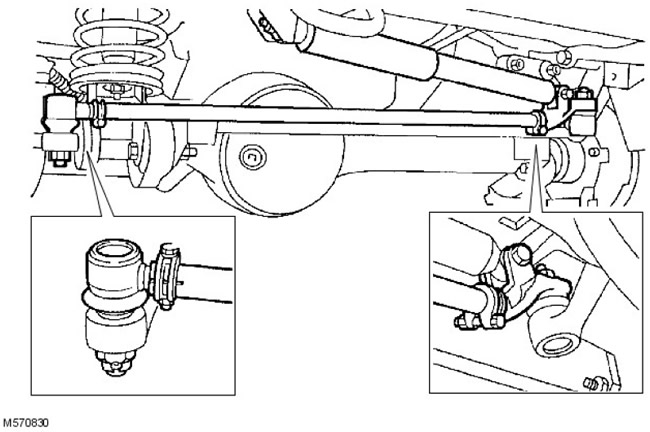
1. Check the hinges for wear by trying to move the hinge from side to side and back and forth. If play is evident, install a new hinge.
CAUTION: Do not check for wear by observing the joint while an assistant turns the steering wheel from side to side.
2. Check the condition of the steering ball joints, paying particular attention to the dust boots.
NOTE: If it is necessary to replace the steering ball joints, the customer should be consulted as additional labor and/or material costs are required and repairs should not be performed without the customer's consent.
NOTE: Ball joints are lubricated for life at the factory and do not require additional lubrication unless the rubber boot has been displaced or damaged. All joints should be inspected at the specified intervals or more frequently if the vehicle is operated under severe conditions.
Shock absorbers
1. Check the shock absorbers for signs of leaks.
2. Check the shock absorbers for signs of damage.
Towing bracket
1. Check the reliability of the towing bracket.
Engine and gearbox mounts
1. Check the condition of the left front engine mount. Tighten the fasteners if necessary. For more information, refer to the chapter: Specifications (303-01 Engine - Diesel Engine ID4 2.4L, Specifications).
2. Check the condition of the right front engine mount. Tighten the fasteners if necessary. For more information, refer to the chapter: Specifications (303-01 Engine - Diesel Engine ID4 2.4L, Specifications).
3. Check the condition of the left rear gearbox support. Tighten the fastening elements if necessary.
For more information, please refer to the chapter: Specifications (308-03 Manual Transmission/Transmission in Block with Driving Axle, Specifications).
4. Check the condition of the right rear gearbox support. Tighten the fasteners if necessary.
For more information, please refer to the chapter: Specifications (308-03 Manual Transmission/Transmission in Block with Driving Axle, Specifications).
Comments on this article