car logo Ford
car logo Volkswagen
car logo BMW
car logo Opel
car logo Audi
car logo Toyota
car logo Peugeot
English Русский
Български
Беларускі
Український
Српски
Hrvatski
Română
Polski
Slovenský
Magyar


Main
Freelander
Discovery
Range Rover
Defender
Contacts
Articles

ABS Pressure Regulator Pressure Sensor (Range Rover 3)

 
  • Main
  • Range Rover
  • Range Rover 3
  • Chassis
  • Brake system
  • ABS Pressure Regulator Pressure Sensor
 
        0  
Contents: Dismantling ⇩ Assembly ⇩

Dismantling


1. Place a cloth under the pressure regulator to prevent brake fluid from splashing out.

CAUTION: Brake fluid can damage paintwork. If brake fluid comes into contact with painted surfaces, remove any traces of the fluid immediately and rinse the area with water.
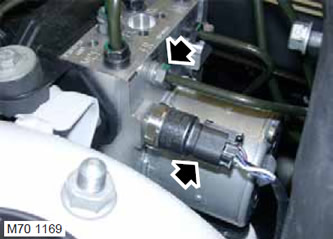

2. Disconnect the brake line from the pressure regulator to gain access to the pressure sensor.


2. Disconnect the brake line from the pressure regulator to gain access to the pressure sensor.

CAUTION: Before disconnecting or removing brake system components, make sure that the adjacent surfaces are free of dirt. Install plugs in the openings of the fittings and pipes to prevent dirt from entering the system.


3. Disconnect the connector from the pressure sensor and remove the pressure sensor.

Assembly


1. Clean the threaded part of the pressure sensor.

2. Install the pressure sensor onto the pressure regulator and tighten to 20 Nm.

3. Connect the connector to the pressure sensor.

4. Connect the brake line to the ABS pressure regulator and tighten the line nut to a torque of 18 N·m.

5. Remove air from the brake system.

6. To ensure that the ABS is working properly, you should perform diagnostics using the Testbook/T4 diagnostic tool.


This article is available at russian, bulgarian, belarusian, ukrainian, serbian, croatian, romanian, polish, slovak, hungarian
Article review: Platon Fedorov


Previous articles
Checking the wear and runout of the front brake disc
Checking the wear and runout of the rear brake disc
Bleeding the brake system
Adjusting the parking brake
Front brake disc
Rear brake disc
Pre-pressure pump
Brake system reservoir

Current article
ABS Pressure Regulator Pressure Sensor

Next article
Dynamic stability control system sensor


Similar articles from Land Rover repair manuals:
• Tire pressure sensor Freelander 2 (2006-2014)
• Manifold Absolute Pressure (MAP) Sensor Freelander 1 (1997-2006)
• Engine Oil Pressure (EOP) Sensor 2.7L Discovery 3 (2004-2009)
• Boost pressure sensor Discovery 1 (1989-1998)
• Manifold Absolute Pressure and Temperature (MAPT) Sensor Defender 2007+ (2007-2016)

Comments on this article


No comments yet


How much will 15 + 39 =


Range Rover 3 
  • General information
  • Using the manual
  • Precautionary measures
  • Repair techniques
  • Identification codes
  • Specifications
  • Tightening torques
  • Materials
  • Maintenance
  • Power unit
  • Diesel engine TD6
  • Petrol engine V8
  • Emission reduction TD6
  • Emission reduction V8
  • Engine management TD6
  • Engine management V8
  • Fuel supply TD6 engine
  • Fuel supply V8 engine
  • Engine cooling TD6
  • Engine cooling V8
  • Exhaust system TD6
  • Exhaust system V8
  • Transfer case
  • Automatic gearbox GM-5L40-E
  • Automatic gearbox ZF 5HP24
  • Chassis
  • Drive shafts
  • Main gear
  • Front axle gear
  • Steering
  • Front suspension
  • Rear suspension
  • Brake system
  • Body and coating
  • Passenger safety
  • Doors and windows
  • Exterior details
  • Interior details
  • Glasses
  • Seats
  • Sunroof
  • Body geometry
  • Body repair
  • Corrosion protection
  • Electrical equipment
  • Heating and ventilation
  • Conditioning
  • Windshield wipers and washers
  • Starting and charging system
  • Lighting and headlights
  • Electronic blocks
  • Entertainment system
  • Wiring harnesses


LRman.ru © 2013-2026 | Mobile version | Free Lander | Discovery | Range Rover | Defender | Contacts | | Sitemap |
Car repair and service instructions Land Rover: Freelander, Discovery, Range Rover, Defender
We use cookies to make pages load faster and provide a more user-friendly experience 🍪