Contents: Dismantling ⇩ Assembly ⇩
Dismantling
1. Remove the front wheel arch liner.
EXTERIOR PARTS, REPAIR WORK, Mudguard - front wheel arch.
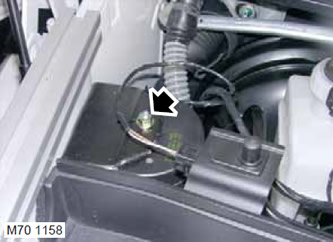
2. Loosen the nut securing the security alarm siren to the bracket and move the siren to the side.
3. Place a container to collect the leaking brake fluid.
CAUTION: Brake fluid can damage paintwork. If brake fluid comes into contact with painted surfaces, remove any traces of the fluid immediately and rinse the area with water.
The article was copied from the website LRMAN.RU
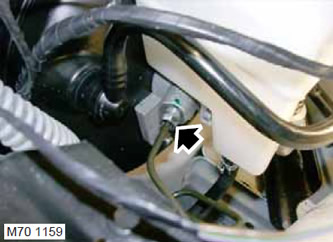
4. Disconnect the brake line from the master cylinder.
CAUTION: Always plug the fittings and holes to protect the system from dirt.
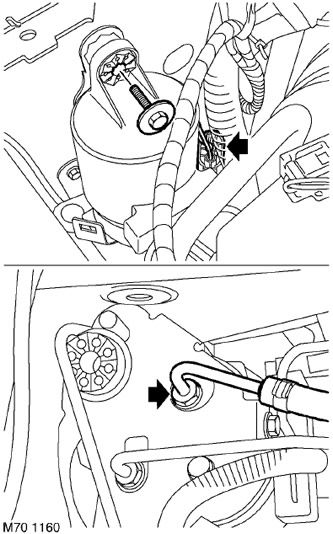
5. Disconnect the supply hose.
6. Remove the screw securing the pre-pressure pump bracket to the vehicle body.
7. Release the pump from the rubber support.
8. Disconnect the connector with the electrical cable.
9. Remove the pre-pressure pump.
NOTE: Do not perform further disassembly if the unit is removed only for ease of access.
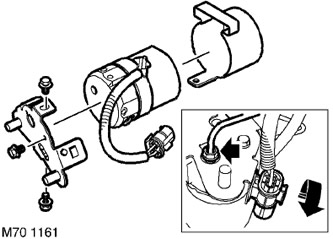
10. Mark the position of the brake pipe and remove it.
11. Remove the cable block, unscrew the 3 screws and separate the bracket and the pump cover.
Assembly
1. Install the mounting bracket and cover onto the pre-pressure pump, tighten the screws and tighten them to 8 Nm.
2. Install the connector block with the cable back into place.
3. Clean the connection points of the brake pipes and pipe ends.
4. Connect the brake line to the pump and lightly tighten the line nut.
5. Connect the cable connector.
6. Connect the pre-pressure pump to the rubber support.
7. Install the pre-pressure pump mounting screw and tighten the screw to 8 Nm.
8. Connect the pre-pressure pump to the master cylinder and tighten the fasteners to a torque of 14 N·m.
9. Connect the feed hose to the master cylinder to the pre-pressure pump and tighten the fastening to a torque of 14 N·m.
10. Install the security alarm siren on the bracket, screw on the mounting nut and tighten it to 8 Nm.
11. Reinstall the front wheel arch mudguard.
EXTERIOR PARTS, REPAIR WORK, Mudguard - front wheel arch.
12. Remove air from the system using the procedure using the Testbook/r4 diagnostic tool.
Comments on this article