WARNING: All components of the SRS system must be replaced after 15 years of operation.
WARNING: If the vehicle is equipped with a front passenger airbag, a child seat designed to carry children facing the rear of the vehicle must not be installed in the front seat.
General warnings
The SRS system contains components which, if not handled correctly, can be hazardous to operating personnel. The following instructions are intended to familiarize service personnel with the hazards involved in operating the SRS system and to demonstrate the consequences of mishandling the SRS system.
WARNING: Always follow the rules for working with the SRS system and the prescribed service and repair procedures. Personnel authorized to work with the SRS system must receive special training and have copies of the rules for working with the SRS system.
WARNING: Do not carry out any work on the SRS system before reading the relevant sections of the Manual.
WARNING: Airbags contain flammable and hazardous substances. Any contact with water, acids or heavy metals may cause an explosion or other negative consequences. Do not disassemble, incinerate or expose to electricity the unactivated airbags.
WARNING: A seat belt that has been critically stressed in a collision or shows signs of failure must be replaced with a new one.
WARNING: Disconnect the battery before welding on a vehicle equipped with SRS.
WARNING: Do not expose airbags or seat belt pretensioners to temperatures above 85°C (185°F).
Please note that these instructions must be followed not only during the direct repair of the SRS system. The same safety rules must be observed when working with associated systems and components located in close proximity to the components of the SRS system. The following systems and components do not limit the complete list of such systems and components:
- Steering - Driver front airbag, rotary contactor
- Control Panel - Front Passenger Airbag
- Upholstery - Side curtain airbags
- Seats - Front seat belt pretensioners
- Electrical Equipment - SRS Wiring Harnesses, Connecting Wires and Connectors
- Front doors - Side airbags
How to deactivate the SRS system
Before working on the SRS system or in the immediate vicinity of the location of its components, deactivate the system.
To do this, perform the following operations.
- Remove the key from the ignition
- Disconnect the battery. Disconnects first "mass" the wire.
- Wait 10 minutes. During this time, the power source of the SRS system is discharged.
Batteries are used to power the SRS system, which ensures that the system is activated in the event of a power failure during an accident. Sufficient time must elapse for the batteries to be completely discharged (10 minutes). This will eliminate the possibility of accidental operation of the system.
Installing SRS components
To ensure reliable operation of the SRS system, periodic inspections and maintenance are necessary. All components of the SRS system must be carefully inspected before installation. Do not install components that show signs of rough handling, such as dents, cracks, or signs of permanent deformation.
WARNING: The reliability of the SRS system directly affects the vehicle's passive safety. Firmly adhere to the following rules.
WARNING: Do not use interior trims that cover airbags (e.g. pillar cladding "A"), to secure accessories or for other purposes.
- Do not install used SRS components; do not attempt to repair components of the SRS system.
- When repairing the SRS system, use only original spare parts.
- It is forbidden to apply electrical voltage to the terminals of the components of the SRS system, unless it is prescribed by the instructions.
- Special fasteners are used to attach airbags - strictly observe their tightening torques. Do not use any other fasteners.
- When replacing components of the SRS system, replace the fasteners with new ones.
- When replacing the electronic unit of the SRS system (DCU) make sure it is installed correctly. Between the electronic unit (DCU) and the bracket for its fastening should not have any gap. Incorrect installation of the electronic unit of the SRS system (DCU) may cause system malfunction.
WARNING: When installing the side curtain airbag, make sure that its clips are securely fastened and do not interfere with the deployment of the airbag. When installing the pillar upholstery "A" and headliner, make sure they do not interfere with airbag deployment.
CAUTION: SRS system components must be free of oil, grease, cleaning agents, or water.
CAUTION: Torque wrenches should be checked regularly. This will ensure that all fasteners are properly tightened.
NOTE: Once the seat belt pretensioners have deployed, the seat belts can be used as normal belts without pretensioners. In this case, the belts must be replaced as soon as possible to restore the SRS system to its intended function.
NOTE: If SRS components need to be replaced, the part number and barcode of the new part must be recorded.
SRS System Component Check Precautions
Airbags deploy at a relatively low amperage, so always follow these instructions:
WARNING: When testing SRS components, do not use multimeters or other multi-purpose equipment as this may cause the airbags to deploy. Use only the special Testbook/T4 diagnostic tool to diagnose the system.
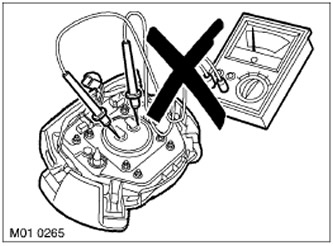
WARNING: Do not use multi-purpose diagnostic equipment to troubleshoot SRS harnesses that are not disconnected from system components - this may result in airbag deployment and personal injury.
Transportation and storage
When handling SRS system components, follow the instructions below.
WARNING: The storage requirements for SRS components are high. This may require coordination with local authorities. The components of the SRS system require careful handling and pose an increased risk if handled and stored improperly. Always follow the instructions below:
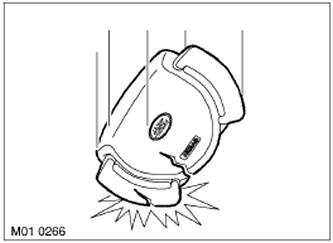
- Do not drop SRS components. The electronic unit of the SRS system requires especially careful handling. The airbags and seat belt pretensioners may deploy in the event of a severe impact.
- Do not wrap your arms around the airbags. When transporting airbags, hold them by the cover, with the cover in the highest position and the base facing away from your torso.
- Do not carry airbags or seat belt pretensioners in the vehicle. When transporting by car, place the airbags and seat belt pretensioners in the trunk.
WARNING: Do not attach anything to the airbag cover or upholstery covering the airbags. Do not place any objects on top of the airbags.
WARNING: System components should be stored in a cool, dry and safe environment.
WARNING: Do not apply lubricants or cleaners to the seat belt pretensioners. This could damage the pretensioners.
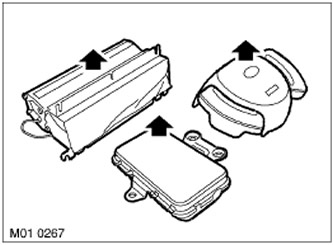
WARNING: Store airbags face up. If the airbag is stored face down, accidental deployment could cause serious injury.
WARNING: Airbags and seat belt pretensioners are classified as explosives. For storage overnight or longer, they must be placed in a steel safe that has the required degree of protection and is registered with the local authorities.
WARNING: Store airbags or seat belt pretensioners only in the designated area. If there is no specially equipped place for storage, then they should be stored in a closed volume of the car (trunk). The head of production must be informed about this.
WARNING: Improper storage may damage airbags and render them unusable. If there is reason to believe the airbag is defective, then it must be replaced. To activate and dispose of the airbag, refer to the appropriate section of the Manual.
WARNING: Store the side curtain airbag in its original packaging until it is directly installed on the vehicle. Store the removed side curtain airbag in the empty packaging.
WARNING: When transporting the side curtain airbag, grasp the gas generator housing, DO NOT HOLD it by the airbag. Do not wrap your fingers around the gas generator when carrying. Do not throw the airbag over your shoulder or around your neck.
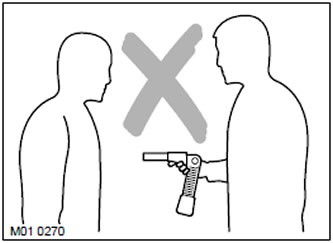
Carry seat belt pretensioners by holding the piston tube with the open side of the tube facing the ground and the opposite side of the tube away from the body. Do not cover the open end of the piston tube. DO NOT hold the seat belt pretensioners by the cable or mounting bracket. Do not point the piston tube towards your torso or towards other people.
SRS wiring harnesses and connectors
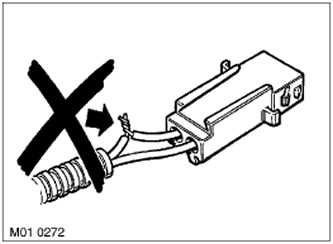
Observe the following instructions when working on the SRS harnesses:
- Do not modify, add to, or otherwise repair the SRS harnesses.
- Do not install potential sources of electromagnetic interference (mobile phone, radio station or entertainment equipment) in close proximity to the SRS harnesses. If you need to install such equipment, consult with a specialist.
NOTE: The wires in the SRS harnesses can be identified by the yellow color of the outer insulation (sometimes black insulation with a yellow stripe is used).
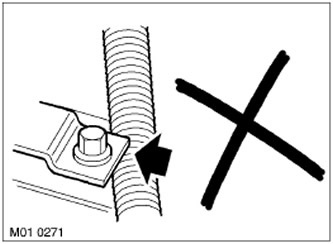
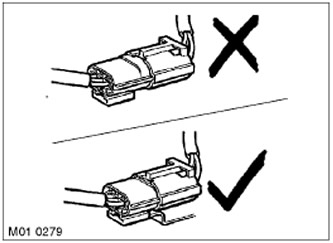
WARNING: After installation, always check that the SRS harnesses are routed correctly. When installing, be careful not to pinch or damage the SRS harnesses. Do not allow connectors to hang loose or SRS components to be installed without being secured to the body. After installing the components, there should be no friction points on the moving parts of the body.
Inspection of the side impact sensor
After any body side impact, both side impact sensors should be inspected. The side impact sensor must be replaced if it shows signs of damage or deformation of the fasteners.
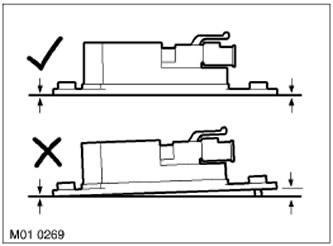
Check that the side impact sensor is installed correctly. There must be no gap between the mounting bracket and the sensor. To secure the sensor, use either the mounting bolts supplied with the new sensor or new mounting bolts ordered separately.
WARNING: Exercise extreme caution when carrying out body repair or painting work in the vicinity of impact sensors. Avoid direct contact of shock sensors and connecting harnesses with heat guns, welding and painting equipment. When replacing vehicle components, be careful not to damage the sensor or wiring harnesses.
CAUTION: Checking or installing a rotary contactor must be carried out in strict accordance with the instructions given in section "Repair of the SRS system". For reliable operation of the system, all operations must be carried out in strict accordance with all safety and installation requirements. Observe the following precautions:
- After removing the rotary contactor from the vehicle, do not rotate or open it.
- After removing the rotary contactor from the vehicle, do not turn the steering wheels of the vehicle.
- Install and remove the rotary contactor only in the central position. The front wheels must be in the straight ahead position. For detailed instructions, see "Repair of the SRS system".
- When installing a new rotary contactor, make sure that the rotary contactor retainer is not broken; Rotary contactors with a broken retainer must not be installed on a vehicle.
Decals indicating the location of the airbags on the car
Decals with the location of the airbags are installed in several places inside the car. SRS system components have additional tags (warning labels), for handling precautions. Tagged SRS components: airbags, impact sensors, and seat belt pretensioners.
WARNING: Do not carry out any work on the SRS system before reading the relevant sections of the Manual.
NOTE: The information below refers to the possible location and content of warning labels. The exact location and content of the inscriptions depends on the model year of the vehicle, the country of export and the legislation in force.
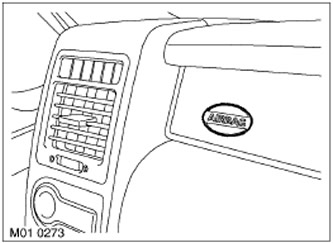
Decal on the front panel on the passenger side
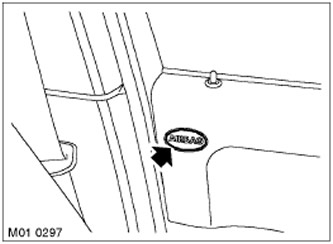
Decal on the driver's/front passenger's door
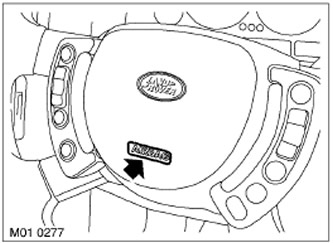
Steering wheel label
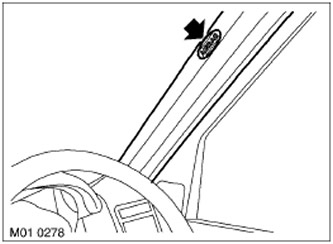
Plaque on the stand "A"
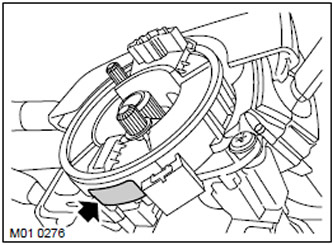
Warning tag (plate) on the rotary contactor. This plate also has a part number
If the airbag needs to be replaced, record the part number in the Land Rover designation.
When working with system components, be careful, follow the developed instructions when replacing components; Do not open or attempt to repair removed components.
System components contain compressed gas and flammable materials. To avoid injury, observe the following rules:
- Do not disassemble, incinerate or expose to electricity (For example, "call" tester) not activated airbags.
- Do not store system components in places with temperatures above 93°C (200°F).
- It is forbidden to install removed components on other vehicles.
- Do not install foreign objects between the airbag and its cover or inside the airbag module.
- Maintenance or disposal of components should be carried out in accordance with the instructions provided.
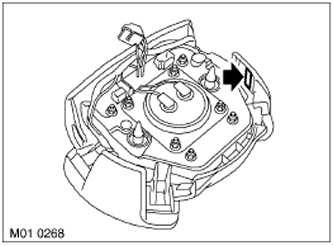
Driver airbag decal
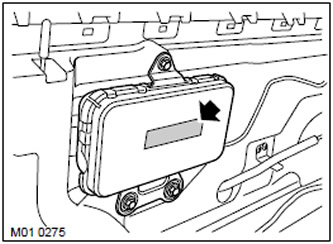
Passenger Airbag Decal
The most important system components are labeled (tag) marked with a part number or bar code. If it is necessary to replace the airbag, then write off its number according to the Land Rover designation.
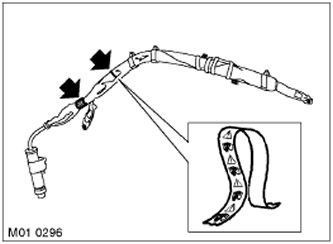
side curtain airbag decal
plate (tag) on the airbag contains a warning about the need to read the relevant sections of the Manual before working on the components of the SRS system.
WARNING: In order for the airbags to deploy correctly, only the designed trim panels must be installed. Do not re-install decorative panels covering the SRS cushions if they show signs of damage. If they are damaged, new decorative panels must be installed.
Towing - SRS system components did not work
When the vehicle is being towed, the SRS components are unlikely to be activated. However, as a precaution, turn off the ignition and disconnect both battery wires. "Negative" the wire is disconnected first.
Towing - SRS components have been triggered
If the driver's airbag has deployed, partial towing is allowed (the front axle rests on the body of the tractor). However, as a precaution, turn off the ignition and disconnect both battery wires. "Negative" the wire is disconnected first.
Activation of airbags and seat belt pretensioners
When activating the components of the SRS system, you must strictly follow the safety rules and sequence of actions. Only properly trained personnel are allowed to carry out work to activate the components of the SRS system. Strictly observe the following safety rules:
- Use only special equipment for activation.
- Activation of airbags and seat belt pretensioners must only be carried out in well-ventilated areas specially designed for this purpose.
- Before activation, check that the airbags and seat belt pretensioners are not damaged.
- Notify the appropriate authorities of your intention to activate the airbags or pretensioners.
- During the activation of the SRS system components, it is forbidden to stay closer than 15 meters (45 feet) from the epicenter.
- The activation attachment must be connected according to the instructions in section "SRS system" this guide. The activation attachment MUST NOT be connected to the battery before it is connected to the airbag connector.
- When the seat belt pretensioners are activated, the pretensioner must be securely attached to the seat frame.
- When removing deployed airbags or pretensioners, wear protective clothing. Carry the triggered components with gloves. Once removed from the vehicle, seal the triggered component in a plastic bag.
- If any of the components of the SRS system has been triggered, then all components of the SRS system should be replaced. DO NOT reuse SRS components that have been removed from the vehicle.
- Do not lean on the airbag while connecting the wires of the activation box to its connectors.
If the car is to be recycled, then the installed airbags and belt pretensioners must be forcibly activated. In this case, the airbags can be activated directly on the vehicle. Before starting the activation, make sure that the airbag is securely fixed in place. Activating the driver's airbag directly on the vehicle can damage the steering wheel. If the car is not intended for recycling, then the airbag must be activated by first removing it from the car.
WARNING: During activation, parts of the airbag will reach high temperatures, which may cause burns. After activation of the airbag, at least 30 minutes must elapse before the parts of the airbag can be touched.
Comments on this article