Contents: General information ⇩ Clutch master cylinder ⇩ Low pressure tube ⇩ High pressure tubes ⇩ Release of the coaxial working…⇩ Coaxial slave cylinder ⇩ Clutch housing assembly ⇩ Clutch drive disc ⇩ Double flywheel ⇩
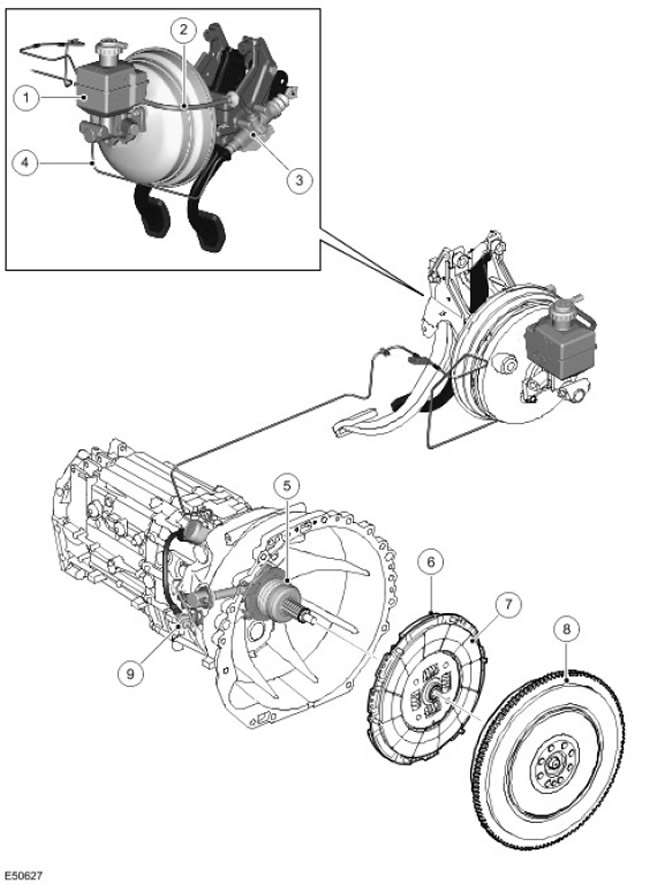
| Item name | Spare part catalog number | Description |
| 1 | - | Common brake/clutch fluid reservoir |
| 2 | - | Low pressure tube |
| 3 | - | Clutch master cylinder |
| 4 | - | High pressure tube |
| 5 | - | Coaxial slave cylinder |
| 6 | - | Clutch housing assembly |
| 7 | - | Leading disk |
| 8 | - | Double flywheel |
| 9 | - | Release of coaxial working cylinder |
General information
The operation of the clutch system is based on the well-known principle of hydraulic actuation of a single driven plate and a diaphragm spring clutch housing assembly from the clutch pedal. When the clutch pedal is depressed, hydraulic fluid is pumped through the master cylinder, the piping system and the slave cylinder and, ultimately, actuates the clutch fingers to disengage the clutch and disengage the drive and crankshaft. When the foot is removed from the pedal, the spring presses the pressure plate against the driven plate, which, in turn, is pressed against the flywheel. As a result, the engine crankshaft meshes with the transmission input shaft, forcing them to rotate at the same speed.
The clutch system has a conventional design and includes the following main components:
- Clutch master cylinder
- Clutch pressure lines
- Clutch Release Bearing/Slave Cylinder
- Clutch housing assembly
- Clutch slave disc
- Double flywheel
Clutch master cylinder
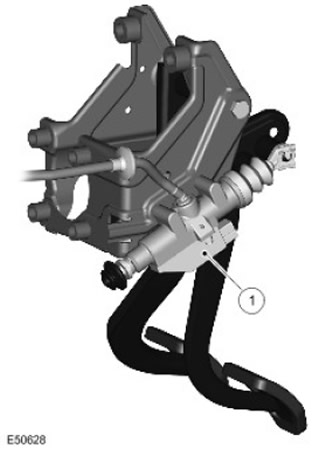
| Item name | Spare part catalog number | Description |
| 1 | - | Clutch master cylinder |
The clutch master cylinder is attached directly to the pedal box assembly located in the driver's side footwell.
The cylinder contains a piston assembly with a rod connected to the clutch pedal and spring. When pressed, the clutch pedal pushes the piston through a lever mechanism. Further pressing of the pedal increases the pressure in the cylinder and pipes.
The cylinder has 2 hydraulic connections:
- With low pressure feed pipe (through which fluid is supplied from the brake fluid reservoir)
- With high pressure tube
The pedal travel is limited by upper and lower stops built into the master cylinder.
Low pressure tube
The low pressure pipe is a plastic tube that runs between the master cylinder and the common rail. (combined) brake fluid reservoir. This tube ensures that the hydraulic system is constantly filled with fluid. The tubes are connected at each end using push-type pipe connectors.
High pressure tubes
The high pressure lines are routed on the right side of the vehicle, from the clutch master cylinder to a location near the transmission clutch housing. The line assembly consists of a steel pipe and a flexible pipe. The flexible pipe absorbs vibrations between the metal pipes attached to the vehicle body and transmission.
A vibration damper is installed in the tube. The damper is located at the front end of the transmission tunnel on the right side of the car and is attached to a bracket on the body.
The high pressure pipes are connected using quick-release connectors with a U-shaped fastening spring clamp.
Release of the coaxial working cylinder assembly
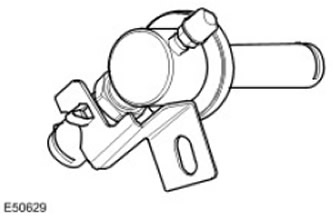
The coaxial slave cylinder outlet assembly connects the external pipes to the clutch release system built into the clutch housing. The mounting bracket ensures the correct orientation of the unit. A seal is provided between the unit and the clutch housing. The bleed nipple is also located in this location.
Coaxial slave cylinder
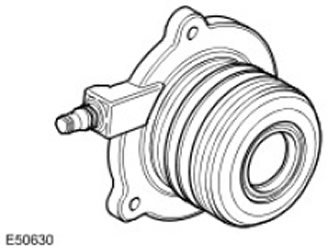
The coaxial slave cylinder assembly consists of a clutch release bearing and a slave hydraulic cylinder. The entire unit is secured to the front of the gearbox with 3 bolts. The bolts are asymmetrically positioned, which ensures the required angular position of the slave cylinder, which is also centered by a flange. In its free state, the slave cylinder is fully extended, and after installation of the clutch housing on the engine, it automatically takes the correct position. The unit does not require any adjustment or regulation.
Clutch housing assembly
The clutch housing assembly is also called a self-adjusting clutch. Its nominal diameter is 260 mm.
Self-adjusting clutch
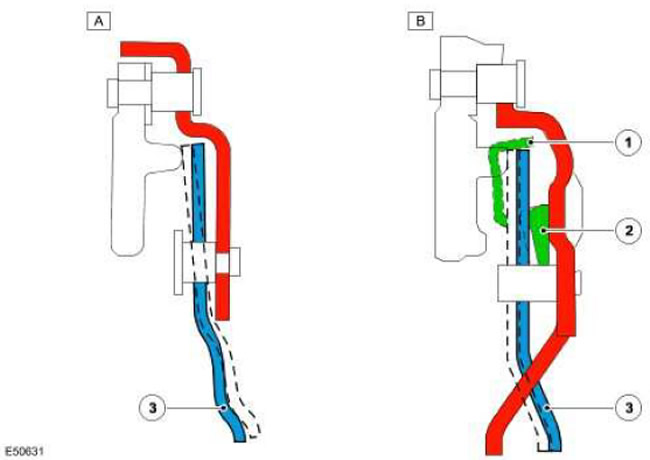
| Item name | Spare part catalog number | Description |
| A | - | Normal clutch |
| B | - | Self-adjusting clutch |
| 1 | - | Sensor springs |
| 2 | - | Regulator ring |
| 3 | - | Diaphragm spring |
The self-adjusting clutch incorporates a mechanism that improves system performance and driver comfort by providing a more consistent pedal force as the friction surfaces wear, unlike a conventional clutch that requires increased pedal force as wear occurs.
In a conventional clutch design, wear on the surfaces causes the angle of the moving diaphragm spring to change as the clutch pressure plate moves axially toward the engine, resulting in more force being required to engage the clutch. (the driving force of the diaphragm varies depending on the angle of the diaphragm). The self-adjusting clutch minimizes this disadvantage by allowing the diaphragm spring to follow the axial movement of the pressure plate, thereby maintaining the same diaphragm spring angle throughout the life of the clutch. In addition to stabilizing the pedal force, the clamping force on the pressure plate also remains constant as it wears.
The diaphragm spring is not fixed at the pivot point as in conventional systems, but pivots between the sensor spring and the adjuster ring. The sensor spring creates a counter force just sufficient to maintain the diaphragm spring axially relative to the housing via the adjuster ring during normal clutch engagement. As the friction linings wear, the tendency for the diaphragm angle to change causes an increase in the engagement force required to operate the clutch. When this increased force begins to exceed the counter force of the sensor spring, the diaphragm spring shifts axially toward the pressure plate, restoring the original angle. In this state, the required engagement force is reduced to the counter force of the sensor spring, ensuring equilibrium of the diaphragm spring in the new position.
During the axial movement of the diaphragm spring, the adjuster ring travels an increased distance between the spring and the housing. The ring has protruding segments with an inclined profile that fit into corresponding recesses in the clutch housing. When the diaphragm spring is displaced axially to compensate for wear, 3 preloaded cylindrical coil springs in the clutch housing cause the adjuster ring to rotate, lifting the protrusions and providing additional travel between the diaphragm spring and the clutch housing.
NOTE: During operation, the regulator ring turns clockwise. (when accessed from the gearbox side). If a worn driven disc is replaced during operation and the clutch cover assembly is left in place for any reason, the adjuster ring must be rotated back to the preload position. This operation requires a press to relieve the load on the clutch while the adjuster ring is being adjusted, so it is not recommended to perform this operation during servicing. When performing any repair, it is recommended to replace the clutch cover assembly and driven disc together.
NOTE: If for any reason the clutch cover and driven plate have been removed and the driven plate is later found to be serviceable, the original cover/driven plate can be reinstalled without any adjustment.
Clutch drive disc
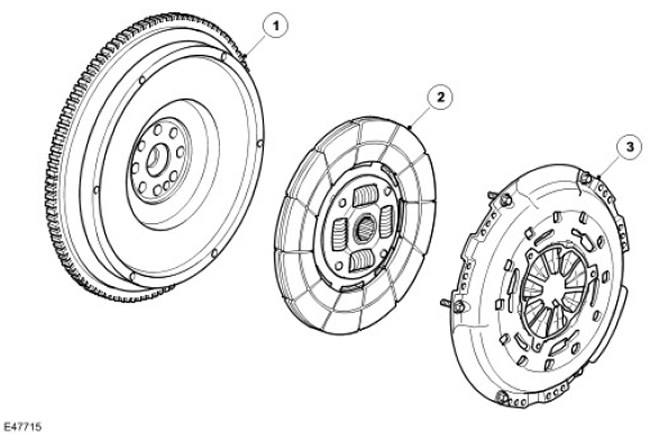
| Item name | Spare part catalog number | Description |
| 1 | - | Double flywheel |
| 2 | - | Leading disk |
| 3 | - | Pressure plate |
The clutch driven disc has a traditional design with a splined sleeve to position the primary spline joint of the gearbox. The joint does not require lubrication. The lead-free and asbestos-free friction material is connected to the sleeve by a spring pack, which reduces the transmission of torsional force to the gearbox.
Double flywheel
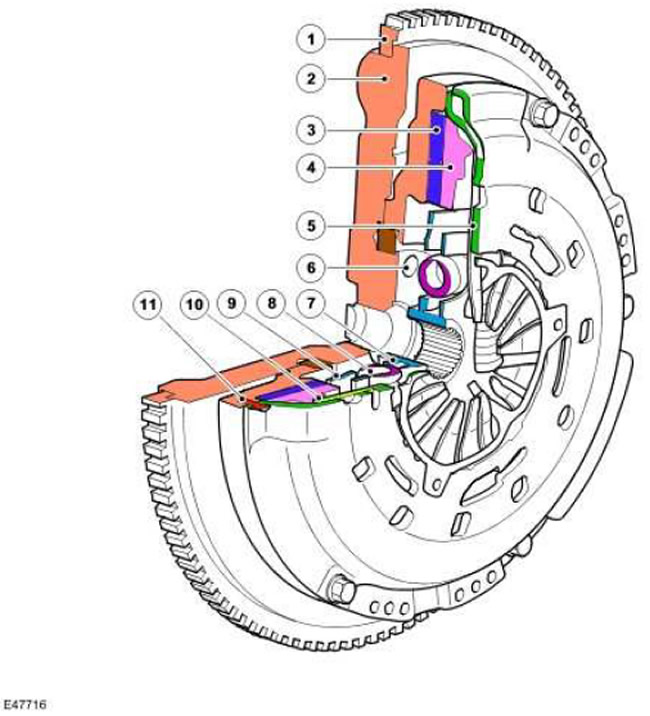
| Item name | Spare part catalog number | Description |
| 1 | - | Ring gear |
| 2 | - | Primary flywheel |
| 3 | - | Inner drive disc |
| 4 | - | Spring housing |
| 5 | - | Lid |
| 6 | - | Mounting hole |
| 7 | - | Splined bushing |
| 8 | - | Shock absorbing springs |
| 9 | - | Inner drive disc |
| 10 | - | Spring housing |
| 11 | - | Secondary flywheel |
As the name suggests, this unit consists of two main sections: the primary section, which is secured to the crankshaft using 8 fasteners, and the secondary section, to which the clutch housing assembly is attached.
The primary section moves the starter ring gear and the roller bearing into which the long primary shaft of the gearbox is inserted.
The secondary section forms the contact surface for the clutch lining and is secured with 3 pins and 6 mounting holes which are used to secure the clutch housing to the flywheel.
If the flywheel is removed or replaced, it is recommended to use new crankshaft fasteners.
The secondary section is supported by the bearing and radial springs of the primary section.
The free rotation of the parts between the primary and secondary sections (masses) produces a shock-absorbing effect, reducing the amplitude of torsional vibrations between the crankshaft and the gearbox.
Comments on this article