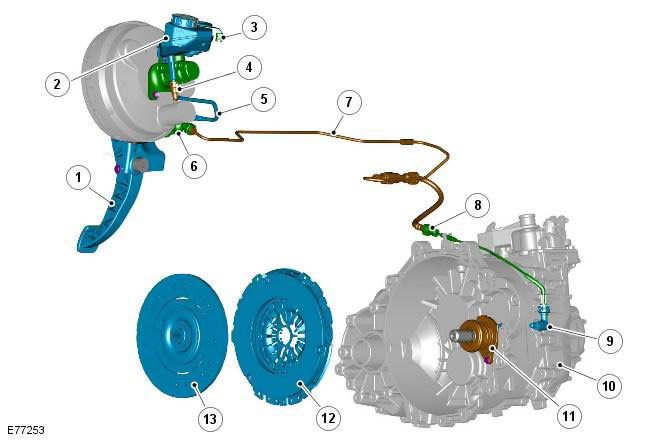
| Pos. | Spare part number | Name |
| 1 | - | Clutch pedal |
| 2 | - | Brake/clutch fluid reservoir |
| 3 | - | Liquid level sensor |
| 4 | - | Connector |
| 5 | - | Low pressure hose |
| 6 | - | Master cylinder |
| 7 | - | High pressure clutch line |
| 8 | - | Connector |
| 9 | - | Clutch Bleed Adapter |
| 10 | - | Transmission |
| 11 | - | Slave cylinder and clutch release bearing |
| 12 | - | Clutch housing assembly |
| 13 | - | Slave disk |
The clutch has a traditional design with one driven disk and a clutch housing with a diaphragm spring. The hydraulic drive is activated by the clutch pedal.
The main elements of the clutch are the clutch housing assembly (pressure plate), engine flywheel and driven disk. The clutch housing together with the flywheel and driven disk form a friction system, it is secured to the flywheel with bolts inside the housing.
Clutch housing
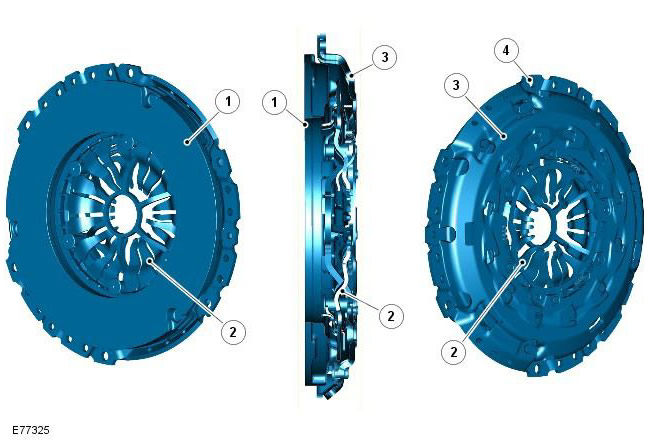
| Pos. | Spare part number | Name |
| 1 | - | Pressure plate |
| 2 | - | Diaphragm spring |
| 3 | - | Lid |
| 4 | - | Mounting holes |
The clutch housing transmits engine torque through the driven disk to the primary shaft. The contact force required to transmit engine torque is provided by a diaphragm spring with slots. Due to the low engagement force, the diaphragm spring allows the driver to apply less force to the clutch pedal. The pressure plate has a friction surface with which the driven disk engages.
The diaphragm spring is a compressed type spring, which is actuated by the slave cylinder. When the slave cylinder is operating, the force from the diaphragm spring is transmitted through the clutch housing to the flywheel to which it is bolted. The pressure on the driven disk is released and the transmission of motion to the gearbox is disconnected.
The clutch housing pressure plate is attached to the clutch housing by leaf springs. The cams on the pressure plate protrude through holes in the housing, and the outer diaphragm springs rest on the cams. The pressure plate is attached to the housing by means of bolts and wire rings. During operation of the slave cylinder, the pressure on the diaphragm springs weakens and the pressure plate can rotate on the cams, relieving the pressure on the driven disk.
Slave disk
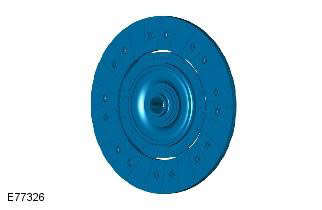
The driven disc is the central connecting element in the clutch. In combination with the clutch housing assembly, it separates and links the engine and transmission, connecting the engine crankshaft to the transmission input shaft.
The driven disk is a rigid friction disk. To reduce noise and reduce wear on the gearbox, the dual flywheel absorbs torque fluctuations caused by combustion processes.
Double flywheel
The dual mass flywheel has two main components: the primary section is attached to the engine crankshaft, and the secondary section is attached to the clutch housing assembly.
The starter ring gear is attached to the outer perimeter of the primary section. The starter uses the ring gear to turn the engine crankshaft during starting. The primary section is secured to the crankshaft with 8 bolts. A pin on the crankshaft flange ensures the correct position of the flywheel.
The secondary section has a smooth friction surface to which the friction material of the driven disc is connected. Pins and mounting holes ensure correct alignment and fastening of the clutch housing assembly.
The primary and secondary sections are connected to long coil springs. The two sections can rotate in opposite directions, the rotation is limited by the coil springs, which absorb the torsional load when the clutch is engaged and the torsional vibrations from the engine.
Comments on this article