For information on specific areas of the engine, refer to the general procedures in this section and the appropriate section of the manual.
Inspection and verification
1. Check the customer complaint.
2. Visually inspect for obvious signs of mechanical or electrical damage.
Visual inspection
|
Mechanical elements |
Electrical equipment |
|
• Engine oil level • Coolant level • Transmission fluid level • Fuel level • Coolant leaks • Oil leaks • Fuel leaks • Visibly damaged or worn parts • Loose or missing nuts or bolts • Fuel contamination/fuel brand/fuel quality • Mounting/sensor condition • Viscous fan clutch and electromagnetic valve • Laying of piping systems, etc. to avoid vibrations • Contact between the driveshaft and the chassis |
• Fuses • Wiring harness • Electrical plug(s) • Nozzles • Glow plugs • Sensor power supply 5V • Sensor(s) • Fan solenoid valve with viscous coupling • Engine Control Module (ECM) |
3. If an obvious cause for the problem you identified or the customer described is found, resolve it before proceeding with further actions (if possible).
4. Before referring to the symptom chart or diagnostic trouble code (DTC) index, read all DTCs with a validated diagnostic system or scan tool.
Checking oil pressure
NOTE: Perform a 10 km road test before checking the engine oil pressure. Do not attempt to reach normal operating temperature by letting the engine idle
1.
Warnings:
- Hot engine oil will inevitably be spilled during this procedure, so take appropriate precautions to avoid scalding. Failure to do so may result in injury.
- Use protective gloves.
Remove the oil pressure sensor.
For more information, refer to: Engine Oil Pressure (EOP) Sensor (303-14 Electronic controls - Diesel engine ID4 2.4L, Removal and installation).
2. Install the oil pressure sensor and connect its connector.
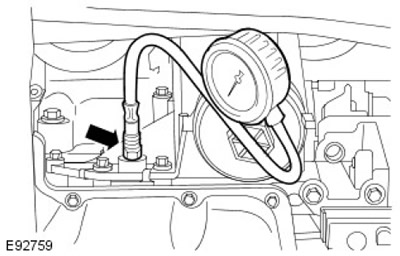
3. Check the engine oil level and top up if necessary.
4. Start the engine and let it run.
5. Record the oil pressure readings at engine idle and at 2,000 rpm.
For more information, please refer to: Specifications (303-01 Engine - Diesel Engine ID4 2.4L, Specifications).
6. Turn off the engine.
7. Remove the special tool.
8. Install the oil pressure sensor.
For more information, refer to: Engine Oil Pressure (EOP) Sensor (303-14 Electronic controls - Diesel engine ID4 2.4L, Removal and installation).
9. Check the engine oil level and top up if necessary.
For a complete list of diagnostic trouble codes that may be stored in the vehicle, see Section 100-00. For additional information, refer to: How to Use This Manual (100-00 General information, Description and operating principle).
Comments on this article