Contents: Cylinder head and valves ⇩ Camshafts ⇩ Cylinder head gasket ⇩ Glow plugs ⇩ Injectors ⇩ Cylinder Head Temperature (CHT)…⇩ High pressure fuel manifold ⇩ Intake manifold ⇩ Exhaust manifold ⇩ Camshaft housing ⇩ Hydraulic clearance compensator ⇩ Camshaft Position Sensor (CMP) ⇩ Cylinder head cover and engine cover ⇩
The cylinder head consists of the following main elements:
- Cylinder head and valves
- Camshafts
- Cylinder head gasket
- Glow plugs
- Fuel injectors
- Cylinder Head Temperature (CHT) Sensor
- High pressure fuel manifold
- Intake manifold
- Exhaust manifold
- Camshaft housing
- Hydraulic valve clearance compensator
- Camshaft Position Sensor (CMP)
- Camshaft and engine cover
Cylinder head and valves
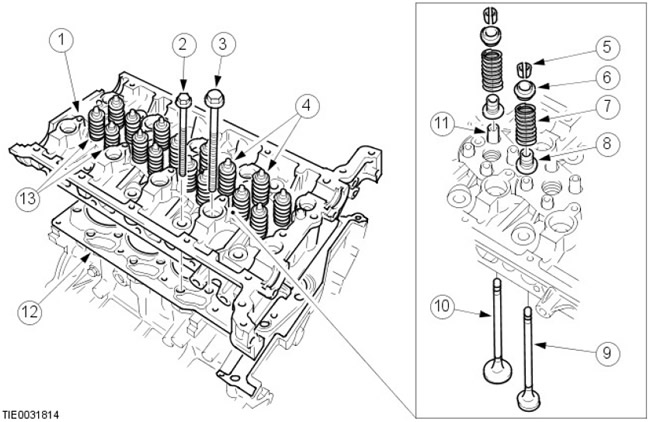
| Pos. | Spare part number | Name | |
| 1 | - | Cylinder head | |
| 2 | - | Outer cylinder head bolt (8 pcs.) | |
| 3 | - | Inner cylinder head bolt (10 pcs.) | |
| 4 | - | Inlet valves (16 pcs.) | |
| 5 | - | Valve crackers (32 pcs.) | |
| 6 | - | Spring holder (16 pcs.) | |
| 7 | - | Valve spring (16 pcs.) | |
| 8 | - | Valve stem oil deflector cap (16 pcs.) | |
| 9 | - | Exhaust valve (8 pcs.) | |
| 10 | - | Inlet valve (8 pcs.) | |
| 11 | - | Valve guide bushing (16 | pcs.) |
| 12 | - | Cylinder head gasket | |
| 13 | - | Valve assembly |
The cylinder head is cast from aluminum using the chill casting method. The presence of four valves per cylinder provides improved cylinder supply, compact combustion chamber and vertical arrangement of fuel injectors, which creates optimal distribution of fuel in the combustion chamber.
The cylinder head is fastened to the cylinder block by eighteen recessed bolts (to reduce deformation) bolts. The 8 outer cylinder head bolts are shorter than the inner ones and are located under the camshafts: 4 under the intake camshaft and 4 under the exhaust camshaft. 2 hollow pins ensure the alignment of each cylinder head with the cylinder block.
The cylinder head has four holes per cylinder (two outlets and two inlets), the arrangement of which corresponds to the arrangement of the cylinders. One of the inlet ports is screw-shaped and acts as a swirl channel, and the other - a tangential port - is located on the side and is responsible for the supply of the combustible mixture.
NOTE: The cylinder head cannot be further processed.
All valves have powder metal seats and guide bushings. In both intake and exhaust valves, single valve springs are retained by bushings, valve plates and spring seats. Valve stem seals are integrated into the spring seats.
Camshafts
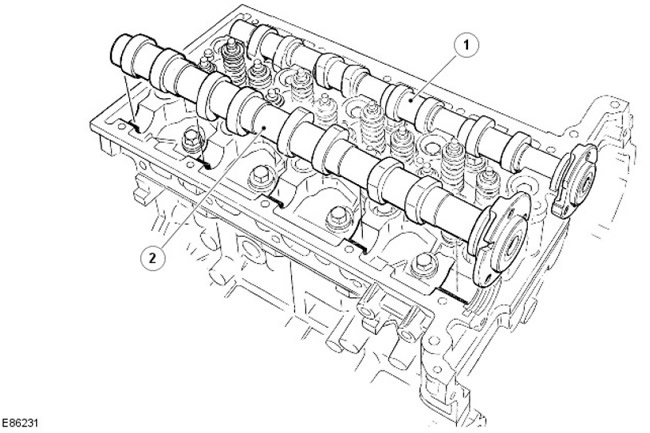
| Pos. | Spare part number | Name |
| 1 | - | Intake camshaft |
| 2 | - | Exhaust camshaft |
The camshafts are hollow, with pressed-in protrusions made of powdered metal; the front surface of the camshafts is machined to accept the sprocket. The camshafts are fixed in the cylinder head by the camshaft housing. The impulse wheel, machined in the area of the rear of the intake camshaft, provides a signal for the camshaft position (CMP) sensor, which the ECM uses to determine the position of the camshaft relative to the crankshaft.
For more information, see the chapter: Electronic controls (303-14 Electronic Controls - ID4 2.4L Diesel Engine, Description and Operating Principle).
Cylinder head gasket
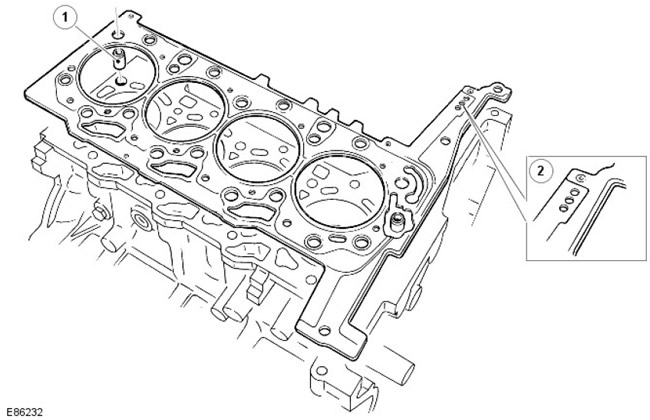
| Pos. | Spare part number | Name |
| 1 | - | Mounting sleeve (2 pcs.) |
| 2 | - | Identification holes |
Cylinder head gasket 4-layer steel; gaskets are available in 3 standard sizes by thickness. The choice of the required standard size depends on the maximum piston protrusion. The thickness of the gasket is determined by the number of holes in the front part of the gasket.
The cylinder block is equipped with two mounting bushings that serve to center the cylinder head gasket.
NOTE: When replacing the cylinder head gasket, use only a new gasket with the same identification mark. When installing new pistons or connecting rods, measure the maximum piston protrusion height and select the appropriate gasket.
Damage to the gasket or the mating surfaces of the cylinder head and block will result in leaks and should therefore be avoided. It is important to ensure that there is no dirt between the layers of the gasket before installing a new gasket.
Glow plugs
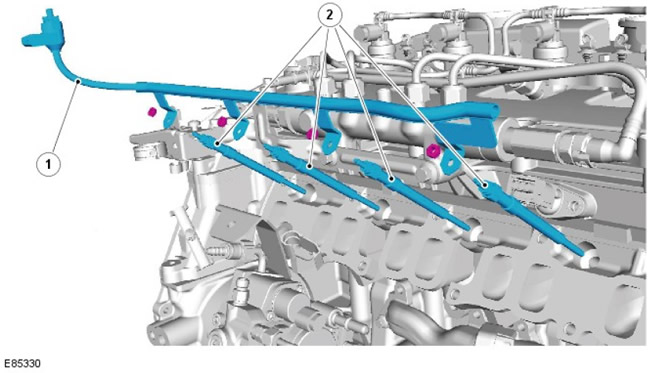
| Pos. | Spare part number | Name |
| 1 | - | Power cord |
| 2 | - | Glow plugs (4 pcs.) |
The glow plugs are installed in the center on the intake valve side, between the two pipes of each cylinder.
For more information, refer to the chapter: Glow Plug System (303-07 Glow Plug System - ID4 2.4L Diesel Engine, Description and Operating Principle).
Injectors
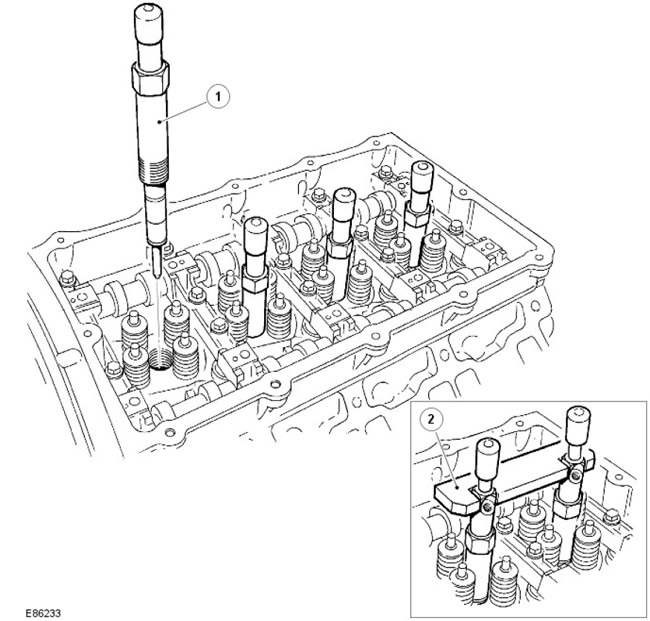
| Pos. | Spare part number | Name |
| 1 | - | Nozzle |
| 2 | - | Injector Centering Tool |
4 electronic fuel injectors are centrally located (1 above each cylinder) and are attached to the cylinder head with a nut.
Fuel injectors inject the required amount of fuel into the combustion chambers according to the current engine load. To ensure optimal fuel injection advance and precise fuel injection quantity, special fuel injectors with hydraulic servo system and electric actuator are used (electromagnetic valve).
The injectors are controlled directly by the engine control unit (ECM).
For more information, refer to the chapter: Fuel Supply and Controls (303-04A Fuel Delivery and Controls - ID4 2.4L Diesel Engine, Description and Operation), Electronic controls (303-14 Electronic Controls - ID4 2.4L Diesel Engine, Description and Operating Principle).
Cylinder Head Temperature (CHT) Sensor
The CHT sensor is located in the center of the rear of the cylinder head (from the gearbox side). The sensor measures the temperature of the cylinder head, not the coolant temperature.
The CHT sensor affects the following functions:
- amount of fuel injected
- start of fuel injection
- idle speed
- operation of pre-heating
- EGR system
For more information, see the chapter: Electronic controls (303-14 Electronic Controls - ID4 2.4L Diesel Engine, Description and Operating Principle).
The article was copied from a resource (www.lrman.ru)
High pressure fuel manifold
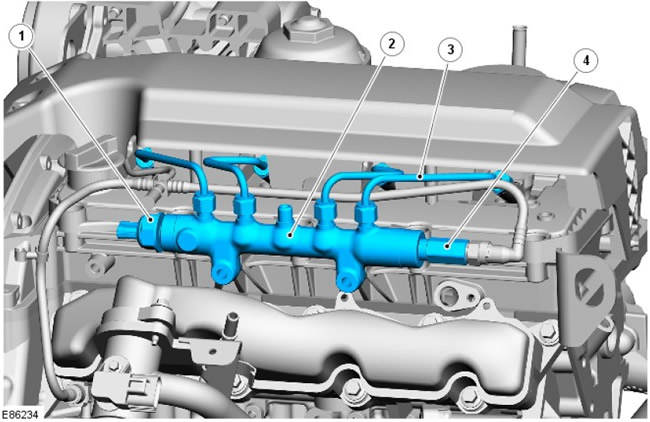
| Pos. | Spare part number | Name |
| 1 | - | Fuel pressure sensor |
| 2 | - | High pressure fuel manifold |
| 3 | - | High pressure fuel lines (between the fuel manifold and the injectors) |
| 4 | - | Pressure relief valve |
Fuel manifold (battery fuel system, ATS) it is made of forged steel. It is used to store fuel under high pressure and prevent pressure fluctuations in the high-pressure system.
The high-pressure fuel pump delivers fuel through the high-pressure fuel line to the fuel rail. The fuel is then sent to the individual fuel injectors through four injector fuel lines, which are all the same length.
The pressure limiting valve opens at a fuel pressure of approximately 2000 bar. It acts as a safety device in the event of a fault in the high-pressure system, preventing damage due to excess pressure.
NOTE: The pressure relief valve is non-serviceable. If it is triggered, it must be replaced, as its further tightness is not guaranteed.
The operation of the pressure limiting valve is detected by the ECM, which then sets a corresponding diagnostic trouble code (DTC) and illuminates the emission control system malfunction indicator lamp (MIL).
For more information, refer to the chapter: Fuel Supply and Controls (303-04A Fuel Delivery and Controls - ID4 2.4L Diesel Engine, Description and Operation), Electronic controls (303-14 Electronic Controls - ID4 2.4L Diesel Engine, Description and Operating Principle).
Intake manifold
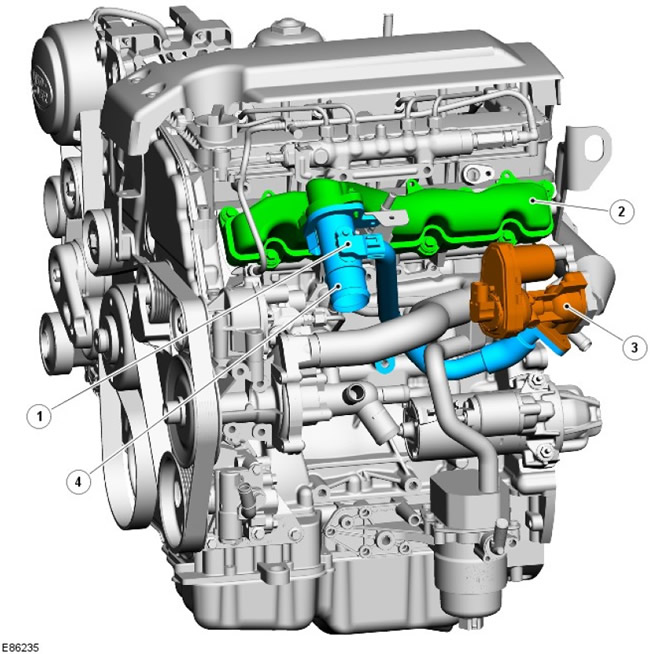
| Pos. | Spare part number | Name |
| 1 | - | Mass Air Flow/Intake Air Temperature (MAF/IAT) Sensor |
| 2 | - | Intake manifold |
| 3 | - | EGR valve |
| 4 | - | EGR Outlet Valve Assembly |
The plastic intake manifold is mounted on the left side of the cylinder head and has a connector for the EGR valve outlet pipe. The EGR outlet pipe also contains the MAF/IAT sensor, which is used by the ECM to calculate the amount of air entering the engine.
For more information, see the chapter: Electronic controls (303-14 Electronic Controls - ID4 2.4L Diesel Engine, Description and Operating Principle).
Exhaust manifold
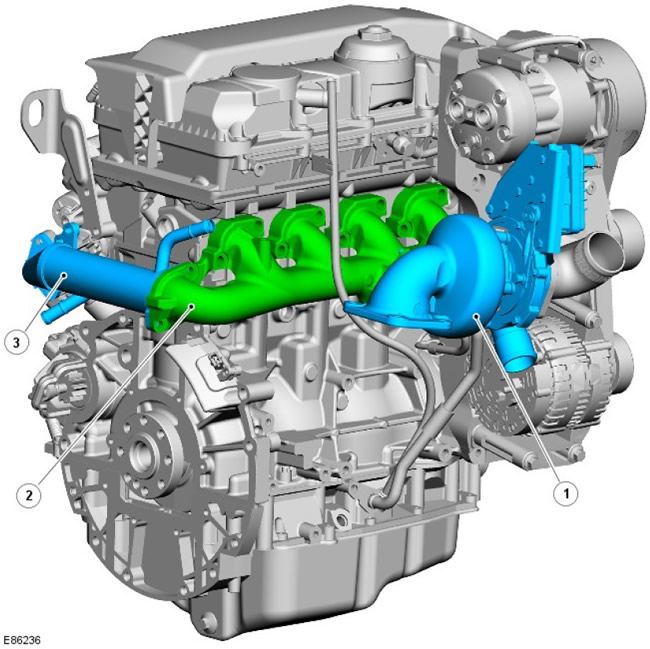
| Pos. | Spare part number | Name |
| 1 | - | Turbocharger assembly |
| 2 | - | Exhaust manifold |
| 3 | - | EGR cooler |
The cast iron exhaust manifold is attached to the cylinder head by means of 8 studs with nuts. Two metal gaskets are used as a seal between the manifold and the cylinder head.
The flange at the front of the manifold is designed to attach the turbocharger. The turbocharger is attached to the flange with 3 bolts and sealed with a metal gasket.
The second flange, located on the rear of the manifold, is designed to attach the EGR cooler. The cooler flange is attached to the manifold with 2 bolts. There is no gasket between the EGR cooler and the exhaust manifold.
The EGR system directs exhaust gases into the intake manifold for use in the combustion process. The main effect of this is to reduce combustion chamber temperatures, which in turn reduces nitrogen oxide (NOx) emissions.
For more information, see the chapter: Reducing Exhaust Emissions (303-08 Emission Control - ID4 2.4L Diesel Engine, Description and Operating Principle).
Camshaft housing
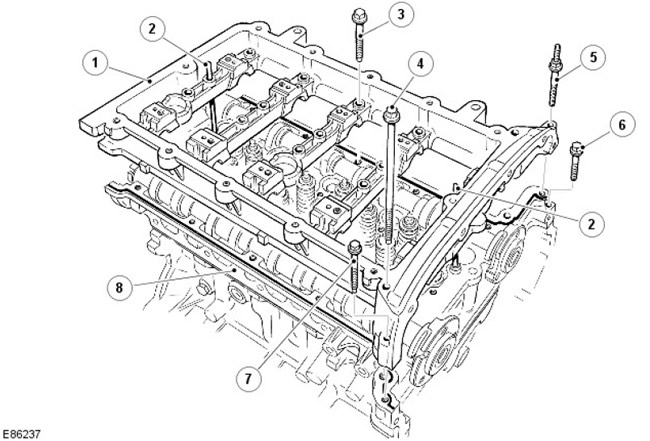
| Pos. | Spare part number | Name |
| 1 | - | Camshaft housing |
| 2 | - | Centering pin |
| 3 | - | Bolt (20 pcs.) |
| 4 | - | Bolt (2 pcs.) |
| 5 | - | Hairpin |
| 6 | - | Bolt |
| 7 | - | Bolt |
| 8 | - | Cylinder head |
The aluminum camshaft housing is located on the cylinder head and is secured with a pin and 24 bolts. Two centering studs are provided for precise installation of the housing on the cylinder head.
Hydraulic clearance compensator
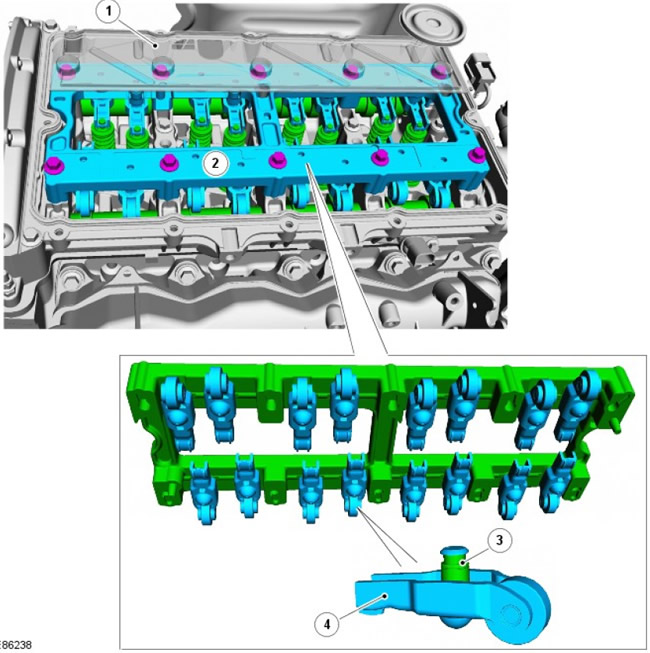
| Pos. | Spare part number | Name |
| 1 | - | Oil deflector plate |
| 2 | - | Aluminum support |
| 3 | - | Hydraulic clearance compensator (16 pcs.) |
| 4 | - | Rocker arms (16 pcs.) |
The valves are actuated by roller rocker arms and hydraulic lash adjusters via the camshaft lobes. The hydraulic lash adjusters are built into the rocker arms, and the unit itself is located inside the camshaft housing. When the camshaft lobes press on the top of the roller lever mechanism, the corresponding valve is lowered, opening the intake or exhaust port. This drive method reduces friction in the valve timing mechanism.
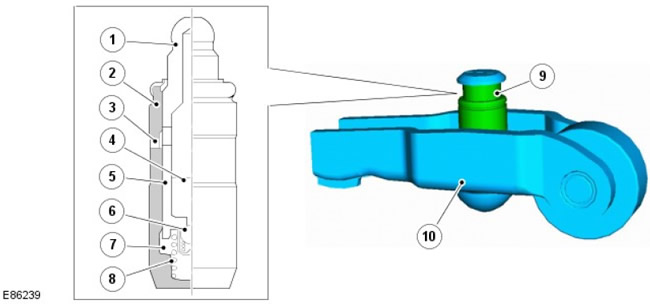
| Pos. | Spare part number | Name |
| 1 | - | Plunger cap |
| 2 | - | Hydraulic clearance adjuster housing |
| 3 | - | Oil supply hole |
| 4 | - | Tank chamber |
| 5 | - | Pusher |
| 6 | - | Locking ball |
| 7 | - | Pressure chamber |
| 8 | - | Plunger spring |
| 9 | - | Hydraulic clearance compensator |
| 10 | - | Rocker arm |
The hydraulic lash adjuster housing contains a plunger and two chambers for supplying oil and pressurized oil. Pressurized oil is supplied to the lash adjusters through the main oil galleries in the cylinder head and through an opening in the side of the lash adjuster housing. The oil passes into the lash adjuster feed chamber and then into a separate discharge chamber through a one-way ball valve.
The flow of oil from the discharge chamber is determined by the clearance between the outer housing and the central plunger of the lash adjuster. Oil is forced to the upper side of the plunger whenever the lash adjuster moves. The downward force acting on the plunger forces a corresponding amount of oil into the lash adjuster housing. When the downward force from the camshaft and tappet disappears (that is, after the approach side of the camshaft cam has passed), the oil pressure forces the lash adjuster plunger to rise again. This pressure is not enough to operate the valve effectively, but it eliminates the gap between the tappet and the top of the valve stem.
Camshaft Position Sensor (CMP)
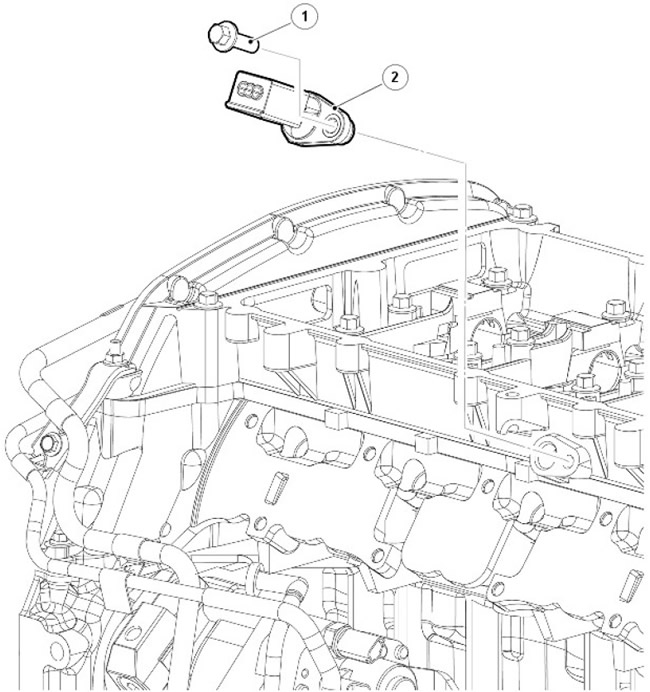
| Pos. | Spare part number | Name |
| 1 | - | Bolt |
| 2 | - | CMP sensor (camshaft positions) |
The CMP sensor is located on the left side of the cylinder head, near the rear. The tip of the sensor protrudes above the cylinder head to monitor the rotation of the pulse wheel on the intake camshaft. The CMP sensor is a Hall effect sensor.
The ECM uses the CMP sensor signal to determine the engine position. Once this is determined, the ECM can activate the correct injector to inject fuel into the cylinder when the piston is at TDC for injection.
The CMP sensor is used by the ECM when the engine is started to synchronize the ECM with the CKP sensor signal. The ECM does this by using the CMP sensor signal to identify cylinder #1 to ensure proper injection advance. Once the ECM has set the injection advance, the CMP sensor signal is no longer used.
For more information, see the chapter: Electronic controls (303-14 Electronic Controls - ID4 2.4L Diesel Engine, Description and Operating Principle).
Cylinder head cover and engine cover
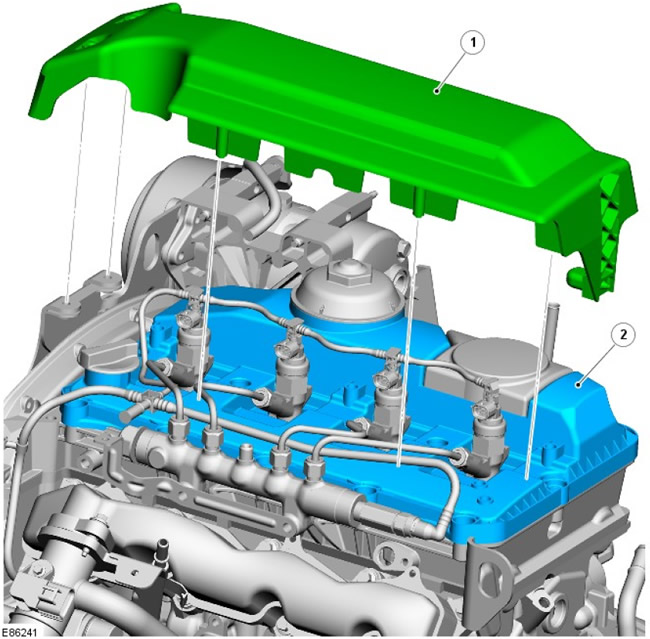
| Pos. | Spare part number | Name |
| 1 | - | Engine cover |
| 2 | - | Camshaft cover |
Comments on this article