car logo Ford
car logo Volkswagen
car logo BMW
car logo Opel
car logo Audi
car logo Toyota
car logo Peugeot
English Русский
Български
Беларускі
Український
Српски
Hrvatski
Română
Polski
Slovenský
Magyar


Main
Freelander
Discovery
Range Rover
Defender
Contacts
Articles

Description and principle of operation of exhaust toxicity reduction (Defender 2007+)

 
  • Main
  • Defender
  • Defender 2007+
  • Power unit
  • Exhaust system
  • Description and principle of operation of exhaust toxicity reduction
 
        0  
Contents: Exhaust Gas Recirculation (EGR)…⇩ Review ⇩ Placement of engine crankcase…⇩ Review ⇩

Exhaust Gas Recirculation (EGR) Component Locations
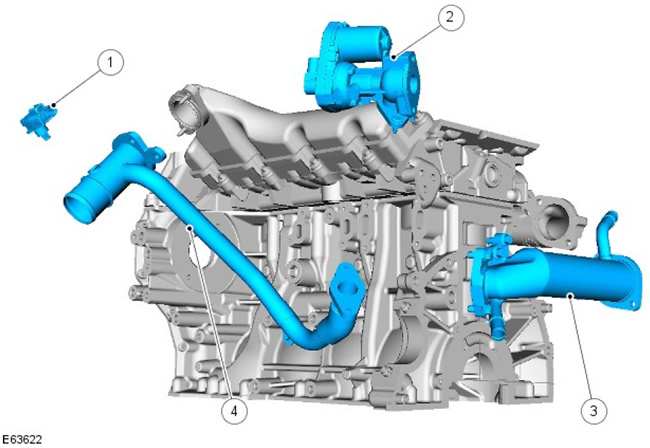

Exhaust Gas Recirculation (EGR) Component Locations


Pos.Spare part numberName
1-Sensor (shown for illustrative purposes only) manifold Absolute Pressure (MAP)
2-EGR valve
3-EGR system heat exchanger
4-Pipes for gas transfer and mixing

Review


The EGR system includes the following components:
  • EGR modulator
  • EGR system heat exchanger
  • Gas Transfer Pipe and Gas Mixer

The exhaust gas directly from the exhaust pipe enters the EGR heat exchanger, where it is cooled by passing through a bundle of water pipes integrated into the overall engine cooling system. On the cold side of the heat exchanger is the EGR valve. This valve is driven by an electric motor - it is controlled by the engine control unit (ECM), which provides different amounts of EGR recirculation depending on engine operation. When the engine is turned off, the valve opens and closes several times to release any deposits that may have accumulated on it during operation.

The EGR pipe transports the cooled gas to the mixer, where the gas is mixed with the incoming air stream.


The ECM monitors the EGR system function and stores fault codes if a fault occurs. The EGR valve can also be activated to allow testing using the Land Rover approved diagnostic system.

Placement of engine crankcase ventilation components
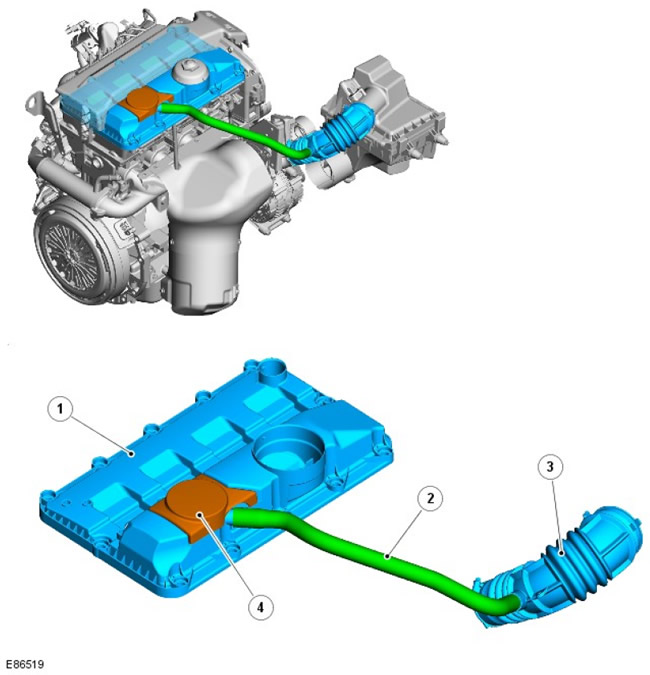

Placement of engine crankcase ventilation components


Pos.Spare part numberName
1-Cylinder head cover
2-Gas Transfer Pipeline
3-Air intake manifold
4-Oil separator

Review


The engine crankcase ventilation system regulates the pressure increase during engine operation. To prevent excessive oil loss or consumption, the separator ensures that all gases leaving the engine crankcase during operation are separated from any oil particles.

The crankcase gas enters the oil separator block, located under the engine cam cover, due to the difference between the crankcase pressure and the air intake manifold pressure. The oil separator removes oil from the crankcase gases. The crankcase pressure is released into the air intake system through the crankcase ventilation manifold. The separated oil flows from the oil separator into the oil pan through the internal engine oil passages.


This article is available at russian, bulgarian, belarusian, ukrainian, serbian, croatian, romanian, polish, slovak, hungarian
Article review: Saveliy Ushakov


Previous articles
Exhaust system specifications
Description and operating principle of the exhaust system
Catalytic converter — removal and installation
Front muffler — removal and installation
Emission Control Specifications
Diagnostics and tests to reduce exhaust toxicity

Current article
Description and principle of operation of exhaust toxicity reduction

Next articles
Exhaust Gas Recirculation (EGR) Valve
Exhaust Gas Recirculation (EGR) Cooler


Similar articles from Land Rover repair manuals:
• Description and principle of operation Freelander 2 (2006-2014)
• The principle of operation of the system Discovery 3 (2004-2009)
• Description of the Emission Reduction System Discovery 1 (1989-1998)
• Exhaust and intake manifolds and exhaust system Range Rover 3 (2001-2012)

Comments on this article


No comments yet


How much will 40 + 40 =


Defender 2007+ 
  • General information
  • Maintenance
  • Identification codes
  • Power unit
  • Diesel engine ID4 2.4L
  • Engine inspection
  • Engine cooling
  • Fuel supply
  • Fuel tank
  • Exhaust system
  • Accessory drive
  • Air filtration
  • Electronic parts
  • Mechanical gearbox
  • Transfer case
  • Clutch
  • Chassis
  • Car suspension
  • Wheels and tires
  • Steering
  • Steering column
  • Brake system
  • Front drive axle
  • Rear drive axle
  • Cardan shaft
  • Body and coating
  • Interior trim
  • Instrument panel and console
  • Exterior finish
  • Lockable body parts
  • Handles, locks, latches
  • Glass, frames and mechanisms
  • Windshield wipers and washers
  • Seats
  • Electrical equipment
  • Battery
  • Generator and regulator
  • Lighting and headlights
  • Winch
  • Heating and ventilation
  • Instrument panel
  • Other electronics


LRman.ru © 2013-2026 | Mobile version | Free Lander | Discovery | Range Rover | Defender | Contacts | | Sitemap |
Car repair and service instructions Land Rover: Freelander, Discovery, Range Rover, Defender
We use cookies to make pages load faster and provide a more user-friendly experience 🍪