


Contents: 110 - Arrangement of elements ⇩ 90 - Arrangement of elements ⇩ Review ⇩ Front section ⇩ Central section ⇩ Rear section of the exhaust pipe ⇩
110 - Arrangement of elements
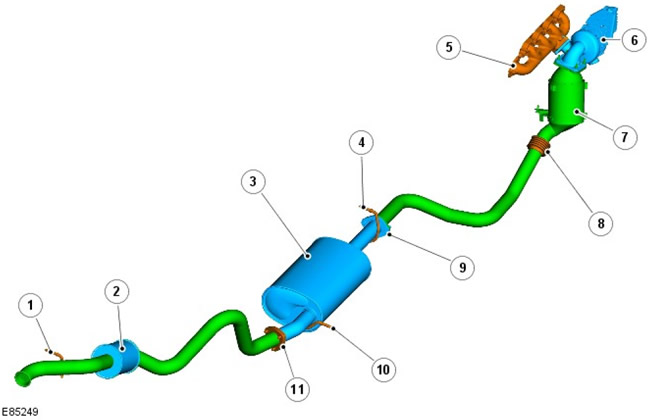
| Pos. | Spare No | Name |
| 1 | parts | Rear Hanger Bracket |
| 2 | - | Rear muffler |
| 3 | - | Middle muffler |
| 4 | - | Front center hanger bracket |
| 5 | - | Exhaust manifold |
| 6 | - | Turbocharger (turbocharging) |
| 7 | - | Catalytic converter of exhaust gases |
| 8 | - | Flexible joint |
| 9 | - | Front hinge |
| 10 | - | Rear center hanger bracket |
| 11 | - | Rear hinge |
90 - Arrangement of elements
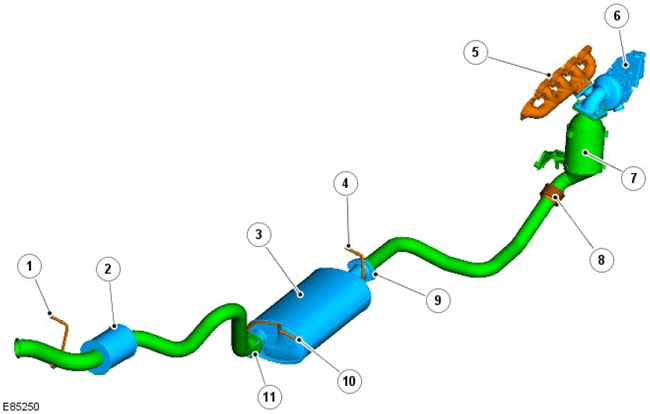
| Pos. | Spare No | Name |
| 1 | parts | Rear Hanger Bracket |
| 2 | - | Rear muffler |
| 3 | - | Middle muffler |
| 4 | - | Front center hanger bracket |
| 5 | - | Exhaust manifold |
| 6 | - | Turbocharger (turbocharging) |
| 7 | - | Catalytic converter of exhaust gases |
| 8 | - | Flexible joint |
| 9 | - | Front hinge |
| 10 | - | Rear center hanger bracket |
| 11 | - | Rear hinge |
Review
The exhaust system is made of stainless steel and consists of three separate units:
The original text can be found at: www.LRman.ru
- The front section includes a catalytic converter
- In the central part there is a central muffler
- At the rear there is a rear muffler
The exhaust system is attached to the underbody by three rubber supports, which are located on mild steel hangers welded to the system. On the underbody, the rubber cushions are attached to hooks welded to the underbody.
Spare parts are supplied for repairing the downpipe and crosspipe of the exhaust system. The punched arrows indicate the cut-off points for replacing the front section. When using a spare section, the pipes are connected at the cut-off points using a bushing with clamps.
Front section
A flange with four M10 studs for the four mounting holes of the turbocharger flange is welded to the front section. There is also a bracket for connecting the two rear studs to the manifold; they are secured to the turbocharger with four M10 nuts.
The flange is welded to the inlet cone of the neutralizer, which in turn is welded to the neutralizer body. The outlet cone is welded to the bottom of the neutralizer. The corner section of the outlet pipe is welded to it. The outer diameter of the corner section and the outlet pipe is 60 mm, the wall thickness is 1.5 mm. The disconnect coupling is welded between the corner section and the outlet pipe.
The catalytic converter is attached to the engine using a support bracket with two M8 bolts.
The rear part of the outlet socket fits into the central section, and the free flange is mounted on two M10 studs. Two M10 nuts are used for fastening and sealing.
Central section
The central muffler is an absorption chamber with a volume of 21.33 liters (1302 in³) with triple seam. The muffler contains baffles, perforated pipes and E-glass filters, which reduce noise when exhaust gases pass through the muffler. A hanger bracket is welded to the front of the muffler intake pipe (directed to the left) for fixing in a rubber support. The second hanger bracket is welded to the right rear of the muffler on the 90 model and to the exhaust pipe on the 110/130 models. The outside diameter of the inlet and outlet pipes is 63.5 mm, the thickness of the pipe walls is 1.5 mm.
The central and rear sections are connected by a flange coupling. Three studs of the rear mounting flange enter three holes in the rear section and are secured with three M10 nuts.
Rear section of the exhaust pipe
The rear section of the 90 model contains a 0.73L straight-through chamber (44.55 in³) with a seam. The outside diameter of the inlet pipe is 63.5 mm, the wall thickness is 1.5 mm, there is a flange for connection to the central section. The outside diameter of the outlet pipe is 70 mm, the wall thickness is 1.2 mm, a rolled end is provided for safety. On the left side, a bracket is welded to the outlet pipe for fastening to a rubber support.
The rear section of the 110/130 models contains a 0.73 l straight-through chamber (44.55 in³) with a seam. The outside diameter of the inlet pipe is 63.5 mm, the wall thickness is 1.5 mm, there is a flange for connection to the central section. The outside diameter of the outlet pipe is 63.5 mm, the wall thickness is 1.2 mm, a rolled end is provided for safety. On the left side, a bracket is welded to the outlet pipe for fastening to a rubber support.
Comments on this article