Contents: Arrangement of elements ⇩ Review ⇩
Arrangement of elements
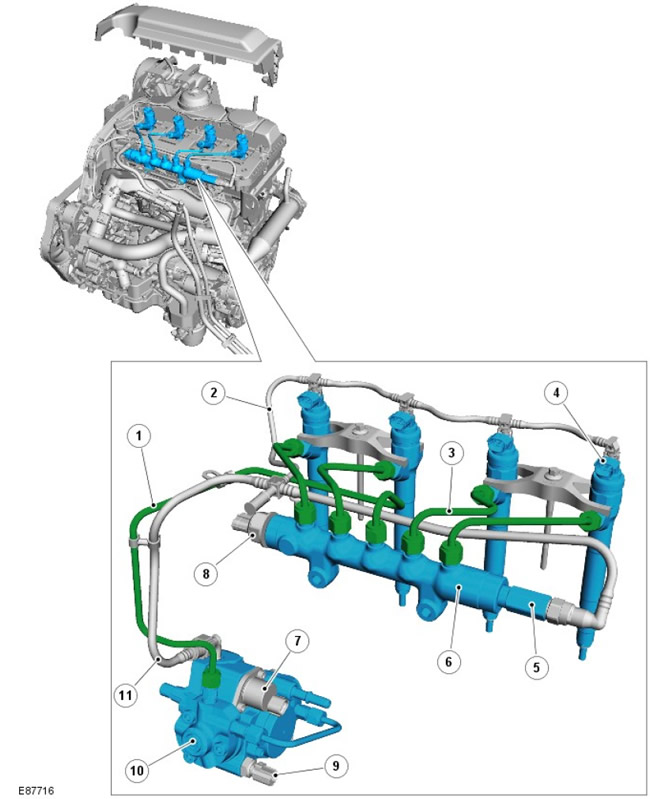
| Pos. | Spare part number | Name |
| 1 | - | High pressure fuel line |
| 2 | - | Fuel drain line |
| 3 | - | High pressure fuel line |
| 4 | - | Fuel injector |
| 5 | - | Pressure relief valve |
| 6 | - | Fuel manifold |
| 7 | - | Pump capacity controller (VCV) |
| 8 | - | Fuel pressure sensor |
| 9 | - | Fuel temperature sensor |
| 10 | - | High pressure fuel pump |
| 11 | - | Fuel return line |
Review
The 2.4L diesel engine is equipped with a high-pressure fuel injection system (battery type). With this fuel injection process, the high-pressure fuel pump creates uniform pressure in the shared lines (battery fuel system), which serve all 4 fuel injectors. The pressure in the fuel manifolds is maintained at an optimal level for smooth operation and can reach 1600 bar.
The system provides two-phase injection (preliminary and main phases), which reduces the noise of the working process and the mechanical load on the engine parts.
Fuel injection pressure is generated regardless of engine speed and fuel injection events. Fuel injection timing and fuel volume are calculated by the engine control module (ECM), which then activates the solenoid of the appropriate injector.
The common rail fuel injection system has the following features:
- High fuel injection pressures up to 1600 bar for better fuel atomization (which improves performance and reduces exhaust toxicity)
- Independent regulation of injection parameters by cylinders ensures optimal combustion in all modes
- Low tolerances and high accuracy throughout the life of the system
The fuel supply system consists of two circuits:
- Low pressure system
- High pressure system
The low pressure circuit includes the following components:
- Low pressure pump (located inside the high pressure pump)
- Fuel filter
- Fuel system radiator
The high pressure circuit includes the following components:
- High pressure fuel pump
- Fuel manifold
- High pressure fuel lines
- Injectors
Comments on this article