Contents: Removal ⇩ Installation ⇩
General equipment
Pneumatic vacuum gun.
Removal
Warnings:
- Some fuel will inevitably spill during this operation. Make sure that all necessary precautions are taken to prevent fire and explosion.
- Do not carry or use a cell phone while working with or in the immediate vicinity of any fuel related components. There is a risk of ignition of flammable vapors. Failure to follow these instructions may result in injury.
- Do not smoke or carry a lighted cigarette or open flame of any type when working on or near fuel-related components. There is a risk of ignition of flammable vapors. Failure to follow these instructions may result in injury.
- If fuel gets into your eyes, rinse them with cold water or a special eye wash solution and seek medical attention immediately.
- Wash your hands thoroughly after handling fuel, as prolonged contact with the skin may cause irritation. If irritation occurs, seek medical attention.
- Do not perform any repairs to the fuel system while the engine is running. Fuel pressure in the system can reach 2000 bar. Failure to follow this instruction may result in injury.
Warnings:
- Diesel fuel injection equipment is manufactured to very precise tolerances and very small clearances. Therefore, absolute cleanliness is required when working with these components.
- Be sure to install new plugs in all open ports and lines. Failure to do so may result in dirt entering the fuel injection system.
- Always perform the cleaning procedure before performing any repairs to fuel injection system components. Failure to do so may result in dirt entering the fuel injection system.
- Do not disconnect the fuel injector electrical connectors while the engine is running. Failure to do so may result in serious engine damage.
- Keep the area of the service station where the vehicle is being worked on as clean and dust-free as possible. Dirt and dust from clutch, brake, machining, or welding work can contaminate the fuel system and cause problems later.
1. Disconnect the ground wire from the battery.
For more information, refer to the chapter: Disconnecting and connecting the battery (414-01 Battery, Battery Mounting and Cables, General Procedures).
2. Remove the engine cover.
For more information, refer to the chapter: Engine Cover (501-05 Interior trim, Removal and installation).
3. Using a vacuum cleaner, remove foreign material from the high-pressure fuel supply lines, fuel rails and high-pressure fuel pump.
For more information, refer to the chapter: Cleaning the fuel injection system components (303-04A Fuel Delivery and Controls - ID4 2.4L Diesel Engine, General Procedures).
4.
Warnings:
- Avoid striking the sealing lens of the high-pressure fuel supply line, as this may damage the ends of the line and allow dirt to enter the fuel injection system.
- Plug all openings. Use new caps.
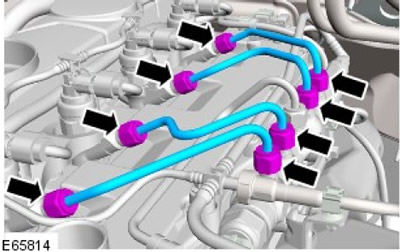
Remove the 4 high pressure fuel supply lines and discard them.
5.
Warnings:
- Avoid striking the sealing lens of the high-pressure fuel supply line, as this may damage the ends of the line and allow dirt to enter the fuel injection system.
- Plug all openings. Use new caps.
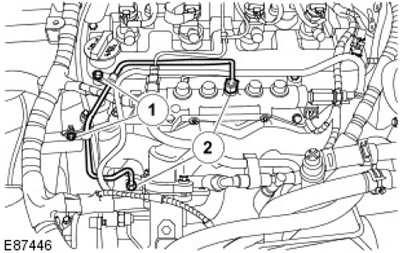
Remove the high pressure fuel supply line and discard it.
- 1. Release the clamps.
- 2. Remove the fuel supply line from the fuel rail.
6.
CAUTION: Plug all openings. Use new caps.
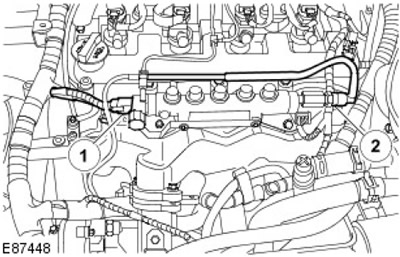
Disconnect the fuel rail pressure (FRP) sensor electrical connector and fuel return line.
- 1. Disconnect the FRP sensor electrical connector.
- 2. Disconnect the fuel return line from the fuel manifold.
7. Remove the intake manifold.
For more information, refer to the chapter: Intake Manifold (303-01 Engine - Diesel engine ID4 2.4L, On-car repair).
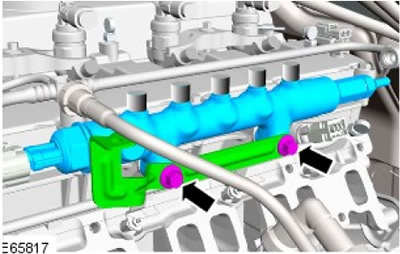
8. Remove the fuel rail.
- Remove two bolts.
- Remove the bracket.
Installation
Warnings:
- Some fuel will inevitably spill during this operation. Make sure that all necessary precautions are taken to prevent fire and explosion.
- Do not carry or use a cell phone while working with or in the immediate vicinity of any fuel related components. There is a risk of ignition of flammable vapors. Failure to follow these instructions may result in injury.
- Do not smoke or carry a lighted cigarette or open flame of any type when working on or near fuel-related components. There is a risk of ignition of flammable vapors. Failure to follow these instructions may result in injury.
- If fuel gets into your eyes, rinse them with cold water or a special eye wash solution and seek medical attention immediately.
- Wash your hands thoroughly after handling fuel, as prolonged contact with the skin may cause irritation. If irritation occurs, seek medical attention.
- Do not perform any repairs to the fuel system while the engine is running. Fuel pressure in the system can reach 2000 bar. Failure to follow this instruction may result in injury.
Warnings:
- Diesel fuel injection equipment is manufactured to very precise tolerances and very small clearances. Therefore, absolute cleanliness is required when working with these components.
- Be sure to install new plugs in all open ports and lines. Failure to do so may result in dirt entering the fuel injection system.
- Always perform the cleaning procedure before performing any repairs to fuel injection system components. Failure to do so may result in dirt entering the fuel injection system.
- Do not disconnect the fuel injector electrical connectors while the engine is running. Failure to do so may result in serious engine damage.
- Keep the area of the service station where the vehicle is being worked on as clean and dust-free as possible. Dirt and dust from clutch, brake, machining, or welding work can contaminate the fuel system and cause problems later.
1.
CAUTION: At this stage, tighten the bolts only finger tight.
NOTE: Clean the contact surfaces of the parts.
Install the fuel manifold.
- Install the bracket.
- Screw in the bolts, but do not tighten them.
2.
Warnings:
- Apply pressure to the high pressure fuel supply line to keep the sealing lenses in contact with the fuel injector cones and fuel rail when connecting.
- Avoid striking the sealing lenses of the high-pressure fuel supply line, as this may damage the ends of the line and allow dirt to enter the fuel injection system.
- At this stage, tighten the connections with hand force only.
[The text of the article was taken from the website www.LRman.ru]
NOTE: Remove and discard plugs.
Install the new high pressure fuel supply line, but do not tighten it completely.
3.
Warnings:
- Apply pressure to the high pressure fuel supply line to keep the sealing lenses in contact with the fuel injector cones and fuel rail when connecting.
- Avoid striking the sealing lenses of the high-pressure fuel supply line, as this may damage the ends of the line and allow dirt to enter the fuel injection system.
- At this stage, tighten the connections with hand force only.
NOTE: Remove and discard plugs.
Install the new high pressure fuel supply lines, but do not tighten them permanently.
4. Secure the fuel manifold.
- Step 1: Tighten the bolts to 8 Nm.
- Step 2: Tighten the bolts (tightening torque 23 Nm).
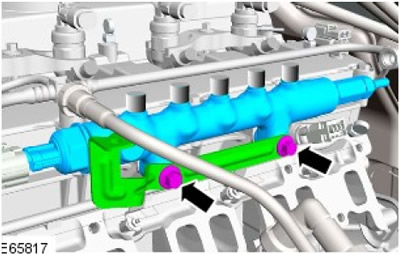
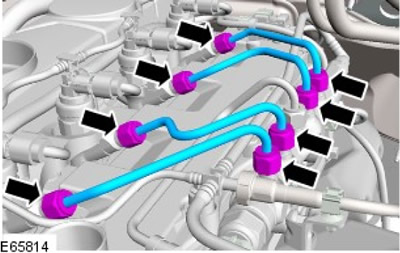
5. Secure the high pressure fuel lines.
- Step 1: Tighten the connection (tightening torque 5 Nm).
- Step 2: Tighten the connection (tightening torque 35 Nm).
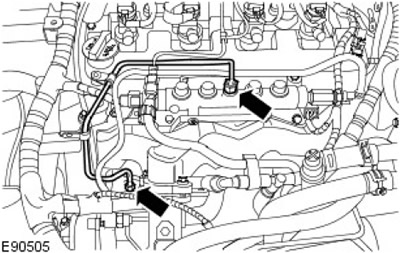
6. Secure the fuel supply line to the fuel rail.
- Step 1: Tighten the connection (tightening torque 5 Nm).
- Step 2: Tighten the connection (tightening torque 35 Nm).
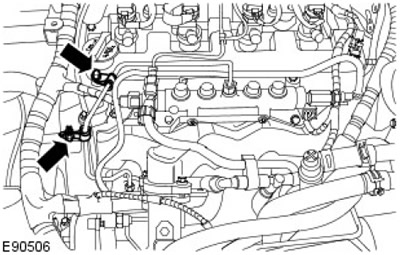
7. Tighten (tightening torque 10 Nm).
8. Reinstall the intake manifold.
For more information, refer to the chapter: Intake Manifold (303-01 Engine - Diesel engine ID4 2.4L, On-car repair).
9. Connect the FRP sensor electrical connector.
10.
NOTE: Remove and discard plugs.
Connect the fuel return line.
11. Replace the engine cover.
For more information, refer to the chapter: Engine Cover (501-05 Interior trim, Removal and installation).
12. Connect the ground wire to the battery.
For more information, refer to the chapter: Connecting the Battery (414-01 Battery, Battery Mounting and Cables, General Procedures).
13. Check the fuel system for leaks using the Land Rover approved diagnostic system.
Comments on this article