Contents: Arrangement of elements ⇩ High pressure fuel pump (HPFP) ⇩ Principle of high pressure generation ⇩ Fuel manifold ⇩ Fuel injectors ⇩ Fuel injector solenoid valve ⇩
Arrangement of elements
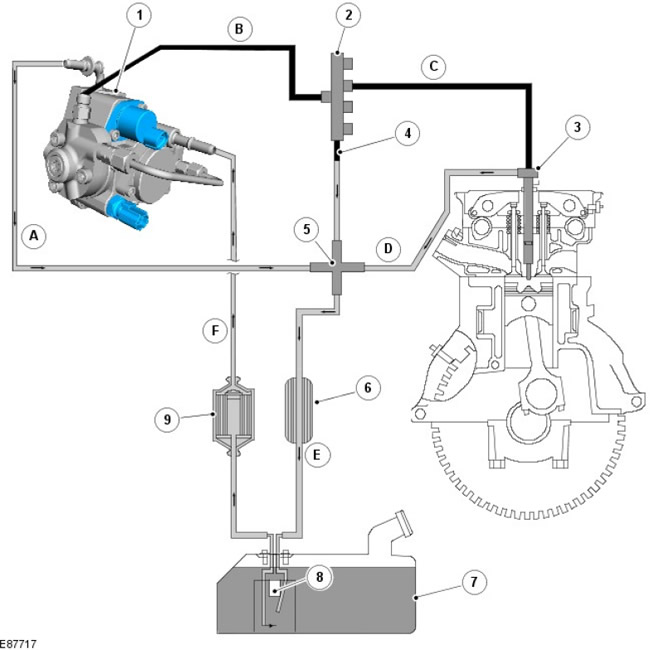
| Pos. | Spare part number | Name |
| A | - | Fuel return from high pressure pump |
| B | - | High pressure fuel line |
| C | - | High pressure fuel line |
| D | - | Fuel drain line |
| E | - | Fuel return line to the fuel tank |
| F | - | Fuel supply |
| 1 | - | High pressure pump |
| 2 | - | Fuel manifold |
| 3 | - | Fuel injector |
| 4 | - | Pressure relief valve |
| 5 | - | Tee |
| 6 | - | Fuel system radiator |
| 7 | - | Fuel tank |
| 8 | - | Fill level sensor |
| 9 | - | Fuel filter |
Fuel is drawn from the fuel tank through the fuel filter by means of a transfer pump built into the high-pressure pump. The high-pressure pump compresses the fuel and delivers it to the fuel rail. Depending on the fuel injection requirements, the injectors create the required pressure. Fuel flowing out of the injectors and/or returning from the high-pressure pump is diverted back to the fuel tank.
High pressure fuel pump (HPFP)
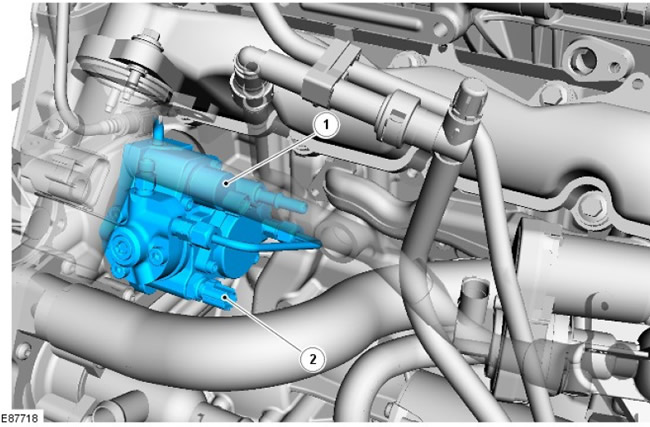
| Pos. | Spare part number | Name |
| 1 | - | Pump capacity controller (VCV) |
| 2 | - | Fuel temperature sensor |
The high-pressure fuel pump is the interface between the low-pressure and high-pressure systems. Its purpose is to supply fuel at the required pressure under all operating conditions throughout the life of the vehicle.
The fuel pump is located under the intake manifold and is driven by the timing chain on the front of the engine. The pump unit includes a low-pressure pump, a high-pressure pump, a VCV and a fuel temperature sensor.
The high-pressure pump receives fuel under the transfer pressure from the transfer pump and increases the fuel pressure. Then the high-pressure fuel is transferred from the high-pressure pump to the fuel rail.
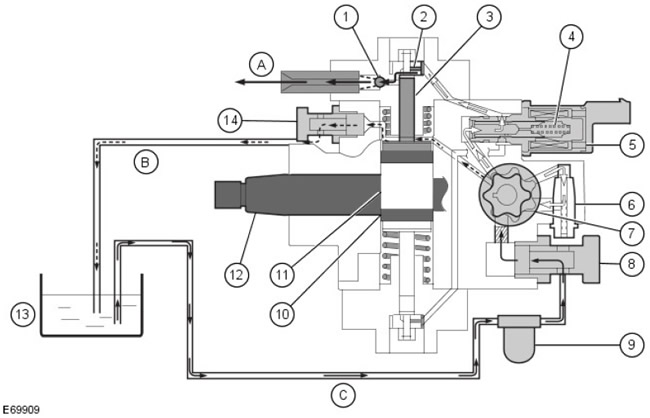
| Pos. | Spare part number | Name |
| A | - | High pressure fuel to fuel rail |
| B | - | Fuel return line |
| C | - | Fuel supply |
| 1 | - | High pressure chamber release valve |
| 2 | - | High pressure chamber inlet valve |
| 3 | - | Pump plunger |
| 4 | - | VCV return spring |
| 5 | - | Pump capacity controller (VCV) |
| 6 | - | Intake pressure regulating valve (internal pressure in the pump) |
| 7 | - | Low pressure pump |
| 8 | - | Fuel inlet |
| 9 | - | Fuel filter |
| 10 | - | Eccentric ring |
| 11 | - | Eccentric cam |
| 12 | - | Half shaft |
| 13 | - | Fuel tank |
| 14 | - | Fuel bypass valve |
The transfer pump receives fuel from the fuel tank via the inlet port (8). The internal pressure of the pump is regulated via the inlet pressure control valve (6), providing the necessary lubrication and cooling of the high-pressure pump components. Excess fuel is transferred to the inlet side of the low-pressure pump (7) via the inlet pressure control valve, with some fuel flowing into the VCV (5) from the low-pressure pump. The amount of fuel supplied to the high-pressure chambers is determined by the cross-section of the VCV orifice. A small, restricted orifice in the bypass valve (14) ensures automatic bleeding of air from the high-pressure pump. The entire low-pressure system is designed to allow a certain amount of fuel to flow back into the fuel tank via the pressure bypass regulating line, helping to cool the high-pressure pump.
To generate high pressure, two high-pressure chambers (1 and 2) are used, one for each pump plunger (3). The pump plungers are driven by an eccentric cam (11), which in turn is driven by a drive shaft (12). The high-pressure pump constantly generates high pressure in the system for the fuel manifold.
Principle of high pressure generation
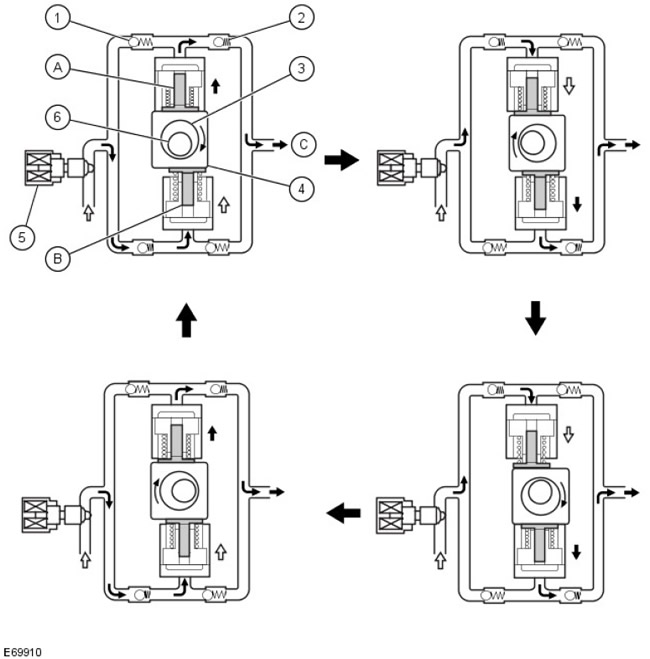
| Pos. | Spare part number | Name |
| A | - | Pump plunger 1 |
| B | - | Pump plunger 2 |
| C | - | To the fuel manifold |
| 1 | - | Inlet valve |
| 2 | - | Exhaust valve |
| 3 | - | Eccentric cam |
| 4 | - | Eccentric ring |
| 5 | - | Fuel metering valve |
| 6 | - | Half shaft |
The rotary motion of the drive shaft (6) is converted into reciprocating motion of the eccentric cam (3). The eccentric ring (4) transmits the reciprocating motion to the pump plungers (1 and 2).
The pump plungers are offset by 180 degrees. This means that during reciprocating motion, the plunger of pump 1 moves in the opposite direction relative to the plunger of pump 2.
When the eccentric pushes plunger 1 upwards, the latter moves towards TDC, compressing the fuel and pushing it into the fuel manifold through the outlet valve (2). The inlet valve (1) is pressed into its seat by the supply pressure. The plunger of the pump 2 moves under the action of the extension spring towards the bottom dead center (BDC). Due to the high pressure in the fuel manifold, the outlet valve is pressed into its seat. The internal pressure of the pump opens the inlet valve, and the fuel flows into the high-pressure chamber.
When the eccentric pushes the plunger down, the process occurs in the opposite direction.
The VCV valve is located on the high-pressure fuel pump. The valve regulates the fuel supply (and therefore the amount of fuel) from the transfer pump to the plunger pairs of the high-pressure pump, depending on the fuel pressure in the manifold. This makes it possible to match the supply of the high-pressure fuel pump with the engine's requests from the low-pressure side. At the same time, the amount of fuel going to the return drain is reduced to a minimum. In addition, this adjustment reduces the energy consumption of the high-pressure fuel pump, increasing engine efficiency.
For more information, see the chapter: Electronic controls (303-14 Electronic Controls - ID4 2.4L Diesel Engine, Description and Operating Principle).
Following replacement of the high pressure pump and/or ECM, the VCV must be calibrated using Land Rover approved diagnostic equipment.
The fuel temperature sensor is also located on the injection pump. The ECM constantly monitors the fuel temperature to properly respond to changes in fuel density depending on its temperature.
For more information, see the chapter: Electronic controls (303-14 Electronic Controls - ID4 2.4L Diesel Engine, Description and Operating Principle).
If the fuel temperature sensor becomes disconnected, the engine will run in a reduced power mode and a DTC will be generated.
Fuel manifold
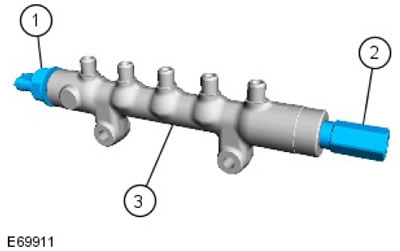
| Pos. | Spare part number | Name |
| 1 | - | Fuel pressure sensor |
| 2 | - | Pressure relief valve |
| 3 | - | Fuel manifold |
The fuel manifold performs the following functions:
- accumulates fuel under high pressure
- minimizes pressure fluctuations
Pressure fluctuations occur in the high-pressure fuel system due to the working movements in the high-pressure chambers of the fuel pump and the opening and closing of the electromagnetic valves in the fuel injectors. Therefore, the fuel manifold design provides a volume sufficient to minimize pressure fluctuations, but at the same time provides an increase in fuel pressure for a quick start in the shortest possible time.
The fuel supplied by the high pressure pump passes through the high pressure line to the high pressure accumulator. The fuel is then sent to the individual fuel injectors through four injector fuel lines, which are all the same length. When the fuel is received from the fuel rail for the injection process, the pressure in the fuel rail is maintained almost constant.
The pressure limiting valve opens at a fuel pressure of approximately 2000 bar. It serves as a safety device in the event of a fault in the high-pressure system. The valve is replaceable: after a single operation, it must be replaced, since its further tightness is not guaranteed. The operation of the pressure limiting valve is detected by the ECM, after which a corresponding diagnostic trouble code (DTC) is generated and the emission control indicator lamp (MIL) is activated.
The fuel rail pressure sensor is located at the far end of the fuel rail. The sensor measures the fuel pressure in the fuel rail. The signal from the sensor is used by the ECM to regulate the amount of fuel delivered to the fuel rail.
For more information, see the chapter: Electronic controls (303-14 Electronic Controls - ID4 2.4L Diesel Engine, Description and Operating Principle).
If the pressure sensor becomes disconnected, the engine will enter a reduced power mode and a DTC will be generated. The sensor is not serviceable and is supplied as part of a new manifold with a pressure limiting valve.
Fuel injectors
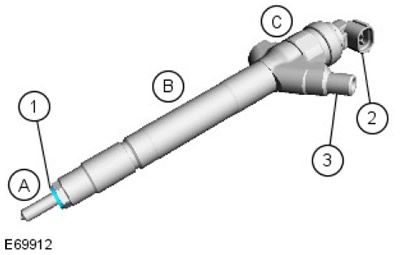
| Pos. | Spare part number | Name |
| A | - | Nozzle |
| B | - | Hydraulic servo system |
| C | - | Solenoid valve |
| 1 | - | Combustion chamber seal |
| 2 | - | Electrical connection - solenoid valve |
| 3 | - | High pressure fuel line nipple |
The 4 fuel injectors are located in the cylinder head, between the 4 valves of each cylinder. Each injector is sealed in the cylinder head by means of a copper washer. Each injector has an electrical connector for power supply, as well as connectors for connection to the ECM. The fuel injectors are controlled directly by the ECM to meter the fuel (injection start and amount of fuel injected). A return fuel pipe is installed on the top of each injector, through which the fuel passing through the injector can return to the fuel tank.
NOTE: Copper washers that seal the injectors in the cylinder head must not be reused.
Each injector is equipped with a solenoid valve; when power is applied to the solenoid, the valve ball is lifted above the seat. This allows the compressed fuel to lift the injector needle valve and inject fuel into the cylinder in the form of a fine mist. Fuel that passes the ball valve is directed into the return line, which is connected to the return line of the high-pressure fuel pump.
The ECM controls each injector solenoid individually, providing ground to open the injector orifice at the correct time and for the correct amount of time, delivering a precisely metered injection of fuel into the cylinder. The ECM uses signals from other sensors and the fuel delivery program to deliver the exact amount of fuel at the correct time to maximize fuel efficiency and minimize harmful emissions.
Fuel injector solenoid valve
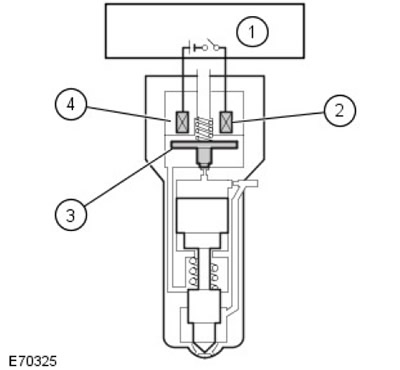
| Pos. | Spare part number | Name |
| 1 | - | ECM |
| 2 | - | Winding |
| 3 | - | Electromagnet anchor |
| 4 | - | Solenoid valve |
The ECM supplies power to the injector solenoids in 3 stages:
- 1. 18 A
- 2. 8 A
- 3. 4 A
To start the injection process, a high initial starting current is applied to the solenoid valve so that it opens faster. After a short period of time, the starting current is reduced to a low holding current.
To ensure optimum fuel economy, the ECM must receive injector change data via a 16-digit identification number. Within the hydraulic servo system are various orifices with extremely small diameters that meet manufacturing tolerances. These manufacturing tolerances are specified as part of the identification number, which is located on the fuel injector body.
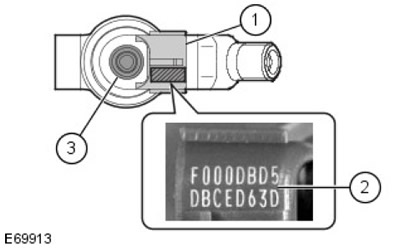
| Pos. | Spare part number | Name |
| 1 | - | Solenoid valve |
| 2 | - | 16-digit identification number |
| 3 | - | Connection for bypass pipe |
NOTE: If the identification numbers are not entered correctly using Land Rover approved diagnostic equipment, the following faults may occur:
- Increased emission of black smoke
- Poor idle performance
- Increased combustion noise
In addition, the fuel injector configuration should be adjusted after loading new ECM software using Land Rover approved diagnostic equipment.
The ECM detects injector faults based on the energy consumption of the solenoids. If a fuel injector is faulty, any of the following symptoms may be observed:
- Misfires
- Problems in idle mode
- Deterioration of engine energy performance
- Increased fuel consumption
- Difficulty starting from cold
- Difficulty starting a hot engine
- Increased smoke from exhaust gases
Comments on this article