


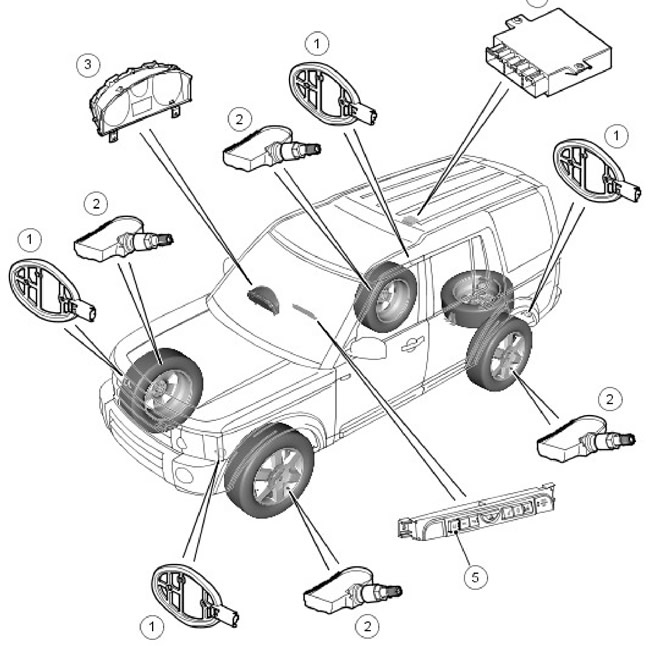
| Item name | Spare part catalog number | Description |
| 1 | - | Initiator |
| 2 | - | Tire pressure sensor |
| 3 | - | Instrument panel |
| 4 | - | Tire Pressure Monitoring System (TPMS) Module |
| 5 | - | TPMS switch (not installed on vehicles for North American markets) |
The tire pressure monitoring system (TPMS) helps the driver maintain the pressure in the car's tires at an optimal level, thereby solving the following problems:
- Reduced fuel consumption
- Maintaining high operational and dynamic characteristics
- Reduces the risk of sudden flat tires that can occur due to underinflation
- Compliance with applicable legal requirements
The air pressure monitoring system measures the air pressure in each tire (including, if necessary, a spare tire) and warns the driver if the air pressure in at least one tire goes beyond the set limits.
NOTE: When a tire "blows out" the pressure will usually drop very quickly. The system is not designed to warn the driver of a tire "blowout" as this cannot be done in a short time. The purpose of the TPMS is to help the driver maintain the correct air pressure in the tires, which reduces the risk of a tire "blowout".
The TPMS uses a single-row hardware configuration. Two levels of instrument clusters are available: a "low level" with two LED indicators and a "high level" with a message center display and one LED indicator.
TPMS installed with a high-level instrument cluster provides the driver with additional options for identifying tires on the vehicle and a more advanced interface.
Comments on this article