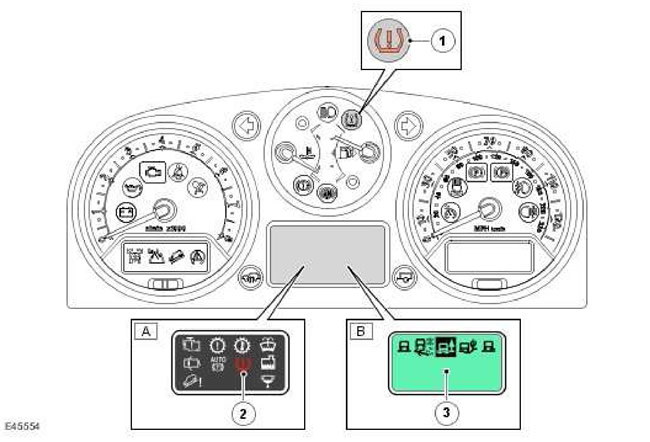
| Item name | Spare part catalog number | Description |
| A | - | Low Level Instrument Cluster |
| B | - | High Level Instrument Cluster |
| 1 | - | Yellow indicator |
| 2 | - | Red indicator |
| 3 | - | Message Center Display |
Warning indications depend on the type of instrument cluster fitted to the vehicle. On vehicles with a low-level instrument cluster, tyre pressure warnings are provided by a yellow and red LED indicator. On vehicles with a high-level instrument cluster, warnings are provided by a yellow LED indicator and a text message displayed on the instrument cluster.
The TPMS module controls the display on both types of instrument clusters, sending messages via the CAN bus. When the ignition key is turned to position II, the instrument cluster software turns on the indicators for 3 seconds for testing.
NOTE: If the vehicle does not have a TPMS system, the indicators will never come on.
When the TPMS module transmits a signal to turn on the indicator, the instrument cluster may sound a chime.
The following table shows the operation of the indicators for various events for both types of instrument clusters.
| Event | Low Level Instrument Cluster | High Level Instrument Cluster |
| Any "working" tire has reached a secondary air pressure limit | The yellow LED is on | Yellow LED is on. 'CHECK TIRE PRESSURES' message is displayed. (CHECK TIRE PRESSURE). |
| In the spare tire (if it is equipped with a sensor) secondary air pressure limit reached | The yellow LED lights up for 20 seconds and then goes out. Each time the ignition is turned on, the yellow LED lights up for 20 seconds and then goes out. | The yellow LED lights for 20 seconds and then goes out. Each time the ignition is turned on, the yellow LED lights for 20 seconds and then goes out. The message 'CHECK SPARE TYRE PRESSURE' is displayed. (CHECK THE SPARE TIRE PRESSURE) |
| Any "working" tire has reached its maximum air pressure limit. | The red LED is on. The beep sounds once when the LED is on. | The message 'XX TIRE PRESSURE VERY LOW' is displayed (VERY LOW TIRE PRESSURE XX). The sound signal is given once when the message is displayed on the display. |
| Maximum air pressure limit reached in several "working" tires | The yellow and red LEDs are lit. When an important event is detected, a sound signal is activated. The sound signal is given once before the yellow and red LEDs are lit and the vehicle speed increases from 0 to 60 km/h. | The message 'TYRE PRESSURES VERY LOW' is displayed (VERY LOW TIRE PRESSURE). The beep sounds once when the message is displayed on the display. The beep sounds once before the yellow LED turns on, the message appears on the display, and the vehicle speed increases from 0 to 60 km/h. |
| Any "working" tire has reached its maximum overpressure when operating under "normal load" conditions. | No indication | Message 'XX TYRE PRESSURE TOO HIGH' is displayed (TIRE PRESSURE TOO HIGH XX) |
| Several "working" tires reached their maximum overpressure when operating in "normal load" mode. | No indication | The message 'TYRE PRESSURES TOO HIGH' is displayed (EXCESSIVE TIRE PRESSURE) |
| The battery of the pressure sensor of any "working" or spare tire is discharged | No indication (the TPMS module stores a fault code) | No indication (the TPMS module stores a fault code) |
| TPMS malfunction | The yellow LED is on. The yellow LED lights up each time the ignition is turned on. The sound signal is given when the LED is turned on for the first time. | Yellow LED is on. Yellow LED is on each time the ignition is turned on. A buzzer sounds the first time the LED is turned on. 'TYRE PRESSURE MONITORING SYSTEM FAULT' message is displayed. (TIRE PRESSURE MONITORING SYSTEM MALFUNCTION). |
| Malfunction of one TPMS pressure sensor | The yellow LED is on. The yellow LED lights up each time the ignition is turned on. The sound signal is given when the LED is turned on for the first time. | Yellow LED is on. Yellow LED is on each time the ignition is turned on. A beep sounds the first time the LED lights up. 'XX TYRE PRESSURE NOT MONITORED' is displayed. (AIR PRESSURE IN TYRE XX NOT CONTROLLED). |
| Malfunction of several TPMS tire pressure sensors | The yellow LED remains on. The yellow LED lights up each time the ignition is turned on. The buzzer sounds for each additional pressure sensor fault detected. | Yellow LED illuminated. Yellow LED illuminated each time the ignition is turned on. Audible alarm sounds for each additional pressure sensor fault detected. 'TYRE PRESSURE MONITORING SYSTEM FAULT' message displayed (TIRE PRESSURE MONITORING SYSTEM MALFUNCTION). |
| The TPMS switch is held for 4 seconds to set the "normal load" mode when the engine is off and the ignition key is in position II (excluding vehicles for the North American market) | TPMS Switch Status LED is on | TPMS switch status LED is on. 'TIRE PRESSURE MONITORING LIGHT LOAD MODE' message is displayed for 3 seconds (TIRE PRESSURE MONITORING MODE FOR NORMAL LOAD). |
| The TPMS switch is held for 4 seconds to set the "heavy load" mode when the engine is off and the ignition key is in position II (excluding vehicles for the North American market) | TPMS Switch Status LED Goes Out | TPMS switch status LED goes out. 'TIRE PRESSURE MONITORING HEAVY LOAD MODE' message is displayed for 3 seconds (HEAVY DUTY TIRE PRESSURE MONITORING MODE) |
The original article is located on the website (lrman.ru)
NOTE: "XX" indicates the position of the tire on the vehicle: FL (left front), FR (right front), RL (left rear) or RR (right rear).
Comments on this article