car logo Ford
car logo Volkswagen
car logo BMW
car logo Opel
car logo Audi
car logo Toyota
car logo Peugeot
English Русский
Български
Беларускі
Український
Српски
Hrvatski
Română
Polski
Slovenský
Magyar


Main
Freelander
Discovery
Range Rover
Defender
Contacts
Articles

Tire Pressure Monitoring System (TPMS) Module (Discovery 3)

 
  • Main
  • Discovery
  • Discovery 3
  • Chassis
  • Wheels and tires
  • Tire Pressure Monitoring System (TPMS) Module
 
        0  
Contents: Tire arrangement ⇩ Spare Tire Identification ⇩
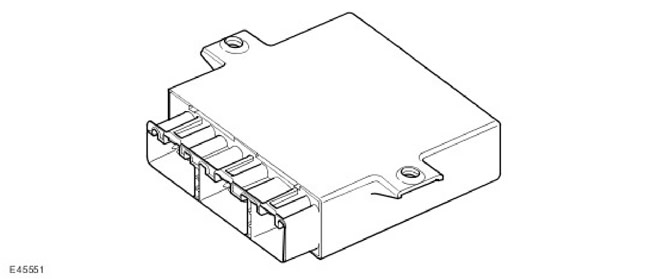
Tire Pressure Monitoring System (TPMS) Module


The TPMS module is located above the vehicle's headliner. It is mounted directly on the roof's center cross member behind the hatch. The module is secured with two screws that are screwed into the cross member's weld nuts. The module's three connectors face the front of the vehicle.

The main purpose of the TPMS module is to detect the following conditions:
  • Tire pressure drops below the minimum recommended - underinflated tire
  • Tire pressure drops below the minimum recommended - significantly underinflated tire
  • Position of the tire on the vehicle.

The TPMS module also communicates with the instrument cluster, providing the driver with appropriate warnings that reflect the importance of the detected conditions, as well as information about the status and malfunctions of TPMS components and parts.

Tire arrangement


Since the set pressure and limit pressure values are different for the front and rear tires, the TPMS module can detect the position of the tires on the vehicle and assign the identification information from the pressure sensors to the corresponding tire positions on the vehicle, such as FL (left front tire), FR (right rear tire), RL (left rear tire) and RR (right rear tire)).


The module detects the positions of the tires automatically. This function does not require driver intervention. The TPMS module can automatically detect the positions of the tires on the vehicle if the location of the tire pressure sensors or the tires themselves are changed.

Under any operating conditions, the TPMS module is capable of detecting the following conditions:
  • Replacing one or more tire pressure sensors
  • Missing one or more tire pressure sensors
  • One or more "foreign" identification signals have been received, i.e. the module may be rejecting identification data from tire pressure sensors that do not belong to the vehicle.
  • Replacing one of the car's wheels with the spare wheel, and vice versa.

[The original source of the article is the website: LRman.ru]

In case of replacement of tire pressure sensors, the module can automatically detect identification information of new sensors. This configuration function does not require manual intervention of the driver.

Spare Tire Identification


Depending on the vehicle's equipment, the spare tire may or may not have a pressure sensor.

If the spare tire has a tire pressure sensor, the TPMS module recognizes it and determines that it is a spare tire. It then monitors the tire pressure of that tire and alerts the driver if necessary. If the TPMS module expects the spare tire to have a tire pressure sensor and there is no pressure sensor, the module does not alert the driver of the malfunction, but a fault code is stored in the TPMS module.

If the spare tire pressure is monitored and the driver replaces the flat "working" tire with the spare, the module will not constantly remind the driver that there is a flat tire in the place of the spare. Thanks to this, the driver will not be constantly distracted by tire pressure warnings.


This article is available at russian, bulgarian, belarusian, ukrainian, serbian, croatian, romanian, polish, slovak, hungarian
Article review: Saveliy Ushakov


Previous articles
Tyre specification
General information about tires and wheels
Image of tire pressure monitoring system

Current article
Tire Pressure Monitoring System (TPMS) Module

Next articles
Operation of the TPMS system
TPMS indication on the instrument cluster
TPMS Inputs and Outputs
TPMS module diagnostics
TPMS control diagram
Inspection and testing of wheels
DTC Trouble Code Index
Element checks


Similar articles from Land Rover repair manuals:
• Rear Tire Pressure Monitoring System (TPMS) Antenna Freelander 2 (2006-2014)
• Relieving pressure in the fuel supply system Freelander 1 (1997-2006)
• Front Wheel Antenna Tire Pressure Monitoring System Range Rover 3 (2001-2012)
• Tire pressure, condition and tread depth Defender 2007+ (2007-2016)

Comments on this article


No comments yet


How much will 17 + 15 =


Discovery 3 
  • General information
  • Using the manual
  • Precautionary measures
  • Service Information
  • Technique
  • Health protection
  • Road test
  • Identification codes
  • Jacking and lifting
  • Maintenance - diesel
  • Maintenance - petrol
  • Chassis
  • Suspension
  • Front suspension
  • Rear suspension
  • Wheels and tires
  • Dynamic suspension
  • Cardan shaft
  • Rear drive axle
  • Front drive axle
  • Front axle axles
  • Rear axle axles
  • Brake system
  • Parking brake
  • Hydraulic brake
  • Vacuum brake booster
  • Anti-lock braking system
  • Steering
  • Steering column
  • Power unit
  • Petrol engine 4.0L
  • Petrol engine 4.4L
  • Diesel engine 2.7L
  • Engine cooling
  • Fuel supply
  • Drive units
  • Launch system
  • Ignition system
  • Emission reduction
  • Air filtration
  • Fuel vapor control
  • Electronic control part
  • Car gearbox
  • Clutch
  • All-wheel drive systems
  • Transfer case
  • Exhaust system
  • Fuel tank and lines
  • Acceleration control
  • Electrical equipment
  • Climate control
  • Instruments and control lamps
  • Battery and charging system
  • Information system
  • Lighting and headlights
  • Power distribution
  • Electronic Function Group
  • Body and coating
  • Body elements
  • Interior and body trim
  • Mirrors and glasses
  • Seats
  • Instrument panel and console
  • Handles and locks
  • Windshield wipers and washers
  • Sunroof and bumpers
  • Safety system
  • Body repairs
  • Repair of front end elements
  • Repair of back elements
  • Side panel repair
  • Frame and body mount

Discovery 1 
  • General information
  • Technical specifications
  • Introduction to manual
  • Troubleshooting
  • Power unit
  • Diesel engine Tdi
  • Petrol engine V8i (3.9 l)
  • Petrol engine V8i (4.0 l)
  • Petrol engine Mpi
  • Reducing harmful emissions
  • Fuel system Tdi
  • Fuel system MFi
  • Fuel system SFi
  • Fuel system MPi (MEMS)
  • Cruise control
  • Cooling system (Tdi)
  • Cooling system (V8i)
  • Cooling system (MPi)
  • Exhaust system
  • Transmission
  • Clutch
  • Manual gearbox R380
  • Manual gearbox LT 77
  • Transfer case LT230T
  • Automatic gearbox
  • Cardan shaft
  • Rear axle
  • Front axle
  • Chassis
  • Steering system
  • Front suspension
  • Rear suspension
  • Brake system
  • Wheels and tires
  • Body and interior
  • Passive safety
  • Doors, locks and windows
  • Exterior body parts
  • Interior trim details
  • Seats
  • Electrical equipment
  • Heating and ventilation
  • Air conditioning
  • Windscreen wipers
  • Starting and charging system
  • Equipment and devices
  • Lighting and headlights


LRman.ru © 2013-2026 | Mobile version | Free Lander | Discovery | Range Rover | Defender | Contacts | | Sitemap |
Car repair and service instructions Land Rover: Freelander, Discovery, Range Rover, Defender
We use cookies to make pages load faster and provide a more user-friendly experience 🍪