Contents: Layout of elements, sheet 1 ⇩ Layout of elements, sheet 2 ⇩ Review ⇩ Engine control unit ⇩ Crankshaft Position Sensor (CKP) ⇩ CMP ⇩ Glow plugs ⇩ Nozzles ⇩ CHT sensor ⇩ Oil pressure relay ⇩ Fuel Rail Pressure Sensor ⇩ Fuel manifold relief valve ⇩ Fuel temperature sensor ⇩ MAF sensor ⇩ Manifold Absolute Pressure and…⇩ EGR system ⇩ Pump capacity controller (VCV) ⇩ Brake light switches ⇩ Clutch Pedal Position Sensor ⇩ Generator ⇩ Control scheme ⇩
Layout of elements, sheet 1
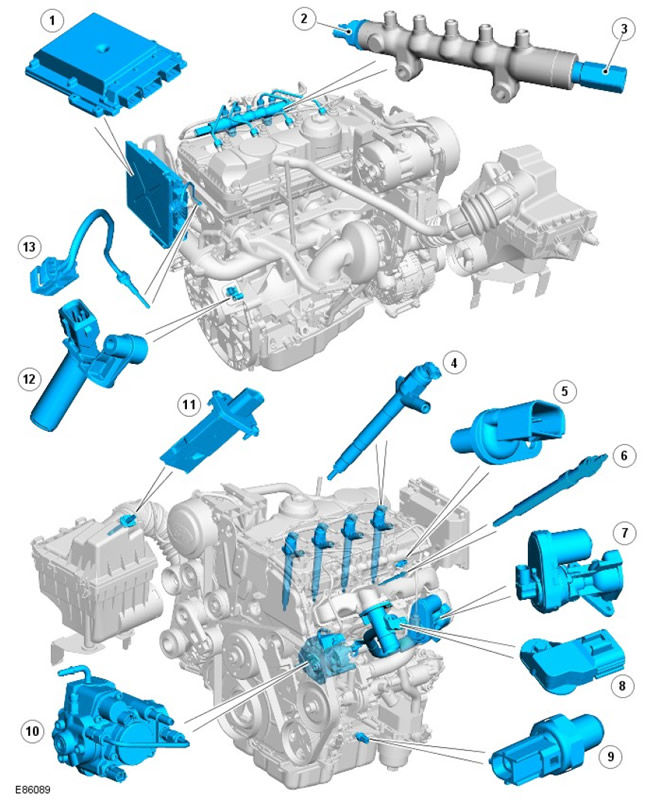
| Pos. | Spare part number | Name |
| 1 | - | engine Control Unit (ECM) |
| 2 | - | Fuel pressure sensor |
| 3 | - | Pressure relief valve |
| 4 | - | Injectors |
| 5 | - | Camshaft Position Sensor (CMP) |
| 6 | - | Glow plugs |
| 7 | - | Exhaust Gas Recirculation (EGR) Valve |
| 8 | - | Manifold Absolute Pressure (MAP) Sensor |
| 9 | - | Oil pressure relay |
| 10 | - | Fuel pump |
| 11 | - | Mass Air Flow (MAF)/Intake Air Temperature (IAT) Sensor |
| 12 | - | Crankshaft Position Sensor (CKP) |
| 13 | - | Cylinder Head Temperature (CHT) Sensor |
Layout of elements, sheet 2
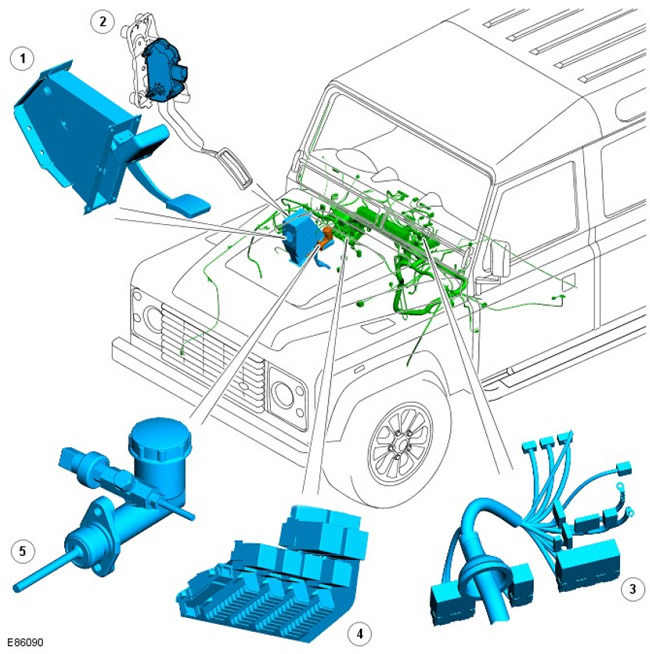
| Pos. | Spare part number | Name |
| 1 | - | Brake pedal sensor |
| 2 | - | Sensor Accelerator Pedal Position (APP) Sensor |
| 3 | - | battery Junction Box (BJB) |
| 4 | - | central Junction Box (CJB) |
| 5 | - | Clutch Pedal Position Sensor |
Review
The engine management system is controlled by the ECM and is able to monitor, adjust and precisely regulate fuel injection. The ECM uses input signals from various sensors and precisely controls the actuators to ensure optimum dynamic performance under all driving conditions.
The ECM controls fuel delivery to all 4 cylinders via a common rail fuel injection system (Common Rail). The Common Rail system consists of a fuel manifold, which contains fuel under very high pressure, and four electronically controlled injectors. The fuel manifold is located in close proximity to the injectors so that at any given moment, each of the injectors develops the pressure specified in the system.
The ECM uses a drive-by-wire approach to control acceleration. There is no physical connection between the engine and the accelerator pedal. The ECM receives a signal of the desired power change from two potentiometers in the APP sensor. The ECM requires two signals to determine the pedal position, the speed at which it is moving, and the direction in which it is moving. The ECM then uses this data, along with other engine information from other sensors, to provide optimal engine response.
ECM processes information from the following sources:
- CKP sensor
- Sensor (CMP)
- Intake manifold air temperature and pressure
- Cylinder head temperature
- Oil pressure
- Air flow and intake temperature
- Fuel temperature
The ECM generates output signals to control the following sensors and actuators:
- Nozzles
- Viscous Fan Clutch Electromagnet
- Turbocharger with electronically controlled vanes
- Fuel pressure control valve (regulator)
- Fuel volume control valve
- Electronic exhaust gas recirculation system EGR
- Glow plugs
Engine control unit
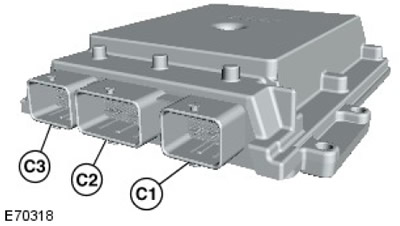
| Pos. | Spare part number | Name |
| C1 | - | Connector 1 |
| C2 | - | Connector 2 |
| C3 | - | Connector 3 |
The ECM is connected to the vehicle's electrical system via three connectors. The ECM includes processors designed to process data and memory chips. The output signals generated by the ECM's final amplifier are sent to the actuators via a controlled "ground" line. The ECM's transistor switch circuits generate heat during normal operation, which is dissipated by the casing. Some sensors receive voltage regulated by the ECM. This measure helps avoid signal distortion caused by voltage drops when the engine is cranked by the starter.
The ECM carries out self-diagnostic routines and stores fault codes in its memory. These fault codes and the diagnostic mode can be accessed using the Land Rover approved diagnostic system. If the ECM is to be replaced, the new ECM is supplied 'clean' and must be configured to suit the vehicle using the Land Rover approved diagnostic system. The EEPROM allows the ECM to be reconfigured to suit changing service and adjustment requirements up to 14 times using the approved diagnostic tool. If a 15th reprogramming is required, the ECM must be replaced. Current engine adjustment data can be accessed using the Land Rover approved diagnostic system.
When a new ECM is installed it must also be synchronised with the anti-theft alarm control module using a Land Rover approved diagnostic system. ECMs cannot be transferred between vehicles.
The ECM is connected to sensors that monitor engine operation. By processing the signals from the sensors, the ECM makes decisions about the actions necessary to maintain the optimal engine operating mode in terms of driving parameters, fuel consumption and exhaust toxicity. During programming, the ECM memory is programmed with instructions with an engine control algorithm, which is called a control strategy. The ECM memory also contains multi-parameter characteristics ("maps") used as a basis for controlling fuel supply and the exhaust toxicity reduction system. By comparing the information received from the sensors with the "maps" data, the ECM is able to generate control signals. The ECM implements an adaptive strategy that updates the system when its components undergo changes due to manufacturing tolerances or aging.
The ECM receives a signal about the vehicle speed. The vehicle speed signal plays an important role in the ECM control strategy. The frequency of these signals depends on the vehicle speed.
Crankshaft Position Sensor (CKP)
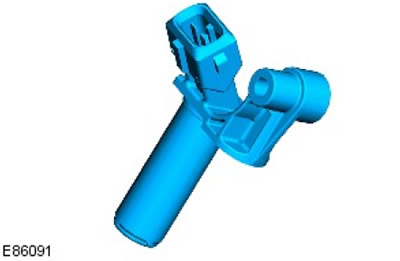
The CKP sensor is installed in the left rear part of the cylinder block. The tip of the sensor is in the plane of rotation of the magnetic disk installed on the crankshaft. The timing disk is pressed onto the end part of the crankshaft. To obtain a phase-correct signal, the timing wheel must be correctly aligned with respect to the crankshaft. A rectangular signal with a frequency proportional to the crankshaft rotation frequency is formed at the sensor output.
The ECM monitors the CKP sensor signal and detects that the crankshaft is overspeeding. The ECM counteracts the overspeed by gradually stopping the functions that involve the rotation of the shaft. The CKP sensor is a Hall sensor. The sensor responds to changes in the magnetic field that occur when the magnetized timing wheel rotates.
The impulse wheel has two missing teeth, corresponding to 12° of crankshaft rotation. The gap of two missing teeth serves to determine the angular position of the crankshaft.
The signal generated when the gap in the timing wheel passes the sensor is used by the ECM to determine the position of the crankshaft. For the correct formation of the sensor signals sent to the ECM, the size of the air gap between its end and the ring of the toothed disk is of great importance. The recommended air gap between the CKP sensor and the timing wheel is 0.4 mm - 1.5 mm.
The ECM uses the CKP sensor signal to perform the following functions:
- Synchronization.
- Determining the moment when fuel supply begins.
- Fuel Pump Relay Circuit Enabled (after preliminary pumping).
- Generation of crankshaft speed signals and their transmission via the CAN data transfer protocol (CAN) bus for use in other systems.
CMP
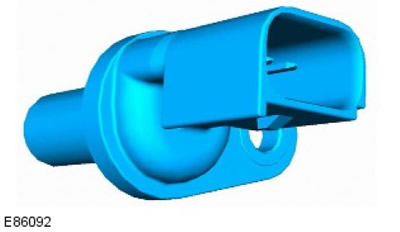
The CMP sensor is located on the left side of the cylinder head, closer to its rear. The tip of the sensor passes through the wall and senses the passage of the timing rotor, located behind the camshaft pulley.
The Hall Effect Camshaft Position Sensor is used by the ECM when the engine is started to synchronize the ECM with the CKP sensor signal. The ECM uses the CMP sensor to identify cylinder 1 to establish the correct fuel injection order. Once the ECM has established the fuel injection order, the CMP sensor signal is no longer used.
The ECM supplies 5V to the CMP sensor. The remaining two connections to the ECM provide ground and signal output.
If the sensor fails, a fault code is stored in the ECM. There are two types of failures: too high a signal frequency or no signal at all. The fault registered by the ECM may also be related to the complete absence of the crankshaft position signal or to the distortion of this signal shape. To determine the cause of the failure, both possibilities must be checked.
If the CMP sensor fails while the engine is running, the engine will continue to run, but the ECM will disable the boost pressure control system. After the engine is stopped, it will restart (despite the fact that the starter turns the engine) will not be possible as long as the fault code remains in memory.
Glow plugs
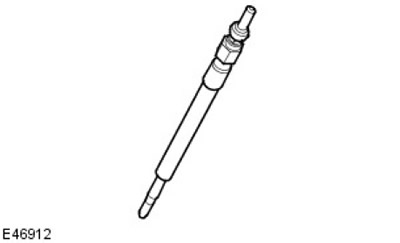
Four glow plugs are installed in the cylinder head on the intake side. The glow plugs and the relay that controls them are essential for ensuring the required starting qualities of the engine. When starting a cold engine, the glow plugs heat the air in the combustion chamber, facilitating the ignition of the fuel. The use of glow plugs allows for a reduction in the starting fuel supply and, accordingly, a reduction in the amount of black smoke. In addition, the use of glow plugs allows for a reduction in the starting injection advance angle, which reduces the harshness of the engine, especially when cold and idling.
The operation of glow plugs is divided into three phases:
- Preheating
- Operation when cranking the crankshaft
- Post-glow
The main part of the spark plug is a tubular heating element protruding into the combustion chamber. The heating element contains a heating coil placed in magnesium oxide powder. At the tip of the tubular heating element is a heating coil. Behind the heating coil is a series-connected control coil. The ballast coil limits the heating of the heating coil, preventing it from overheating.
Preheat is the period of time the spark plugs operate before the starter engages. The duration of the preheat period is controlled by the ECM based on engine coolant temperature (ECT) and battery voltage. If the ECT sensor fails, the ECM defaults to the values received from the IAT sensor. Preheat duration is increased at low ECT and a partially discharged battery.
Postglow is the period of time the spark plugs operate after the engine has started. The duration of postglow is controlled by the ECM based on data from the ECT sensor. Postglow reduces engine noise ("softens" the operating process), improves idle smoothness and reduces hydrocarbon emissions.
When the ignition key is turned to position II, the glow plug indicator lamp lights up on the instrument panel. The glow plug indicator operates independently of the glow plugs, so it does not turn on when the crankshaft is cranked or after the engine is started. When the glow plug indicator is off, the glow plugs themselves can continue to operate during the last two phases.
If the glow plugs fail, the engine will have difficulty starting and there will be increased smoke after starting the engine.
The glow plug indicator lamp also serves a second function in the EDC system. If there is a serious fault with the EDC system, the glow plug indicator lamp will remain illuminated until the fault is rectified. The driver should contact a Land Rover Dealer as soon as possible to have the engine management system checked.
Nozzles
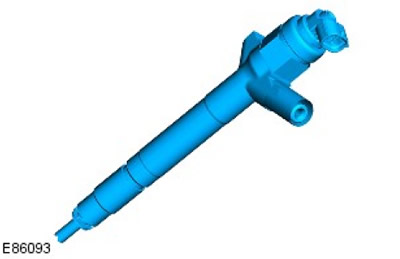
4 electronically controlled injectors (by the number of engine cylinders) are located along the vertical axis of the cylinders, between the four valves. The ECM divides the injectors into 2 banks of 4 cylinders.
Fuel under high pressure is supplied to the injectors from the fuel manifold and sprayed by them into the combustion chambers in a finely dispersed form. The ECM unit separately controls the operation of each injector, determining the order of their operation and the size of the cyclic supply using pulse-width modulation (PWM) pulses. Each injector receives a 12 V supply from the ECM. The engine control unit, based on the recorded control characteristics and sensor signals, calculates the exact moment of the preliminary and main fuel supply phases for each cylinder. If the battery voltage drops to 6-9 V, the injector operation is limited, which worsens environmental parameters and engine operation in idle mode, and also affects the engine speed range. Injector failure may be accompanied by the following symptoms:
- Misfires
- Idle speed unevenness
- Deterioration of engine energy performance
- Increased fuel consumption
- Difficult start
- Increased smoke from exhaust gases
The ECM monitors each injector's power supply circuit for shorts or opens, each injector's solenoid coil, and the transient current characteristic within the ECM itself. If a fault is detected, the ECM records a fault for the injector being tested.
CHT sensor
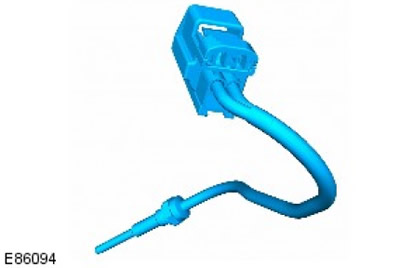
The CHT sensor is located in the upper coolant manifold outlet hose. The ECT sensor provides the ECM and instrument cluster with engine coolant temperature information.
The temperature signal is used by the ECM to implement the following control functions:
- Calculation of fuel cycle supply
- Engine power limitation at excessively high coolant temperature
- Adjusting the operation of the cooling system fan
- Adjusting the operating time of glow plugs.
The instrument cluster uses the temperature information to operate the temperature gauge. The CHT signal is also transmitted by the instrument cluster via the CAN bus for use by other systems.
The ECM CHT sensor circuit consists of an internal voltage divider circuit with a negative temperature coefficient (NTC) thermistor. As CHT increases, the sensor resistance decreases and vice versa. The output signal from the sensor is a change in voltage that occurs due to the increase in current flowing to ground with temperature.
The ECM compares the signal voltage with the "map" data and adjusts the cyclic delivery, ensuring optimum driving performance under all conditions. Due to fuel condensation on the cold combustion chamber walls, the engine requires increased delivery at low coolant temperatures.
To enrich the fuel-air mixture, the ECM increases the injector open time. As the engine warms up, the mixture becomes leaner.
The ECM voltage divider supplies a 5 V reference voltage to the sensor. The sensor ground is also connected to the ECM, which, based on the measured current, determines the sensor resistance corresponding to the coolant temperature.
The table summarizes the CHT values and the corresponding resistance and voltage values.
Coolant Temperature Sensor Characteristics
| Temperature, degrees Celsius | Resistance, kOhm | Voltage, V |
| -40 | 925 | 4,54 |
| -30 | 496 | 4,46 |
| -20 | 277 | 4,34 |
| -10 | 160 | 4,15 |
| 0 | 96 | 3,88 |
| 10 | 59 | 3,52 |
| 20 | 37 | 3,09 |
| 30 | 24 | 2,62 |
| 40 | 16 | 2,15 |
| 50 | 11 | 1,72 |
| 60 | 7,5 | 1,34 |
| 70 | 5,6 | 1,04 |
| 80 | 3,8 | 0,79 |
| 90 | 2,9 | 0,64 |
| 100 | 2,08 | 0,49 |
| 110 | 1,56 | 0,38 |
| 120 | 1,19 | 0,29 |
| 130 | 0,918 | 0,22 |
| 140 | 0,673 | 0,17 |
| 150 | 0,563 | 0,14 |
The following symptoms may accompany a CHT sensor failure:
- Difficulty starting from cold.
- Difficulty starting a hot engine.
- Deterioration of engine performance.
- The temperature indicator does not work or works with a large error.
If the CHT sensor fails, the ECM will default to a coolant temperature of 80°C to regulate fuel delivery. To protect the engine from overheating, the ECM will continuously turn on the cooling fan each time the ignition is turned on.
Oil pressure relay
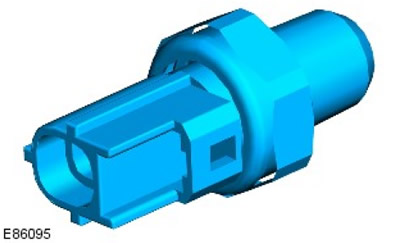
The oil pressure sensor, mounted in the oil cooler assembly, grounds the input signal to the instrument cluster when oil pressure is present. The sensor operates at pressures between 0.15 and 0.41 bar.
Fuel Rail Pressure Sensor
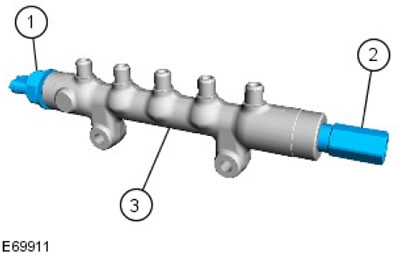
| Pos. | Spare part number | Name |
| 1 | - | Fuel pressure sensor |
| 2 | - | Pressure relief valve |
| 3 | - | Fuel manifold |
The fuel rail pressure sensor is located at the front of the fuel rail. The sensor measures the fuel pressure in the fuel rail. The sensor signal is used by the ECM to regulate the amount of fuel supplied to the fuel rail.
Fuel manifold relief valve
The fuel rail relief valve is located at the far end of the fuel rail. To prevent damage to the high-pressure fuel system, this valve opens when the fuel pressure in the rail reaches approximately 2000 bar. The ECM detects that the valve has opened and requests the emission control indicator lamp (MIL) to be illuminated in the instrument cluster.
Once opened, the valve needs to be replaced.
Fuel temperature sensor
The fuel temperature sensor is located in the high-pressure fuel pump.
This sensor is an NTC type sensor and is connected to the ECM by two wires. The ECM fuel temperature sensor circuit includes an internal voltage divider that contains an NTC thermistor with a negative temperature coefficient. As the temperature increases, the resistance of the sensor decreases. The output signal from the sensor is a change in voltage, which occurs due to an increase in current flowing to the "ground" with a change in temperature.
The ECM constantly monitors the fuel temperature. If the fuel temperature exceeds 85°C, the ECM initiates a dethrottling strategy. The amount of fuel supplied to the injectors is reduced, and the fuel is given a chance to cool down. When switching to this mode, the driver may notice a decrease in power.
Further cooling of the fuel is provided in the heat exchanger, where the fuel, upon reaching a certain temperature, is directed by a bimetallic valve. On cars intended for delivery to countries with a hot climate, the heat exchanger is blown by an electric fan. The fan is switched on and off by a thermal relay when the fuel reaches a specified temperature.
The ECM also monitors the circuit between itself and the sensor for shorts or opens. The ECM also monitors the 5V supply. If a fault occurs, a code is stored in the ECM's memory and the control switches to a backup mode in which the ECM uses the pressure value stored in memory.
If the ECM detects that the discrepancy between the pressure sensor signal and the value stored in memory exceeds a predetermined value, a fault code is stored in the ECM memory. Depending on the degree of discrepancy, the ECM will either limit the cyclic supply, or immediately stop the engine, or not allow the next start.
MAF sensor
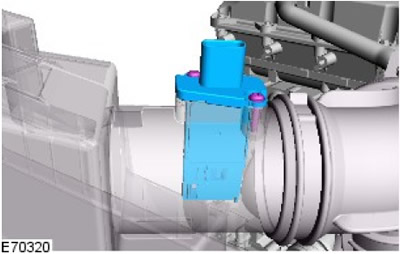
Two MAF sensors are located on the intake air duct immediately after the air cleaner. The sensor is housed in a plastic housing that is installed between the intake manifold and the air intake pipe.
The MAF sensor operates on the principle of a hot film anemometer. There are two film sensing elements in a printed circuit. The temperature of one element is maintained at the intake air temperature, for example, 25°C. The second element is heated to 200°C above the intake air temperature, i.e. to 225°C. Air entering the engine passes through the MAF sensor and cools the film. The ECM measures the current required to maintain a predetermined temperature difference of 200°C and uses this information to generate a non-linear, frequency-based, highly accurate signal corresponding to the mass air flow.
The MAF sensor produces a digital signal proportional to the mass air flow. The ECM uses this information, along with signals from other sensors and stored fuel maps, to accurately calculate the amount of fuel being delivered to the cylinders. This signal is also used as a feedback signal for the EGR system.
The MAF sensor is supplied with a 12 V supply voltage from the BJB, and the connection to the ground is made via the ECM unit. The remaining two contacts with the ECM unit provide signal output from the MAF mass air flow and IAT intake air temperature sensors.
The ECM checks the mass air flow by calculating it as a function of engine speed. If the calculated air flow value is not plausible, the ECM switches to backup values from a stored "map" of average air flow versus engine speed. The mass air flow value is then adjusted for boost pressure, atmospheric pressure, and air temperature.
If the MAF flow sensor fails, the ECM engine control unit switches to standby control based on the crankshaft speed. If the MAF sensor signal fails, any of the following fault signs may occur:
- Difficult start
- Engine stalls after starting
- The engine responds sluggishly to the accelerator pedal
- The exhaust emission control system does not work
- The engine idle speed control function does not work
- Deterioration of engine dynamic characteristics.
Manifold Absolute Pressure and Temperature (MAPT) sensor
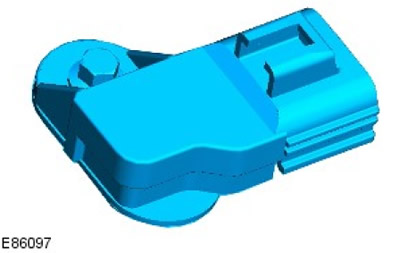
The MAPT sensor is located at the turbocharger outlet after the electric throttle valves. The sensor generates a voltage signal for the ECM based on the intake manifold pressure. The MAPT sensor has a three-pin connector that connects it to the ECM. The connector is used to supply the sensor with a 5-volt reference voltage from the ECM, transmit a signal to the ECM, and connect the sensor to ground.
MAPT sensors use a diaphragm transducer to measure pressure. The sensor signal is used by the ECM to perform the following functions:
- Maintaining boost pressure in the intake manifold.
- Reduces exhaust smoke when driving at high altitudes.
- EGR exhaust gas recirculation system control.
- Vacuum control module control.
If the MAPT intake manifold absolute pressure and temperature sensor fails, the ECM unit defaults to a pressure value of 1013 mbar. If the MAPT sensor fails, the following signs of malfunction may occur:
- The altitude corrector does not work (black smoke on the exhaust)
- Boost pressure control is not working.
The boost pressure is regulated by a direct electric drive of the turbine nozzle. The control drive is located on the side of the turbocharger and is connected by rods to the guide vanes. The high-torque electric motor has a built-in controller.
The electric drive can rotate the blades at an angle of 60 degrees and can remember the extreme positions. The drive operation is regulated by PWM pulse width modulation from the ECM control unit.
EGR system
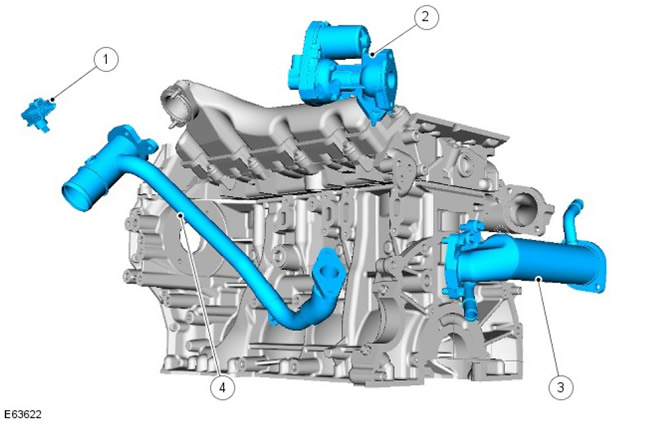
| Pos. | Spare part number | Name |
| 1 | - | MAPT sensor |
| 2 | - | EGR block |
| 3 | - | EGR system heat exchanger |
| 4 | - | Connecting pipeline |
The EGR system includes the following components:
- EGR modulator, 2 pcs.
- EGR heat exchanger, 2 pcs.
- Corresponding connecting tubes.
The EGR modulator and cooler are combined into one unit.
Each bank of cylinders has its own EGR modulator with a heat exchanger, located between the intake manifold and the cylinder head. The EGR heat exchanger is connected to the engine cooling system with hoses. The intake part of the module is connected directly to its exhaust manifold. Exhaust gases pass through the cooler, and then through the actuator and metal pipe are fed to the throttle body. The EGR modulator is an electromagnetic valve controlled by the ECM. The ECM uses the EGR modulator to regulate the amount of exhaust gases sent to the intake to reduce the amount of nitrogen oxides and reduce the noise of the operating process. The EGR system is activated only when the engine reaches operating temperature and when driving in a steady state.
The EGR modulator is supplied with a 12 V supply voltage from the ECM. The modulator is controlled using a PWM signal. The PWM signal is generated by disconnecting/connecting the ground of the electromagnetic valve and sets the exact amount of exhaust gas supplied to the cylinders.
EGR modulators perform a full duty cycle every time the engine is started to clean out soot and carbon deposits.
If the EGR modulator fails, the EGR system will stop working. The ECM monitors the EGR modulator solenoid for short circuits and records a fault code if a fault occurs. The modulator can be activated using a Land Rover recommended diagnostic tool to check for proper operation.
Pump capacity controller (VCV)
The fuel rail flow regulator is built into the high-pressure fuel pump. The VCV valve bleeds excess fuel back into the fuel tank (or in the low pressure circuit), or directs to the PCV. Bleeding off excess fuel allows avoiding the high-pressure pump wasting power on unnecessary compression of fuel in the manifold and the associated heating of the fuel.
Brake light switches
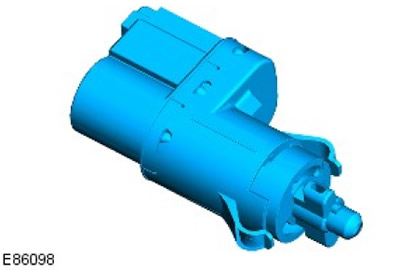
The brake light switch is located on the pedal assembly and is activated by the pedal movement. The switch is a Hall sensor that detects the position of the brake pedal and, based on this, determines when the driver has applied the brakes. The switch is connected directly to the ECM.
The brake light switch consists of an internal sensor and an external mounting sleeve. To ensure proper orientation, the sensor is keyed to the mounting sleeve and the mounting sleeve is keyed to the pedal support bracket. A toothed joint holds the sensor in place in the mounting sleeve. When the brake pedal is not depressed, a tab on the brake pedal rests on the tip of the sensor. When the brake pedal is depressed, the tab moves away from the sensor and causes a change in the sensor output voltage. The ECM detects this change and determines that the brake pedal has been depressed. The ECM uses the signal from the brake pedal to perform the following control functions:
- To limit fuel supply during braking
- To limit or cancel the cruise control effect when braking.
Switch failure may be accompanied by the following symptoms:
- Cruise control not working
- Fuel consumption has increased.
Clutch Pedal Position Sensor
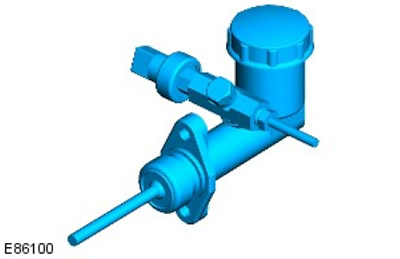
The clutch pedal position sensor is located on the clutch master cylinder. The clutch pedal position sensor is a pressure measuring sensor. When the clutch pedal is pressed, the clutch pedal position sensor sends a signal to the ECM, which reduces engine torque.
Generator
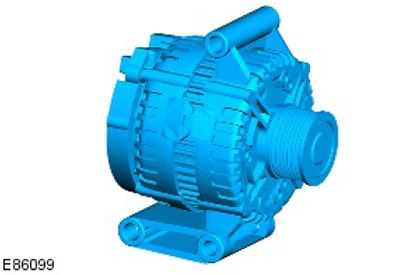
The generator has a multifunctional charging voltage regulator (14 V) with 6-12 zener diode bridge rectifiers.
The ECM monitors the electrical load via the PWM signal and adjusts the generator output according to the demand of the consumers. The ECM also monitors the battery temperature to determine the set point for battery charge control. This parameter is needed to protect the battery from damage. At low battery temperature, its ability to accept a charge is extremely low, and to compensate for this, the charging voltage should be increased as much as possible, but at high temperature, the charging voltage should be reduced to prevent excessive gas formation and, as a result, loss of water from the electrolyte.
The generator circuit contains intelligent control elements that reduce the load on the generator if there is a need to maximize the use of engine torque for other purposes. This control uses three signals from those coming to the ECM:
- The generator sensor (Sensor A) measures the voltage in the CJB.
- The Generator Status Sensor (Alt Com) transmits the desired generator output voltage value from the ECM to the generator.
- The generator status sensor (Alt Mon) reports the current in the generator load circuit to the ECM. This signal notifies the ECM of a fault, which then sends a message to the instrument cluster via the CAN bus to turn on the charge indicator lamp.
Control scheme
NOTE: A = Wired; D = High Speed CAN Bus
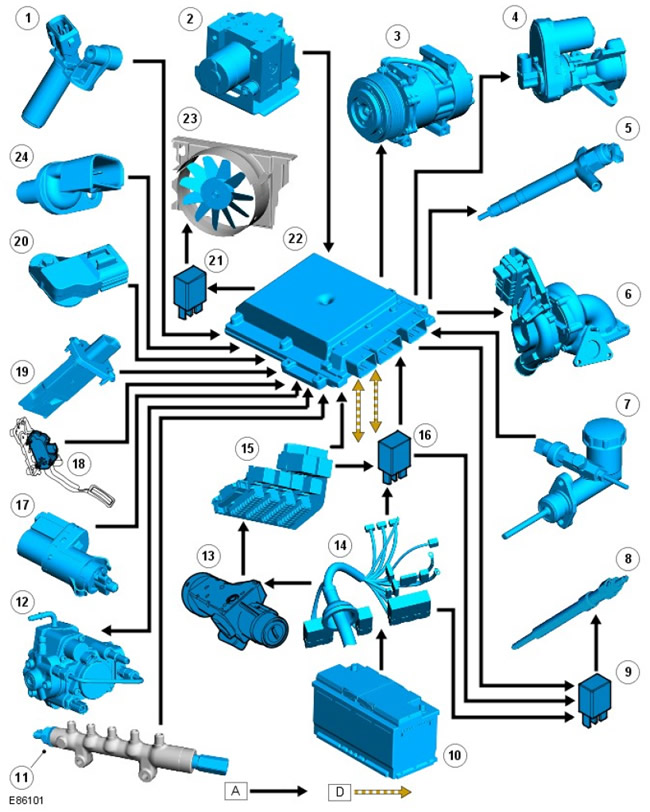
(Data taken from the website: «www.lrman.ru»)
| Pos. | Spare part number | Name |
| 1 | - | CKP |
| 2 | - | Control unit anti-lock braking system (ABS) |
| 3 | - | Air conditioning compressor |
| 4 | - | Exhaust Gas Recirculation (EGR) Valve |
| 5 | - | injectors |
| 6 | - | Turbocharger (turbocharging) |
| 7 | - | Clutch Pedal Position Sensor |
| 8 | - | Glow plugs |
| 9 | - | Glow Plug Relay |
| 10 | - | Battery |
| 11 | - | Fuel pressure sensor in the fuel rail |
| 12 | - | Fuel pump |
| 13 | - | Ignition switch |
| 14 | - | BJB |
| 15 | - | CJB |
| 16 | - | Glow Plug Relay |
| 17 | - | Brake pedal sensor |
| 18 | - | APP |
| 19 | - | MAF/IAT sensor |
| 20 | - | MAP sensor |
| 21 | - | Electric Fan Relay |
| 22 | - | Engine control unit |
| 23 | - | Engine cooling system fan |
| 24 | - | CMP sensor |
Comments on this article