car logo Ford
car logo Volkswagen
car logo BMW
car logo Opel
car logo Audi
car logo Toyota
car logo Peugeot
English Русский
Български
Беларускі
Український
Српски
Hrvatski
Română
Polski
Slovenský
Magyar


Main
Freelander
Discovery
Range Rover
Defender
Contacts
Articles

Brake pressure control valve (Defender 2007+)

 
  • Main
  • Defender
  • Defender 2007+
  • Chassis
  • Brake system
  • Brake pressure control valve
 
        0  
Contents: Removal ⇩ Installation ⇩

Removal


1. Disconnect the battery.

2. Clean the area around the brake pressure control valve ports.

3. Place a container under the valve to collect the leaking brake fluid.

4. Disconnect the nipple connections 'A' of the primary circuit pipes at the brake pressure regulating valve.

5. Disconnect the nipple connections 'B' of the secondary circuit pipes at the brake pressure regulating valve.

6. Seal the pipes to prevent dirt from entering.

7. Loosen the single nut and remove the bolt securing the brake pressure control valve to the engine bulkhead.

8. Remove the brake pressure control valve.
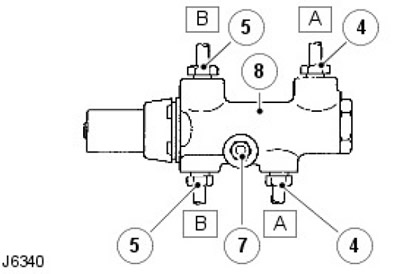
8. Remove the brake pressure control valve.


Installation


1. Install the brake pressure control valve to the engine bulkhead. Tighten the bolt to 15 Nm (11 ft·lbs).

2. Connect the primary and secondary circuit lines to the brake pressure regulating valve. Tighten the nipple connections to 16 Nm (12 ft·lbs).

3. Fill the brake fluid reservoir with the recommended brake fluid.

For more information, please refer to the chapter: Specifications (206-00 Brake System - General Information, Specifications).

4. Remove air from the brake system.


For more information, refer to the chapter: Bleeding the Brake System (206-00 Brake System - General Information, General Procedures).

5. Connect the battery and road test the vehicle.


This article is available at russian, bulgarian, belarusian, ukrainian, serbian, croatian, romanian, polish, slovak, hungarian
Article review: Saveliy Ushakov


Previous articles
Brake system specification
Description and operating principle of the brake system
Bleeding the brake system
Master Brake Cylinder — Removal and Installation
Master Brake Cylinder — Disassembly and Assembly

Current article
Brake pressure control valve

Next articles
Brake pedal and pedal bracket
Vacuum brake booster
Brake booster check valve
Brake vacuum pump
Anti-lock Brake System (ABS) Module
Hydraulic Control Unit (HCU)
Rear wheel speed sensor
Front wheel speed sensor


Similar articles from Land Rover repair manuals:
• Boost Pressure Control Solenoid Valve Freelander 1 (1997-2006)
• Parking brake control Freelander 2 (2006-2014)
• High pressure control solenoid valve Discovery 1 (1989-1998)
• Bleeding air from the brake system under pressure Discovery 3 (2004-2009)
• Boost Pressure Control Solenoid Valve Range Rover 3 (2001-2012)

Comments on this article


No comments yet


How much will 35 + 38 =


Defender 2007+ 
  • General information
  • Maintenance
  • Identification codes
  • Power unit
  • Diesel engine ID4 2.4L
  • Engine inspection
  • Engine cooling
  • Fuel supply
  • Fuel tank
  • Exhaust system
  • Accessory drive
  • Air filtration
  • Electronic parts
  • Mechanical gearbox
  • Transfer case
  • Clutch
  • Chassis
  • Car suspension
  • Wheels and tires
  • Steering
  • Steering column
  • Brake system
  • Front drive axle
  • Rear drive axle
  • Cardan shaft
  • Body and coating
  • Interior trim
  • Instrument panel and console
  • Exterior finish
  • Lockable body parts
  • Handles, locks, latches
  • Glass, frames and mechanisms
  • Windshield wipers and washers
  • Seats
  • Electrical equipment
  • Battery
  • Generator and regulator
  • Lighting and headlights
  • Winch
  • Heating and ventilation
  • Instrument panel
  • Other electronics


LRman.ru © 2013-2026 | Mobile version | Free Lander | Discovery | Range Rover | Defender | Contacts | | Sitemap |
Car repair and service instructions Land Rover: Freelander, Discovery, Range Rover, Defender
We use cookies to make pages load faster and provide a more user-friendly experience 🍪