


Contents: Arrangement of elements ⇩ Review ⇩
Arrangement of elements
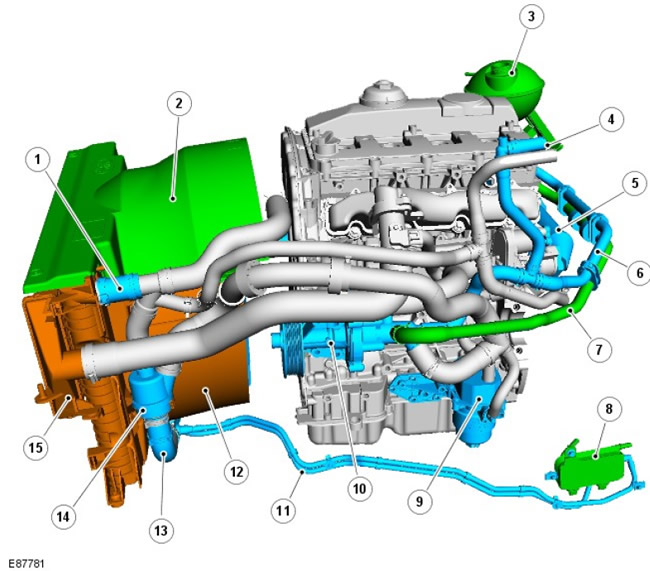
| Pos. | Spare part number | Name |
| 1 | - | Upper radiator hose |
| 2 | - | Upper shield of the cooling system fan |
| 3 | - | Expansion tank |
| 4 | - | Car Interior Heater Connections |
| 5 | - | Exhaust Gas Recirculation (EGR) Heat Exchanger |
| 6 | - | EGR Cooler Outlet Hose |
| 7 | - | Expansion tank hose |
| 8 | - | Fuel system radiator |
| 9 | - | Oil radiator |
| 10 | - | Cooling system pump |
| 11 | - | Fuel cooling system supply and return hoses |
| 12 | - | Lower shield of the cooling system fan |
| 13 | - | Lower radiator hose |
| 14 | - | Thermostat assembly |
| 15 | - | Intercooler |
Review
The cooling system is a bypass type system that ensures the circulation of coolant through the engine and the heater circuit with the thermostat closed. The main purpose of the engine cooling system is to maintain the optimum temperature in the cooling system when environmental conditions and the operation of the engine itself change. Other functions of the cooling system include heating the car interior and cooling the exhaust gas recirculation (EGR) system.
The cooling system consists of:
- Radiator
- Car interior heater
- EGR cooler
- Coolant pump
- Expansion tank
- Cooling system fan
- Connecting hoses and pipelines
Data taken from the website: www.lrman.ru
The coolant is circulated through the system by a centrifugal pump mounted in the front left side of the engine and driven by an additional poly V-belt. The cooling system pump circulates the coolant through the cylinder block and cylinder head, radiator, heater core and EGR cooler, which are connected by coolant pipes.
The thermostat is located in the lower manifold assembly on the inlet side of the cooling circuit; it provides constant control of the coolant temperature in the engine.
The horizontal flow radiator has an aluminum core and molded plastic tanks. The radiator tanks are equipped with brackets for mounting the fan shroud, intercooler and (if any) air conditioner condenser. The lower part of the radiator is mounted on rubber bushings, which rest on brackets fixed to the body side members. The upper part of the radiator is located in rubber bushings, which are fixed with brackets installed on the hood platform.
The air-to-air intercooler is located in front of the radiator and serves to cool the boost air coming from the turbocharger into the engine.
For more information, refer to the chapter: Distribution and filtration of intake air (303-12 Distribution and filtration of intake air - Diesel engine ID4 2.4L, Description and principle of operation).
The upper radiator hose connects to the coolant outlet pipe, which is bolted to the cylinder head. The upper hose has a connection for the heater core supply pipe. The lower radiator hose runs around the front of the engine and connects to the thermostat assembly.
The lower hose also has a return connection for the fuel cooling system. The supply pipe for the fuel cooling system is connected directly below the lower hose connection on the right side of the radiator.
The expansion tank is mounted on the right support cup of the suspension in the engine compartment. The expansion tank receives excess coolant that occurs due to expansion when the engine heats up, and releases the liquid into the cooling system when it cools down.
The EGR cooler is located in the coolant return line from the engine and upper hose. The fluid cools the exhaust gases as they return to the intake manifold, thereby reducing harmful emissions.
The heater radiator outlet hose has a built-in bleeder nipple for bleeding air when filling with coolant.
Comments on this article