Contents: Removal ⇩ Installation ⇩
Removal
1. Remove the rear wheels.
2. Using a suitable hose clamp, secure the flexible brake hose over the rear axle.
3. Remove the brake line from the rear brake caliper.
4. Cap the ends of the pipe to prevent dirt from entering.
5. Remove the pins and springs and take out the pads. If the pads are to be returned to their place, mark them so that they can be set in their original position during subsequent assembly.
6. Remove the two bolts and remove the caliper from the rear axle.
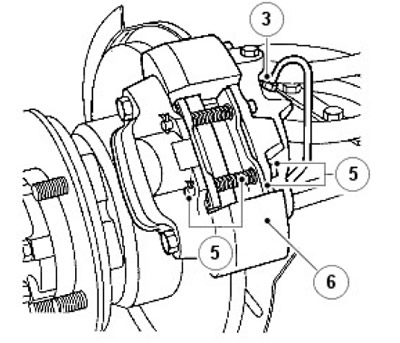
WARNING: Do not separate the caliper sections.
7. Clean the outer surfaces of the caliper with an aerosol brake cleaner.
8. CAREFULLY remove the pistons from the cylinders by applying air pressure to the brake fluid inlet port. It is unlikely that both pistons will be pushed out at the same time; adjust the force using a suitable wooden block inserted between the two pistons.
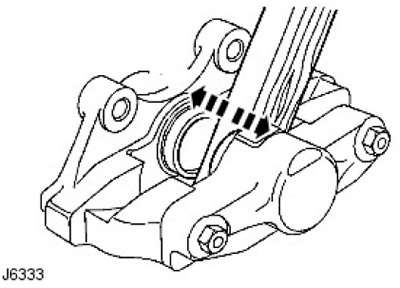
9. Remove the pistons and mark each piston and its corresponding cylinder.
10. Remove the boot holder by inserting a blunt screwdriver between the holder and the boot and carefully prying the holder away from the cylinder inlet.
11. Being careful not to damage the seal grooves, remove the boot and oil seal.
Installation
1. Clean the bores, pistons and, especially, the seal grooves, using only clean brake fluid. If the caliper or pistons show signs of corrosion or are not in perfect condition, new elements should be installed.
2. Apply brake fluid to the new seals. Insert the seals into the cylinder grooves. After the seals are seated, the edge that is located farthest from the cylinder entrance will feel raised to the touch.
3. Apply brake fluid to the pistons. Insert them into the cylinders without tilting them. Do not tilt the pistons when installing, leave them protruding 8 mm from the cylinders.
4. Apply brake fluid to the new boots and install them on the new holders. Slide the assembled elements on (compaction must come first) onto the protruding piston in the recesses in the cylinder.
5. Using a piston clamp (special tool LRT-70-500) reinstall the boot holder and piston. Follow the same procedure to install the pistons and seals on the outside.
6. Install the calipers and pads on the vehicle.
7. Install the caliper on the axle. Tighten the two bolts evenly to 82 Nm.
8. Connect the brake pipe to the caliper. Tighten to 15 Nm.
9. Remove the clamp from the flexible brake hose.
10. On vehicles prior to 2002 model year, install the pads and springs, secure with new pins and flare the pin ends or install new cotter pins (depending on the model).
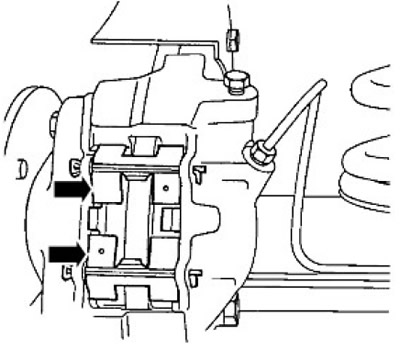
11.
NOTE: On 2002 and later model year vehicles, the rear pads have chamfers on the leading and trailing edges.
On vehicles from model year 2002 onwards, check that the adjusting shim is installed correctly (see fig.).
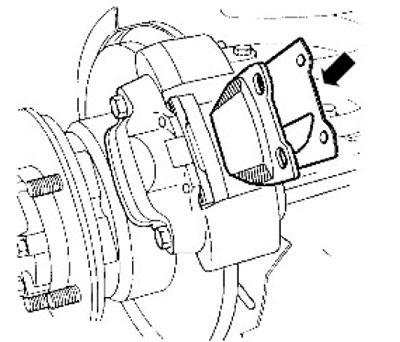
12. Remove air from the brake system.
For more information, refer to the chapter: Bleeding the Brake System (206-00 Brake System - General Information, General Procedures).
13. Press the brake pedal all the way down several times until the brake pads are in a stable position.
14. Install the wheels, remove the supports from under the bridge. Tighten the wheel nuts to the prescribed torque:
- 1. Wheels with light alloy wheels - 130 Nm.
- 2. Wheels with steel disks - 100 Nm.
- 3. Wheels with increased performance characteristics - 170 Nm
15. Perform a road test of the vehicle. Keep in mind that new brake pads must be run-in for several hundred kilometers, and only after that the brakes will work with maximum efficiency.
Comments on this article