GENERAL INFORMATION, Precautions when working with electrical equipment.
Pressure test
1. Put the car on a lift.
2. Disconnect the negative plug from the storage battery.
3. Pump out a working liquid from a reservoir of the hydraulic booster.
4. Remove the protective shield.
EXTERIOR PARTS, REPAIR WORKS, Engine protection - front.
5. Place a suitable container under the power steering pump.
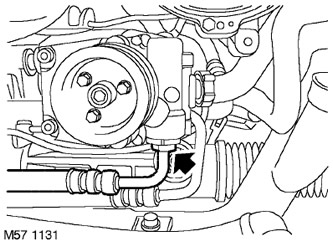
6. Loosen the union nut, disconnect the high pressure pipe from the power steering pump and separate the sealing ring.
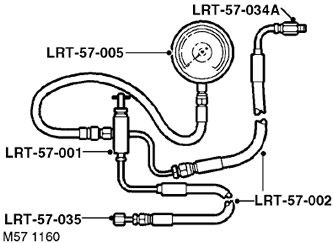
7. Install the adapter LRT-57-034A on the high pressure fitting of the power steering pump.
8. Connect adapter LRT-57-035 to existing high pressure piping.
9. Attach tubing LRT-57-002 to each adapter.
10. Connect pressure gauge LRT-57-005 to test valve LRT-57-001.
11. Connect hoses LRT-57-002 to valve LRT-57-001 and tighten connections.
12. Attach the negative plug to the storage battery.
13. Check for fluid leaks from the steering system and test equipment connections.
14. During testing, maintain the required level of working fluid in the hydraulic booster reservoir.
15. Open the test valve and start the engine.
16. With the engine idling, slowly turn the steering wheel to its full position and hold it.
17. Repeat the operation for the other end position.
18. Record the system pressure readings.
19. With the engine idling, release the steering wheel. The pressure in the system must be less than 7 bar.
20. If the pressure is higher than specified, this indicates a malfunction.
21. To determine if there is a problem with the pump or steering assembly, close the valve for a maximum of 5 seconds.
WARNING: If the valve is kept closed for longer, the power steering pump may fail.
22. If the pressure values are outside the limits specified in General Information, replace the power steering pump.
23. If the maximum pressure in the hydraulic system is within the norm, the malfunction may be in the steering gear assembly.
24. Complete the test, stop the engine, disconnect "negative" wire from the battery and pump out excess working fluid from the hydraulic booster reservoir.
25. Remove the test equipment.
26. Clean the power steering pump and pipe connections.
27. Install a new sealing ring on the end of the pipeline, connect the pipeline to the power steering pump and tighten the high pressure union nut to a torque of 25 Nm.
28. Remove the container from under the power steering pump.
29. Empty the container from the working fluid and clean the container.
30. Connect the negative terminal to the battery.
31. Add working fluid to the required level and remove air from the system.
STEERING, ADJUSTMENTS, Power Steering (PAS) - removal of air.
32. Replace the protective shield.
EXTERIOR PARTS, REPAIR WORKS, Engine protection - front.
Comments on this article