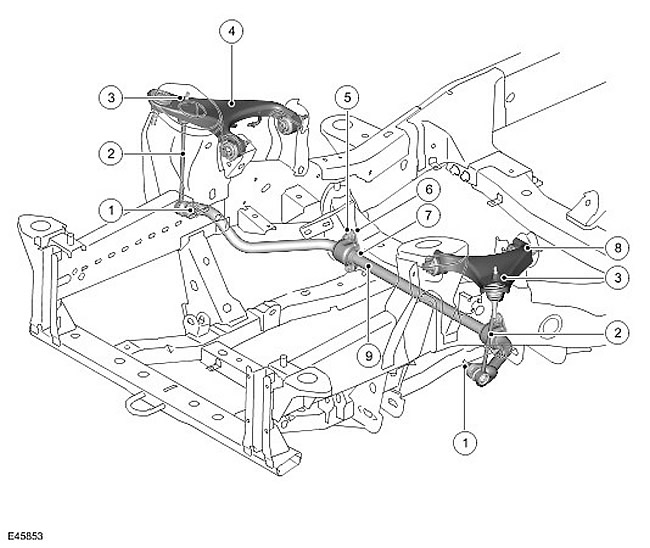
| Item name | Spare part catalog number | Description |
| 1 | - | Nut for fastening the strut to the stabilizer (2 pcs.) |
| 2 | - | Rack (2 pcs.) |
| 3 | - | Nut for fastening the rack to the upper control arm (2 pcs.) |
| 4 | - | Right Upper Control Arm |
| 5 | - | Nut (4 pcs.) |
| 6 | - | Bracket (2 pcs.) |
| 7 | - | Bushing (2 pcs.) |
| 8 | - | Left Upper Control Arm |
| 9 | - | Stabilizer |
The stabilizer is made from a solid induction-hardened spring steel rod. The shock absorber is actuated through a pair of struts from their attachment to the upper control arm.
The stabilizer is attached to the front surface of the front chassis crossmember. The stabilizer is attached to the crossmember by means of two bushings with Teflon inserts. Brackets pressed into the bushings are attached to the crossmember with nuts, which are screwed onto the crossmember studs. The stabilizer has corrugated "stop" rings pressed from the inside of the bushings. The rings prevent lateral movement of the stabilizer.
The ends of the stabilizer are connected to the upper control arms by means of struts. This allows the stabilizer to move together with the wheels, providing maximum efficiency. Each strut has ball joints at both ends. The upper ball joint is connected to the strut parallel to its axis. The ball joint is installed in a hole in the upper control arm and secured with a self-locking nut. The lower ball joint is connected to the strut at an angle of 90 degrees to its axis. The ball joint is installed in a hole in the end of the stabilizer and secured with a self-locking nut. The struts do not differ by sides and can be installed on either side of the stabilizer.
Comments on this article