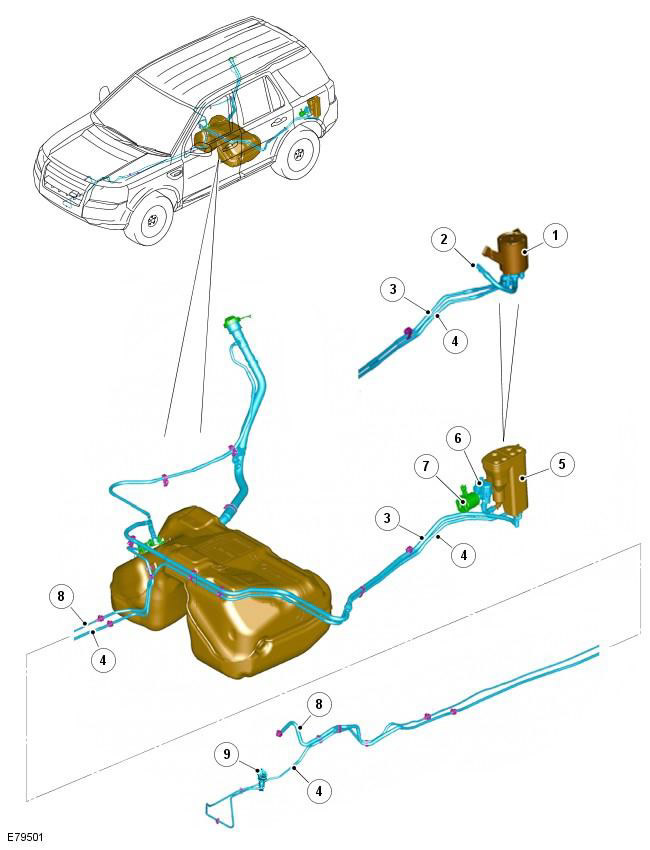
| Pos. | Spare part number | Name |
| 1 | - | Fuel Evaporative Recovery System Canister - Rest of the World (ROW) derivative |
| 2 | - | Ventilation duct and filter |
| 3 | - | Vapor line to fuel vapor control system canister |
| 4 | - | Vapor bleed line to intake manifold |
| 5 | - | Fuel Evaporative Control System Canister - North American Option (NAS) |
| 6 | - | Fuel tank leak monitoring pump |
| 7 | - | Fuel Tank Leak Monitoring Pump Filter |
| 8 | - | Fuel supply line to the engine |
| 9 | - | Fuel Evaporative Canister Purge Valve |
The Evaporative Emissions (EVAP) system reduces the amount of hydrocarbons released into the atmosphere from the fuel tank. The system consists of a charcoal canister, a purge valve, vent lines and hoses.
Fuel vapors are formed in the fuel tank. The higher the fuel temperature, the more vapors are formed. Fuel vapors freely enter the carbon adsorber through the fuel tank ventilation system. The ventilation system includes safety flaps that prevent fuel from spilling when the car turns over, and a liquid fuel phase separator installed inside the fuel tank and connected to the outside environment via a ventilation hose. The ventilation line allows fuel vapors to flow into the adsorber.
On North American (NAS) vehicles, fuel vapor displaced from the tank during refueling is freely passed into the charcoal canister.
On all other vehicles except the NAS standard, fuel vapors displaced from the tank during refueling cannot enter the carbon canister, but are freely released into the atmosphere through the filler neck.
Fuel vapors entering the adsorber are absorbed by activated carbon and remain in it. Since the capacity of the carbon adsorber is limited, it must be purged. Purging is performed with the engine running, in which fuel vapors are burned.
Comments on this article