Contents: CAN bus messages ⇩ Gear position sensor (only for…⇩ Output shaft speed sensor for manual…⇩ Range selection switch ⇩ Selected range sensor ⇩
The following signals are received by the transfer case control module:
- Range Select Switch Signal
- Selected range sensor signal
- Transfer case drive motor temperature signal
- Transfer case drive motor position sensor signal
- CAN bus messages
- Gear Position Sensor Signal (only for manual transmission)
- Gearbox Output Shaft Speed Sensor Signal (only for manual transmission).
CAN bus messages
The CAN bus is a high-speed data network that links various vehicle control modules. The CAN network control modules exchange multiple messages, allowing for more complex control without increasing system complexity. To improve communication efficiency, data is transmitted in packets and ranked according to the urgency and importance of the message. The CAN bus is a two-wire line, with the wires twisted together to reduce electromagnetic interference (noise) generated by the bus messages. For more information, refer to Communications Network (418-00)
The transfer case control module is connected to the CAN bus and controls the transfer case operation using CAN messages from other control units on the network. The main data sent to the transfer case control module are: wheel speeds, vehicle acceleration, engine torque and speed, current gear for automatic transmission, temperature information, vehicle configuration data, final drive ratios and Terrain Response™ mode data.
The following symptoms may indicate a CAN bus malfunction:
- Inability to switch from high range to low range or vice versa
- Low range indicator lamp on instrument cluster not working
- Warning messages or indicators displayed on the instrument cluster
Gear position sensor (only for manual transmission)
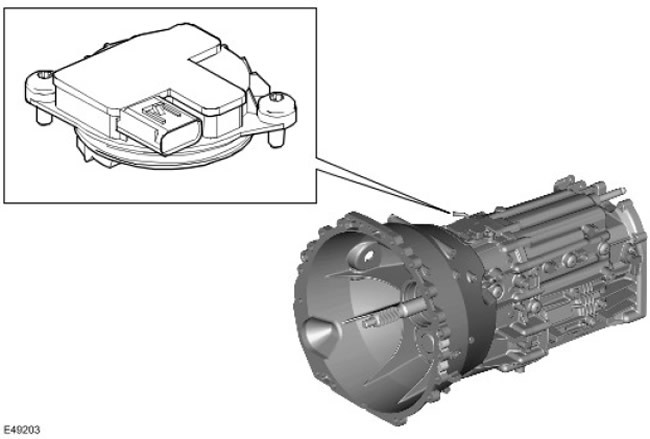
The transfer case control module determines the current gear of the transmission based on position information from the gear position sensor of the manual transmission. This information is distributed over the CAN bus for display in the instrument cluster and use by other vehicle systems. Vehicles equipped with an automatic transmission use similar messages distributed by the transmission control module (TCM). Vehicles equipped with a manual transmission have a tuning function that compares the position information transmitted by the sensor with the gear ratio calculated from the ratio of the engine crankshaft speed to the transmission output shaft speed. The transmission tuning is performed after the vehicle is assembled. If a new transmission is installed during the operation of the vehicle, the tuning algorithm must ensure tuning to the characteristics of the new transmission.
The instrument cluster displays the selected gear as determined by the transfer case. The transfer case also uses this information before attempting to shift range to confirm that the vehicle is in neutral. For more information, refer to Manual Transmission (308-03)
Output shaft speed sensor for manual transmission
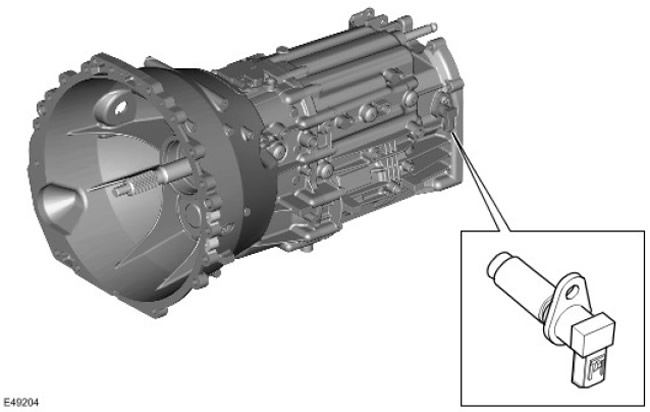
The output shaft speed sensor is located at the rear of the transmission and measures the speed of the transmission output shaft.
The transfer case design allows for range shifting while the vehicle is moving, ensuring that the transmission shaft speed matches the specified threshold values determined by the control module. Based on the transmission output shaft speed and the vehicle wheel speeds, the control module calculates the optimum synchronization time. For more information, refer to Manual Transmission (308-03)
Range selection switch
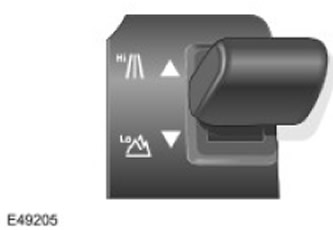
The range selector switch is located on the center console behind the main transmission shift lever. The switch is a 3-position, momentary switch with a center spring. The lever is moved forward to select high range, and rearward to select low range.
The switch has a housing with a sliding contact inside. When the switch is moved to the high or low range position, a short-term connection to the 12 V circuit occurs via one of two microswitches located at either end of the range selector switch. The microswitches correspond to the high and low range positions.
The transfer case control module receives this momentary signal and selects the desired range.
When the switch is released, the spring moves the selector lever to the center position.
Selected range sensor
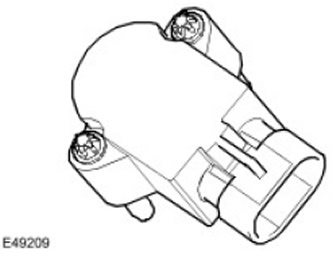
The range selector sensor converts the rotation of the range selector fork into a PWM signal. Each range has its own PWM signal. The transfer case control module checks this signal and informs the driver via the instrument cluster and the range selector switch LEDs whether the range change is complete or not.
The selected range sensor is connected to the transfer case control module via a three-pin connector.
Comments on this article