Contents: CAN bus messages ⇩ Key lock solenoid ⇩ LED of the selected range ⇩ Transfer case electric motor ⇩ Electromagnet ⇩ Status indication ⇩
The transfer case control module transmits the following signals:
- CAN bus messages
- Signal for key lock solenoid
- Signal for the LED of the selected range
- Signal for transfer case electric motor
- Signal for electromagnetic valve
CAN bus messages
The transfer case control module sends transfer case status messages to other control modules on the network via the CAN bus. The main data sent by the transfer case control module are: current range, clutch torque and default mode.
Key lock solenoid
The transfer case control module can send a signal to the key interlock solenoid. This signal locks the key in the ignition lock cylinder, preventing it from being removed unless the automatic transmission is in the Park position.
LED of the selected range
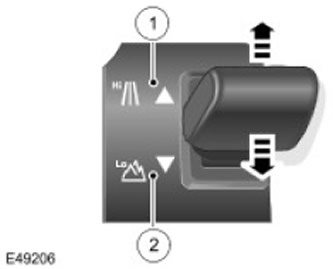
| Item name | Spare part catalog number | Description |
| 1 | - | High Range LED |
| 2 | - | Low Range LED |
The control module is responsible for turning on 2 LEDs of the selected range, located next to the range selector lever. One LED serves as an indicator of the high range, and the other - of the low range.
After selecting a range, the corresponding LED starts to light continuously.
If the range is changed, the current range LED remains on until the new range is set.
At the beginning of the range switching (that is, subject to the requirements for speed and neutral position) the LED of the new range starts to blink. The LED of the new range stops blinking and starts to light constantly at the same time as the LED of the previous range turns off.
The blinking frequency is 2 Hz with a duty cycle of 50%.
The LEDs have 2 brightness levels: high when the car lights are off and low when the lights are on. If both LEDs are flashing at 0.5Hz, this indicates either a faulty transfer case or that the transfer case range is not determined and calibration may be required.
Transfer case electric motor
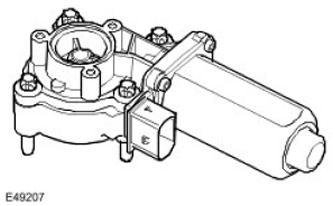
The transfer case electric motor provides range switching and operates the multi-plate clutch. The electric motor is located in the rear crankcase assembly and is secured with 4 bolts.
It is a DC electric motor with pulse-width regulation and a built-in worm gearbox. The electric motor is connected to the transfer case control module via an 8-pin connector; power is supplied to the electric motor via 2 large diameter wires through the electric motor connector. An internal position sensor monitors the rotation of the electric motor.
There is a temperature sensor in the electric motor housing.
Electromagnet
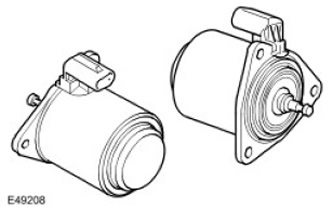
The electromagnet switches the power flow in the drive system, setting the range switching mode or the clutch control mode. When the electromagnet is turned on, the electromagnet rod extends, and the clutch control mode is set. When the electromagnet is turned off, the internal spring retracts the electromagnet rod, and the range switching mode is set.
NOTE: To replace the solenoid during operation, it is necessary to apply current to it using a diagnostic tool.
The solenoid is connected to the transfer case control module via a 2-pin connector.
Status indication
Instrument panel
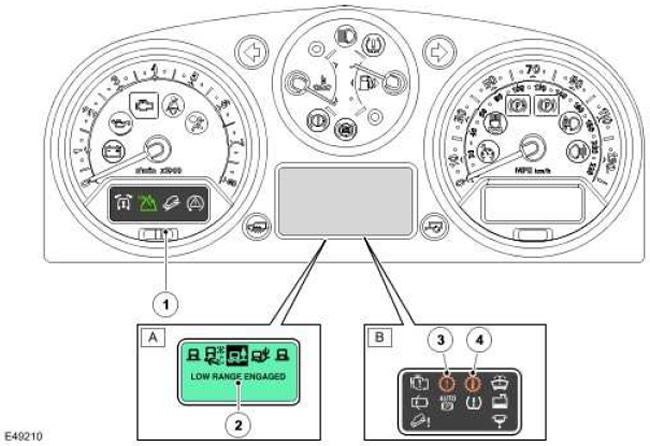
| Item name | Spare part catalog number | Description |
| A | - | Upper row instrument cluster |
| B | - | Lower row instrument cluster |
| 1 | - | Low range on indicator |
| 2 | - | Message Center Text Message Field (for top row only) |
| 3 | - | Propeller shaft malfunction indicator light |
| 4 | Cardan transmission overheating indicator |
In vehicles with a high-row instrument cluster, there is one low-range indicator. This indicator is a mountain symbol and works as follows:
- Indicator on = low range
- Indicator off = high range
- Indicator flashing = range switching in progress / range not defined / fault
Vehicles with a top-row instrument cluster also have a text message display area for the message center, informing the driver of any faults in the transfer case.
The table below shows the messages that may appear in the upper instrument cluster message center display that relate to the transfer case:
| Message | Description | Sound alarm |
| 'LOW RANGE ENGAGED' (low range enabled) | After receiving a range change request, the transfer case low range is engaged | Single beep |
| 'HIGH RANGE ENGAGED' (high range enabled) | After receiving a range change request, the transfer case high range is engaged | Single beep |
| 'SPEED TOO HIGH FOR RANGE CHANGE' (too high speed to change range) | Range change request issued when vehicle speed is too high | Single beep |
| 'SELECT NEUTRAL FOR RANGE CHANGE' (select neutral position to change range) | A range change request was issued but the lever is not in neutral position. | Single beep |
| 'APPLY HANDBRAKE' (PARK BRAKE in the USA and Canada) (apply the brake) | This message alerts the driver that the automatic transmission cannot be parked because the transfer case range is not selected. The transfer case control module has stopped communicating on the CAN bus during a range change or in neutral, making it impossible to park the automatic transmission. | Single beep per second for 3 seconds |
| 'TRANSMISSION RANGE CHANGE NOT AVAILABLE' (changing ranges in the gearbox is not possible) | Transfer case detected fault preventing range shifting. Control unit shut down due to overheating | Single beep |
| 'CENTRE DIFF OVER TEMP REDUCE SPEED' (overheating of the center differential, reduce speed) | The temperature of the center differential is approaching the critical value | Single beep |
| 'CENTRE DIFF FAULT - TRACTION REDUCED' (interaxle differential malfunction - traction force reduced) | Malfunction of the center differential - the differential continues to operate as an open differential | Single beep |
| 'CENTRE DIFF FAULT - TRACTION REDUCED' (interaxle differential malfunction - traction force reduced) | The transfer case control module has stopped transmitting data on the CAN bus and the center differential defaults to open | Single beep |
The transfer case control module receives gear position signals from the manual transmission gear position sensor and distributes status data on the CAN bus. This data is displayed on the odometer display similar to how automatic transmission models display gear information.
| Odometer display | Description |
| N | The transmission mechanism is in neutral position |
| 1 | The transmission mechanism is in first gear position |
| 2 | The transmission mechanism is in the second gear position |
| 3 | The transmission mechanism is in the third gear position |
| 4 | The transmission mechanism is in fourth gear position |
| 5 | The transmission mechanism is in the fifth gear position |
| 6 | The transmission mechanism is in the sixth gear position |
| R | The transmission mechanism is in the reverse gear position (for Japan only) |
| Blank display | Transmission mechanism between neutral and gear positions |
| E | Gearbox gear position sensor is faulty |
In vehicles with a lower row instrument cluster, a status lamp is used instead of a message center, which operates on the following principle:
- Yellow color - overheating
- Red color - malfunction, stop the car
| Indication | Description |
| OFF | The transfer case operates at normal operating temperature. |
| YELLOW WARNING LAMP IS ON | Transfer case temperature is approaching overheating threshold |
| YELLOW WARNING LAMP IS ON | A fault has been detected in the transfer case that affects the range shift function. (the current range is still maintained), or the operation of the center differential is disrupted. |
| RED WARNING LAMP IS ON | A fault has been detected in the transfer case that prevents the gearbox from engaging in parking lock due to range uncertainty OR the operation of the center differential is impaired with a non-zero locking torque |
| YELLOW WARNING LAMP IS ON | The transfer case control module has stopped transmitting data on the CAN bus and the center differential defaults to open |
| RED WARNING LAMP IS ON | The transfer case control module has stopped transmitting data on the CAN bus during a range change or in neutral, causing the automatic transmission to not engage the parking lock. |
Comments on this article