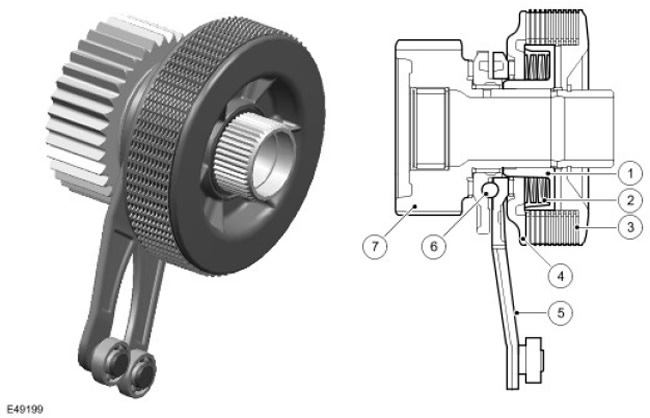
| Item name | Spare part catalog number | Description |
| 1 | - | Clutch hub |
| 2 | - | Disc springs |
| 3 | - | Clutch discs |
| 4 | - | Clutch piston |
| 5 | - | Electric motor levers |
| 6 | - | Ball locking mechanism |
| 7 | - | Star |
The multi-plate clutches of the center and rear differentials operate on the same principle. The multi-plate clutch prevents excessive differential slippage and, as a result, maximizes the vehicle's traction. This is fundamentally different from traction control with braking, which can only neutralize differential slippage when it occurs.
A certain amount of differential slip is necessary when cornering. It allows the vehicle to maintain stability while operating the anti-lock braking system (ABS). The transfer case control module receives commands generated by the driver using the vehicle's main controls and automatically sets the required slip moment for the differentials. The system is fully automated and does not require any special actions from the driver.
The multi-plate clutch actively controls the transmission of torque in the center differential and optimizes the distribution of moments in the cardan transmission. The clutch redistributes the torque of the gearbox to the axle and wheels with greater traction and prevents wheels with less traction from slipping.
The assembled multi-plate clutch consists of a sprocket (7) connected to the front axle gear of the differential, electric motor levers (5) with a ball locking mechanism (6), a clutch hub (1), which serves as a support for the clutch discs (3), a clutch piston (4), which provides friction between the clutch discs, and a pack of disc springs (2), which return the clutch piston to its original position.
One set of friction discs is connected to the clutch hub; another set - with a multi-plate clutch housing, which is welded to the center differential housing.
Engaging the multi-plate clutch
Transfer case electric motor levers in initial position, multi-plate clutch disengaged
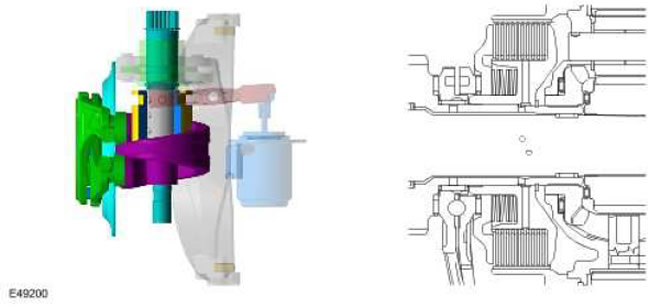
Transfer case electric motor in end position, multi-plate clutch engaged
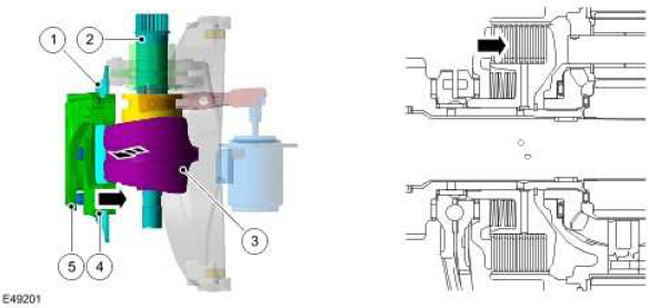
| Item name | Spare part catalog number | Description |
| 1 | - | Clutch piston |
| 2 | - | Electric motor shaft |
| 3 | - | Clutch slave disc |
| 4 | - | Electric motor levers |
| 5 | - | Ball locking mechanism |
(The full version is available on the website: www.lrman.ru)
When the driven clutch disc (3) rotates, the electric motor shaft (2) rotates the electric motor levers (4) relative to each other. This relative movement acts on the 5 balls (5) of the locking mechanism between the 2 levers, causing a certain axial movement. The axial movement causes the clutch piston (1) to create friction between the discs secured to the clutch hub and the discs supported by the clutch housing on the differential cup. The friction force prevents the differential from rotating, causing the differential cup and the half-axle gear of the front differential to lock.
Comments on this article