Transfer case housings
The front and rear crankcases are assembled and cast from aluminum.
Front crankcase assembly
The front crankcase assembly holds the primary shaft and front output flange bearings. It also has threaded holes for installing the chassis support bushing, 2 lifting eyes, and a breather cartridge for the transfer case breather tube. The breather tube balances atmospheric pressure and the internal pressure of the transfer case.
Rear crankcase assembly
The rear crankcase assembly houses the rear output flange bearing, the transfer case electric motor, and the oil filler and drain plugs. Ribs are cast on the rear crankcase to improve heat dissipation. In addition, the gearbox number is stamped on the rear crankcase.
Oil pump
The oil pump is located in the front crankcase and provides lubrication to the bearings and rotating parts through cross-drilled holes in the input shaft. A flat sectioned clutch on the input shaft drives the pump rotor, while the pump stator is fixed to the front crankcase assembly. A tube is connected to the pump, leading to a low-intensity suction zone at the bottom of the 2 crankcase assemblies. A magnet is located in the pump suction zone to collect metal particles.
[The publication was copied from a web resource: LRman.ru]
Chain drive
The chain drive transmits torque from the center differential to the front output flange. A 3/8-inch pitch chain connects the transfer case input shaft sprocket to the sprocket on the front output flange. Since both sprockets have the same number of teeth, the rotational speeds of these sprockets are the same.
Transfer case electric motor
High/low range switching and differential locking device and torque distribution change (multi-plate clutch) controlled by one electric motor. The motor's electromagnet switches between the two functions, and the motor itself creates torque to perform them.
Position of the transfer case electric motor in clutch control mode
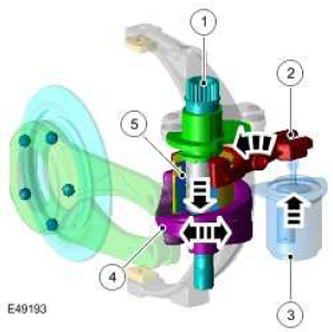
| Item name | Spare part catalog number | Description |
| 1 | - | Electric motor shaft |
| 2 | - | Electromagnet switching fork |
| 3 | - | Electromagnet |
| 4 | - | Clutch slave disc |
| 5 | - | Shift bushing |
To engage the multi-plate clutch, the transfer case control module supplies power to the electromagnet (3). The electromagnet rod rotates the electromagnet shift fork (2), which engages the shift sleeve (5) with the teeth on the driven clutch disc (4). Rotation of the electric motor shaft (1) is transmitted to the driven clutch disc via the shift sleeve.
This state corresponds to the normal operation mode of the transfer case. In this position, the range switching function is disabled and mechanically locked.
Position of the transfer case electric motor in range switching mode
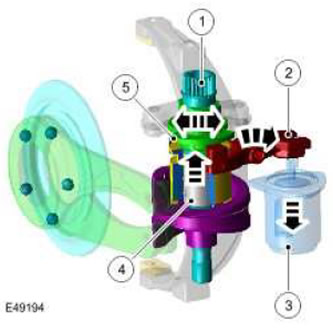
| Item name | Spare part catalog number | Description |
| 1 | - | Electric motor shaft |
| 2 | - | Electromagnet switching fork |
| 3 | - | Electromagnet |
| 4 | - | Shift bushing |
| 5 | - | Drive cam |
To shift the transfer case range, the transfer case control module turns off the power to the solenoid (3). The solenoid spring retracts the solenoid rod and rotates the solenoid shift fork (2). The fork engages the shift sleeve (4) with the teeth on the range shift actuator cam (5). Rotation of the electric motor shaft (1) is transmitted to the cam.
In this position, the multi-plate clutch is disengaged and the differential lock with torque redistribution is not possible. After the range shift is completed, the system returns to the clutch control mode. In the event of a fault in the electrical circuit, the electric motor will remain in this position by default.
Comments on this article