car logo Ford
car logo Volkswagen
car logo BMW
car logo Opel
car logo Audi
car logo Toyota
car logo Peugeot
English Русский
Български
Беларускі
Український
Српски
Hrvatski
Română
Polski
Slovenský
Magyar


Main
Freelander
Discovery
Range Rover
Defender
Contacts
Articles

Rear side glass — removal and installation (Freelander 1)

 
  • Main
  • Freelander
  • Freelander 1
  • Body and coating
  • Interior trim details
  • Rear side glass — removal and installation
 
        0  
Contents: Dismantling ⇩ Installation ⇩
The following equipment is required: Cutting wire with handles, windshield repair kit, sealant gun and suction cups.


Wear protective gloves when working with glass, solvents and primers.


Before performing glass removal and installation work, wear safety glasses.


Dismantling


1. Remove the upper luggage compartment trim panel.

INTERIOR TRIM PARTS, REPAIR WORK, Upper decorative panel of the luggage compartment of a 5-door car.


2. Cover the interior elements of the car with protective covers.
2. Cover the interior elements of the car with protective covers.


3. Cut the seal with a knife at the base of the rear 'D' pillar.

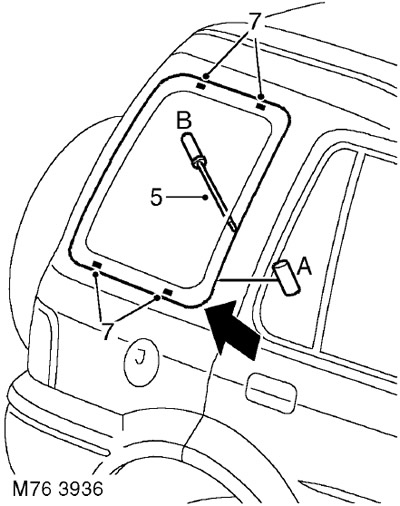
4. Pass the cutting wire through the cut made by the knife and fix the wire to the handles as shown in the figure. The length of the wire between the handles should be approximately 200 mm.

5. With the help of a partner, insert the tube of handle B between the glass and the body in front of the cut and carefully cut the seal in one motion by pulling handle A from the outside. Hold the glass during the last stage of cutting the seal.

If using multi-strand wire, you can use sawing motions when cutting the thickenings of the seal located in the corners of the glass.


Using a sawing motion when cutting single-strand wire can cause the wire to overheat and break.


6. Place the suction cups on the glass and remove it.

Place the glass on felt-covered supports. Do not place the glass on its edge. A chip on the edge of the glass may cause a crack.


7. Assemble 4 spacers.

Installation

Installation


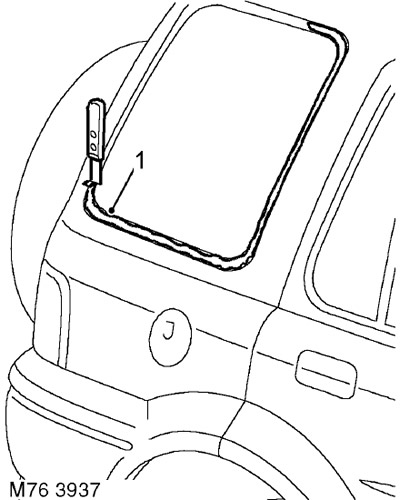
1. Carefully remove any remaining sealant from the windshield frame to obtain a smooth surface.

2. Remove any remaining debris with a vacuum cleaner.

3. If the glass is not being replaced: Carefully remove any remaining sealant from the glass to obtain a smooth surface. Do not damage the tinting strip.

4. Install rubber struts on the body.

5. With the help of a partner, install the glass on the body.

6. To make installation easier, make marks with adhesive tape.

7. Remove the glass and set it aside.

8. Clean the windshield frame and windshield edges with solvent.

Do not touch cleaned or etched surfaces with your hands.


9. Apply etching primer to unpainted surfaces of the windshield frame.

10. Apply glue to the glass and let it dry.

11. Apply primer to the etched surfaces of the windshield frame.


12. Apply the activating agent over the old sealant remaining on the frame.

13. Allow the activating reagent to dry.

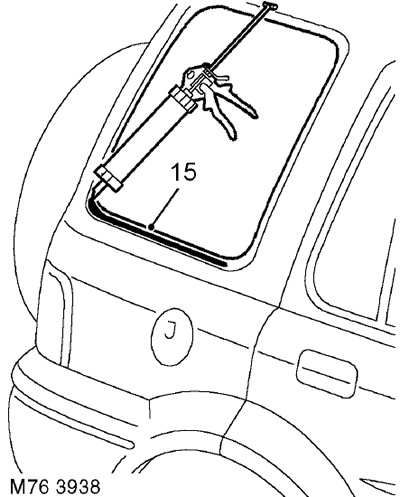
14. Install the pre-cut tip onto the sealant cartridge, remove the cap and scrape off any hardened residue. Install the cartridge onto the sealant gun.

If necessary, change the shape of the tip to obtain the required cross-section of the sealant layer.

If necessary, change the shape of the tip to obtain the required cross-section of the sealant layer.


15. Apply the sealant to the frame in an even layer, as shown in the picture. In the corners, the sealant layer should be slightly thicker.

16. Avoid allowing gaps or air bubbles to form in the sealant.

17. Install the glass on the body and align its position according to the marks.

18. Press the glass lightly to ensure a tight bond with the sealant.

19. Fix the glass with tape until the sealant dries.

20. Remove the protective covers and any remaining tape.

21. Check the seal for leaks. If necessary, apply additional sealant. If water is used to check for leaks, allow the seal to dry before checking. Spray the peripheral surface of the glass with water and check if water leaks into the passenger compartment. Mark the leaks. If necessary, apply an additional layer of sealant after it has completely dried.


22. Install the upper luggage compartment trim panel.

INTERIOR TRIM PARTS, REPAIR WORK, Upper decorative panel of the luggage compartment of a 5-door car.


This article is available at russian, bulgarian, belarusian, ukrainian, serbian, croatian, romanian, polish, slovak, hungarian
Article review: Konstantin Nazarov


Previous articles
Sun visor — removal and installation
Lower decorative panel of the luggage compartment of a 3-door car
Lower decorative panel of the luggage compartment of a 5-door car
Upper decorative panel of the luggage compartment of a 3-door car
Upper decorative panel of the luggage compartment of a 5-door car
Replacing the upper decorative panel of the front A-pillar
Replacing the upper decorative panel of the B/C pillar
Lower decorative panel of the middle B-pillar of a 5-door car

Current article
Rear side glass — removal and installation


Similar articles from Land Rover repair manuals:
• Rear side window glass Discovery 3 (2004-2009)
• Rear (fifth) door glass Discovery 1 (1989-1998)
• Rear door glass Range Rover 3 (2001-2012)
• The trim panel of the rear side of the body Defender 2007+ (2007-2016)

Comments on this article


No comments yet


How much will 19 + 15 =


Freelander 2 
  • General information
  • Using the manual
  • Repair technique
  • Precautionary measures
  • Road test
  • Fault codes
  • Identification codes
  • Jacking and lifting
  • Maintenance - Diesel
  • Maintenance - petrol
  • Chassis
  • Suspension
  • Front suspension
  • Rear suspension
  • Wheels and tires
  • Terrain response
  • Transmission system
  • Cardan shaft
  • Rear drive axle
  • Rear axle shafts
  • Front axle shafts
  • Brake system
  • Parking brake
  • Hydraulic brake
  • Brake booster
  • Anti-lock braking system
  • Exchange rate stability
  • Steering
  • Steering column
  • Power unit
  • Engine device
  • Engine repair
  • Description of the cooling system
  • Cooling system repair
  • Fuel supply
  • Drive units
  • Launch system
  • Ignition system
  • Exhaust toxicity
  • Air filtration
  • Fuel vapor control
  • Electronic control part
  • Automatic gearbox
  • Gearbox cooling
  • Automatic transmission controls
  • Mechanical transmission
  • Transfer case
  • Exhaust system
  • Fuel tank and lines
  • Speed control
  • Electrical equipment
  • Climate control system
  • Climate control
  • Additional climate control
  • Instrument panel
  • Sound signal
  • Information and messages
  • Assistance with parking
  • Battery and alternator
  • Information and entertainment
  • Outdoor Lighting
  • Interior lighting
  • Communication network
  • Wiring harnesses
  • Anti-theft system
  • Multifunctional modules
  • Body and coating
  • Body front panels
  • Lockable body parts
  • Interior trim
  • Rear view mirrors
  • Car seats
  • Glass, frames and mechanisms
  • Instrument panel and console
  • Handles, locks, latches
  • Windshield wipers and washers
  • Sunroof
  • Bumpers
  • Seat belt system
  • Restraint system
  • Body repairs
  • Front end repairs
  • Roof element repairs
  • Side panel repairs
  • Tailgate repairs
  • Subframe and mounts

Freelander 1 
  • General information
  • Using the manual
  • Precautionary measures
  • Technique
  • Specifications
  • Connection tightening torques
  • Maintenance
  • Power unit
  • Diesel engine Td4
  • Petrol engine K1.8
  • Piston group K1.8
  • KV6 petrol engine
  • Piston group KV6
  • Decreased toxicity
  • Motor control EDC
  • Engine management MEMS
  • Motor control Siemens
  • Fuel supply diesel Td4
  • Fuel supply for K1.8 engine
  • Fuel supply of KV6 engine
  • Cooling diesel Td4
  • Engine cooling K1.8
  • Engine cooling KV6
  • Exhaust system Td4
  • Exhaust system K1.8
  • Exhaust system KV6
  • Clutch
  • Mechanical transmission
  • Transfer case
  • Automatic gearbox
  • Chassis
  • Drive shafts
  • Rear axle and final drive
  • Steering
  • Front suspension
  • Rear suspension
  • Brake system
  • Body and coating
  • Passive safety
  • Doors, locks and glass
  • Exterior body parts
  • Interior trim details
  • Seats
  • Roof hatch
  • Roof
  • Body geometry
  • Body parts repair
  • Sealing and corrosion
  • Electrical equipment
  • Heating and ventilation
  • Air conditioning
  • Windshield wipers and washers
  • Starting engine and charging
  • Lighting and headlights
  • Control modules
  • Safety system
  • Window management
  • Entertainment systems
  • Wiring harnesses
  • Governing bodies
  • Devices


LRman.ru © 2013-2026 | Mobile version | Free Lander | Discovery | Range Rover | Defender | Contacts | | Sitemap |
Car repair and service instructions Land Rover: Freelander, Discovery, Range Rover, Defender
We use cookies to make pages load faster and provide a more user-friendly experience 🍪