car logo Ford
car logo Volkswagen
car logo BMW
car logo Opel
car logo Audi
car logo Toyota
car logo Peugeot
English Русский
Български
Беларускі
Український
Српски
Hrvatski
Română
Polski
Slovenský
Magyar


Main
Freelander
Discovery
Range Rover
Defender
Contacts
Articles

Designation of nuts (Freelander 1)

 
  • Main
  • Freelander
  • Freelander 1
  • General information
  • Technique
  • Designation of nuts
 
        1  
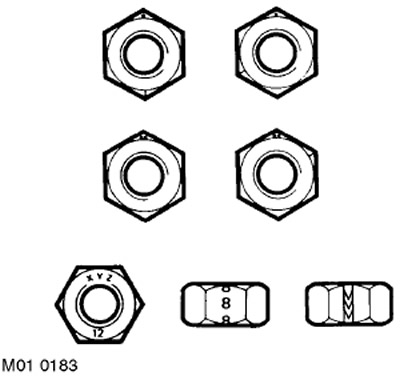
Nuts with metric ISO threads and strength index 8, 12 or 14 are designated by applying the index to one of the ends of the nut or to one of the hexagon faces. Some nuts with strength index 4, 5 or 6 also have a strength index designation. Some nuts may be designated by the symbol "M" on the end opposite the end with the strength index. This symbol designates metric threads.

Nuts with metric ISO threads and strength index 8, 12 or 14 are designated by applying the index to…


Instead of indicating the strength index, the so-called "clock" method of indicating the strength index is sometimes used. A mark is applied to the outer chamfer or end face of the nut, which corresponds to the readings of the clock hands. The "clock" readings are the designation of the strength index.

A dot is used to indicate the 12 o'clock mark, and a notch is used to indicate the movement of the watch (the value of the strength index). If the strength index is greater than 12, then a double dot is used to indicate the 12 o'clock mark.

When tightening a crown nut that has slots for a cotter pin, never loosen the nut to align the holes for the cotter pin, unless the adjustment instructions so require. If you cannot align the holes for the cotter pin, try replacing the washer or nut, or grinding down the existing washer.


If the bearing preload is adjusted using a nut, the nut must be tightened in accordance with separate instructions.

Self-locking nuts
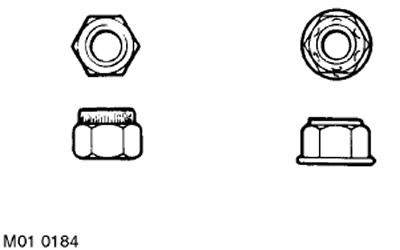

Self-locking nuts


Self-locking nuts (meaning nuts with a nylon insert or nuts with increased thread friction) can be reused provided that an increase in tightening resistance is felt at the moment the insert portion of the nut begins to tighten.

НЕ use heat to try to loosen a nut or bolt that is difficult to remove. This not only damages the protective coating, but also risks damaging electronic equipment and brake pads from excessive heat.

When removing self-locking nuts, it is recommended to replace them with new ones of similar design.

If the bearing preload is adjusted using a nut, the nut must be tightened in accordance with separate instructions.


This article is available at russian, bulgarian, belarusian, ukrainian, serbian, croatian, romanian, polish, slovak, hungarian
Article review: Konstantin Nazarov


Previous articles
General recommendations when performing plumbing work
Ball and roller bearings
Oil seals
Joints and butt surfaces
Locking parts of connections
Parts with cylindrical threads
Bolt Designations

Current article
Designation of nuts

Next articles
Flexible pipes and hoses
Using roller stands for road testing


Similar articles from Land Rover repair manuals:
• Designations bolts And nuts Discovery 3 (2004-2009)
• Designations of bolts and nuts Range Rover 3 (2001-2012)

Comments on this article

Алексндр
28.08.2016
09:34
спасибо за предоставленный материал
answer quote


How much will 16 + 21 =


Freelander 2 
  • General information
  • Using the manual
  • Repair technique
  • Precautionary measures
  • Road test
  • Fault codes
  • Identification codes
  • Jacking and lifting
  • Maintenance - Diesel
  • Maintenance - petrol
  • Chassis
  • Suspension
  • Front suspension
  • Rear suspension
  • Wheels and tires
  • Terrain response
  • Transmission system
  • Cardan shaft
  • Rear drive axle
  • Rear axle shafts
  • Front axle shafts
  • Brake system
  • Parking brake
  • Hydraulic brake
  • Brake booster
  • Anti-lock braking system
  • Exchange rate stability
  • Steering
  • Steering column
  • Power unit
  • Engine device
  • Engine repair
  • Description of the cooling system
  • Cooling system repair
  • Fuel supply
  • Drive units
  • Launch system
  • Ignition system
  • Exhaust toxicity
  • Air filtration
  • Fuel vapor control
  • Electronic control part
  • Automatic gearbox
  • Gearbox cooling
  • Automatic transmission controls
  • Mechanical transmission
  • Transfer case
  • Exhaust system
  • Fuel tank and lines
  • Speed control
  • Electrical equipment
  • Climate control system
  • Climate control
  • Additional climate control
  • Instrument panel
  • Sound signal
  • Information and messages
  • Assistance with parking
  • Battery and alternator
  • Information and entertainment
  • Outdoor Lighting
  • Interior lighting
  • Communication network
  • Wiring harnesses
  • Anti-theft system
  • Multifunctional modules
  • Body and coating
  • Body front panels
  • Lockable body parts
  • Interior trim
  • Rear view mirrors
  • Car seats
  • Glass, frames and mechanisms
  • Instrument panel and console
  • Handles, locks, latches
  • Windshield wipers and washers
  • Sunroof
  • Bumpers
  • Seat belt system
  • Restraint system
  • Body repairs
  • Front end repairs
  • Roof element repairs
  • Side panel repairs
  • Tailgate repairs
  • Subframe and mounts

Freelander 1 
  • General information
  • Using the manual
  • Precautionary measures
  • Technique
  • Specifications
  • Connection tightening torques
  • Maintenance
  • Power unit
  • Diesel engine Td4
  • Petrol engine K1.8
  • Piston group K1.8
  • KV6 petrol engine
  • Piston group KV6
  • Decreased toxicity
  • Motor control EDC
  • Engine management MEMS
  • Motor control Siemens
  • Fuel supply diesel Td4
  • Fuel supply for K1.8 engine
  • Fuel supply of KV6 engine
  • Cooling diesel Td4
  • Engine cooling K1.8
  • Engine cooling KV6
  • Exhaust system Td4
  • Exhaust system K1.8
  • Exhaust system KV6
  • Clutch
  • Mechanical transmission
  • Transfer case
  • Automatic gearbox
  • Chassis
  • Drive shafts
  • Rear axle and final drive
  • Steering
  • Front suspension
  • Rear suspension
  • Brake system
  • Body and coating
  • Passive safety
  • Doors, locks and glass
  • Exterior body parts
  • Interior trim details
  • Seats
  • Roof hatch
  • Roof
  • Body geometry
  • Body parts repair
  • Sealing and corrosion
  • Electrical equipment
  • Heating and ventilation
  • Air conditioning
  • Windshield wipers and washers
  • Starting engine and charging
  • Lighting and headlights
  • Control modules
  • Safety system
  • Window management
  • Entertainment systems
  • Wiring harnesses
  • Governing bodies
  • Devices


LRman.ru © 2013-2026 | Mobile version | Free Lander | Discovery | Range Rover | Defender | Contacts | | Sitemap |
Car repair and service instructions Land Rover: Freelander, Discovery, Range Rover, Defender
We use cookies to make pages load faster and provide a more user-friendly experience 🍪