car logo Ford
car logo Volkswagen
car logo BMW
car logo Opel
car logo Audi
car logo Toyota
car logo Peugeot
English Русский
Български
Беларускі
Український
Српски
Hrvatski
Română
Polski
Slovenský
Magyar


Main
Freelander
Discovery
Range Rover
Defender
Contacts
Articles

Hood Latch Panel (Discovery 3)

 
  • Main
  • Discovery
  • Discovery 3
  • Body and coating
  • Repair of front end elements
  • Hood Latch Panel
 
        0  
Contents: Removal ⇩ Installation ⇩

Removal


NOTE: If the hood latch panel finish is damaged or scratched, it must be repaired using the recommended compound. Refer to Specifications for more information.


1. Disconnect the battery ground cable. For more information, refer to Specification.

2. Remove the front bumper. For more information, refer to Front Bumper (76.22.49)

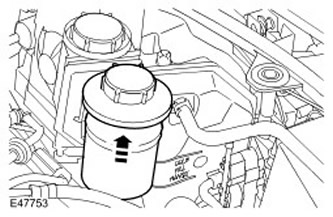
3. Loosen the power steering fluid reservoir mount and move the reservoir to the side.
  • Release the clamp.
Release the clamp.


4. Release the windshield washer reservoir filler neck from the clamp on the coolant reservoir.

5. Remove the 2 bolts securing the coolant expansion tank.

6. Remove the coolant expansion tank.
  • Lift the coolant expansion tank vertically.
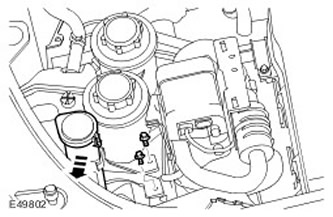
Lift the coolant expansion tank vertically.


7. Remove the radiator mounting pins.
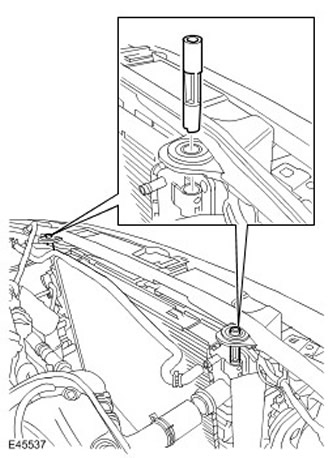


7. Remove the radiator mounting pins.


8. Disconnect the hood lock cable from the junction box.
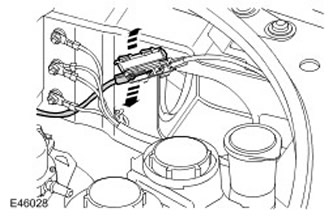
8. Disconnect the hood lock cable from the junction box.


9.
NOTE: Remember the position in which the part is installed.


Release the wiring harness.
  • Disconnect 3 electrical connectors.
  • Release 9 clamps.
  • Release the sealing sleeve.
  • Carefully move the wiring harness to the side and tie it up.
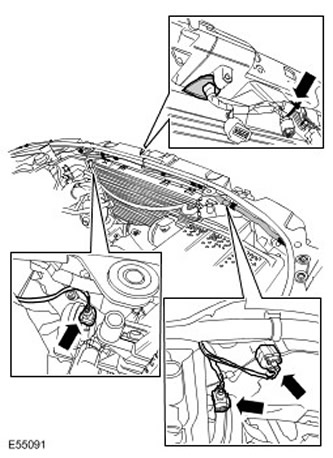
Carefully move the wiring harness to the side and tie it up.


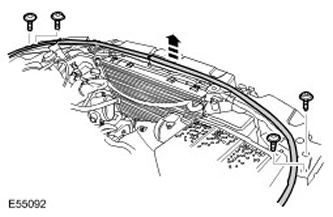
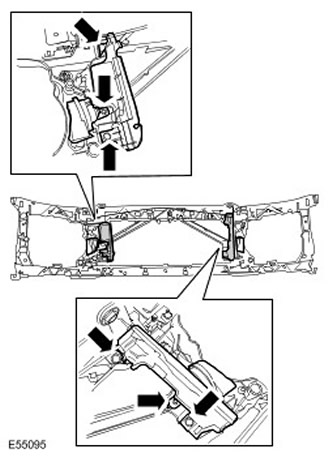
10. Remove the upper panel fastener.


  • Remove 4 Torx head bolts.
Remove 4 Torx head bolts.


11. Remove the lower panel fastener.
  • Remove 6 Torx head bolts.
Remove 6 Torx head bolts.


12.
NOTE: Remember the position in which the part is installed.


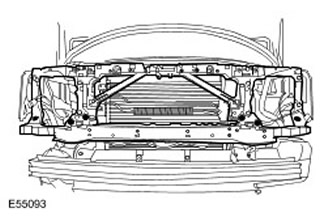
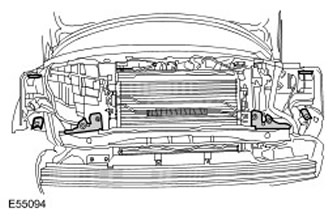
With assistance, remove the hood latch panel.

13. Remove the 6 spacer bushings, remembering their position.
  • Remove 2 clamps.
Remove 2 clamps.


14.
NOTE: Do not perform further disassembly if the part is removed only for access.


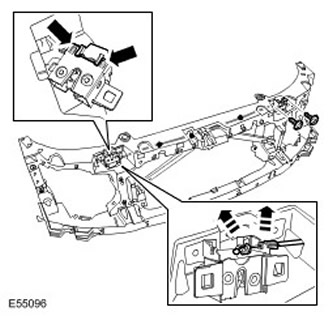
Remove 2 horn assemblies.
  • Remove 2 air deflectors.
  • Remove 2 Torx head bolts.
Remove 2 Torx head bolts.


15. Remove the hood switch.
  • Remove 2 Torx head bolts.
  • Release the 2 clamps.
16. Remove the right hood latch.
  • Release and remove the cable.
17. Remove the left hood latch.
  • Remove 2 Torx head bolts.
Remove 2 Torx head bolts.


Installation


1. Install the horn assemblies.
  • Install air deflectors.
  • Screw in and tighten the bolts. (tightening torque 10 Nm).
2. Install the left hood latch.
  • Tighten the Torx head bolts (tightening torque 10 Nm).
3. Install the right hood latch.
  • Attach the hood release cable.
  • Install the hood switch.
  • Tighten the Torx head bolts (tightening torque 10 Nm).
4. Install the spacer bushings.
  • Install the clamps.
5.
  • NOTE: Align the parts according to their original position.


With assistance, install the hood latch panel.


6. Install the panel fasteners.
  • Screw in and tighten the bolts. (tightening torque 25 Nm).
7.
NOTE: Align the parts according to their original position.


Install the wiring harness.
  • Connect and secure the electrical connector.
  • Secure the clamps securely.
8. Connect the hood release cable.

9. Install the radiator mounting pins.

10. Install the coolant expansion tank.
  • Install the coolant expansion tank back in place, aligning the bushing and eye.
  • Screw in and tighten the bolts. (tightening torque 10 Nm).
11. Reinstall the windshield washer reservoir filler neck.
  • Engage the clamp.
12. Install the power steering fluid reservoir.
  • Place the tank in place and secure it to the bracket.
13. Install the front bumper. For more information, refer to Front Bumper (76.22.49)

14. Open and close the hood to check the operation of the latch.

15. Adjust both hood latches.
  • Loosen the 4 Torx head bolts securing the hood latch.
  • Lower the hood and check that it is in the correct position.
  • Open the hood and tighten the Torx head bolts (tightening torque 10 Nm).
  • Check the operation of the hood safety lock.
  • Repeat the adjustment procedure if necessary.
16. Connect the ground cable to the battery. For more information, refer to Specification.


This article is available at russian, bulgarian, belarusian, ukrainian, serbian, croatian, romanian, polish, slovak, hungarian
Article review: Saveliy Ushakov


Previous articles
Specification
Rear section of the fender apron panel reinforcement
Wing Apron Panel Closing Panel
Sheet metal front elements

Current article
Hood Latch Panel

Next articles
Wing Apron Panel
Front spar
Front cross member
Front wheel arch
Front section of the fender apron panel reinforcement
Wing Apron Panel Section
Front side member section
Front wheel arch section


Similar articles from Land Rover repair manuals:
• Hood Lock Panel Freelander 2 (2006-2014)
• Hood Lock Panel Freelander 1 (1997-2006)
• Hood Lock Panel Range Rover 3 (2001-2012)
• Hood latch Defender 2007+ (2007-2016)

Comments on this article


No comments yet


How much will 28 + 18 =


Discovery 3 
  • General information
  • Using the manual
  • Precautionary measures
  • Service Information
  • Technique
  • Health protection
  • Road test
  • Identification codes
  • Jacking and lifting
  • Maintenance - diesel
  • Maintenance - petrol
  • Chassis
  • Suspension
  • Front suspension
  • Rear suspension
  • Wheels and tires
  • Dynamic suspension
  • Cardan shaft
  • Rear drive axle
  • Front drive axle
  • Front axle axles
  • Rear axle axles
  • Brake system
  • Parking brake
  • Hydraulic brake
  • Vacuum brake booster
  • Anti-lock braking system
  • Steering
  • Steering column
  • Power unit
  • Petrol engine 4.0L
  • Petrol engine 4.4L
  • Diesel engine 2.7L
  • Engine cooling
  • Fuel supply
  • Drive units
  • Launch system
  • Ignition system
  • Emission reduction
  • Air filtration
  • Fuel vapor control
  • Electronic control part
  • Car gearbox
  • Clutch
  • All-wheel drive systems
  • Transfer case
  • Exhaust system
  • Fuel tank and lines
  • Acceleration control
  • Electrical equipment
  • Climate control
  • Instruments and control lamps
  • Battery and charging system
  • Information system
  • Lighting and headlights
  • Power distribution
  • Electronic Function Group
  • Body and coating
  • Body elements
  • Interior and body trim
  • Mirrors and glasses
  • Seats
  • Instrument panel and console
  • Handles and locks
  • Windshield wipers and washers
  • Sunroof and bumpers
  • Safety system
  • Body repairs
  • Repair of front end elements
  • Repair of back elements
  • Side panel repair
  • Frame and body mount

Discovery 1 
  • General information
  • Technical specifications
  • Introduction to manual
  • Troubleshooting
  • Power unit
  • Diesel engine Tdi
  • Petrol engine V8i (3.9 l)
  • Petrol engine V8i (4.0 l)
  • Petrol engine Mpi
  • Reducing harmful emissions
  • Fuel system Tdi
  • Fuel system MFi
  • Fuel system SFi
  • Fuel system MPi (MEMS)
  • Cruise control
  • Cooling system (Tdi)
  • Cooling system (V8i)
  • Cooling system (MPi)
  • Exhaust system
  • Transmission
  • Clutch
  • Manual gearbox R380
  • Manual gearbox LT 77
  • Transfer case LT230T
  • Automatic gearbox
  • Cardan shaft
  • Rear axle
  • Front axle
  • Chassis
  • Steering system
  • Front suspension
  • Rear suspension
  • Brake system
  • Wheels and tires
  • Body and interior
  • Passive safety
  • Doors, locks and windows
  • Exterior body parts
  • Interior trim details
  • Seats
  • Electrical equipment
  • Heating and ventilation
  • Air conditioning
  • Windscreen wipers
  • Starting and charging system
  • Equipment and devices
  • Lighting and headlights


LRman.ru © 2013-2026 | Mobile version | Free Lander | Discovery | Range Rover | Defender | Contacts | | Sitemap |
Car repair and service instructions Land Rover: Freelander, Discovery, Range Rover, Defender
We use cookies to make pages load faster and provide a more user-friendly experience 🍪