Contents: Halogen headlights ⇩ Xenon headlights ⇩ Comparison of xenon and halogen…⇩ Construction of xenon headlights ⇩ Turn signal lamp ⇩ Clearance light ⇩ Side turning light ⇩
The following headlight types can be installed on the vehicle: halogen headlights, dual-mode xenon headlights or adaptive headlights (AFS). The same smooth diffuser is used for all types of headlights.
The headlights are located behind the front support panel as an assembly. Each headlight is secured to the front support panel using two locking strips. The locking strips move in grooves on the back of the headlights and are fixed with their holes on the pins of the front support panel. To fix, each locking strip is pressed down so that the pins enter the holes. The locking strips allow the headlight to be removed from the support panel to replace the lamps without using special tools.
On the rear wall of the headlight unit there is a removable panel that provides access to the bulbs for their replacement. A large cover, which is removed by turning it counterclockwise, provides access to both the halogen and xenon low and high beam bulbs. Another cover provides access only to the halogen high beam bulb, which is held in place by a spring clip. A small cover is also removed by turning it counterclockwise and provides access to the turn signal bulb. Under this cover is a removable cover that provides access to the side light bulb, cornering light/tilt side light bulb, and side marker light bulb. (in US models).
At the rear of the headlights there are two screws for manual adjustment of the headlight axis in the vertical and horizontal planes. On vehicles for the US market (NAS), the headlights have the optical axis direction 'Visual Optically Left' (VOL). The adjustment screws must be turned the same number of turns to ensure the headlight adjustment ratios only in the vertical plane. Adjustment in the horizontal plane is not provided. The headlight adjustment procedure is described in the Repair Manual.
Each headlamp is equipped with a 16-pin connector that provides input and output signals for the headlamp's functional support. The connector pin assignment may vary from model to model, details can be found in the Electrical Reference Library (ERL).
The low beam headlights are switched on when the ignition switch is in position (II) and:
- The light switch is in the headlights on position
- The light switch is in the AUTO position and a signal to turn on the outside lights is sent to the central switching unit from the rain/light sensor.
The high beam headlights are switched on when the ignition switch is in position (II) and:
- the low beam headlights are turned on either by the light switch or by using the AUTO function
- The left multi-function steering column switch has been moved forward, away from the driver.
- The left multifunction steering column switch has been moved back towards the driver
- Low beam headlights are off
- The ignition switch is turned from position I (auxiliary equipment power supply) to position 0 (off).
Halogen headlights
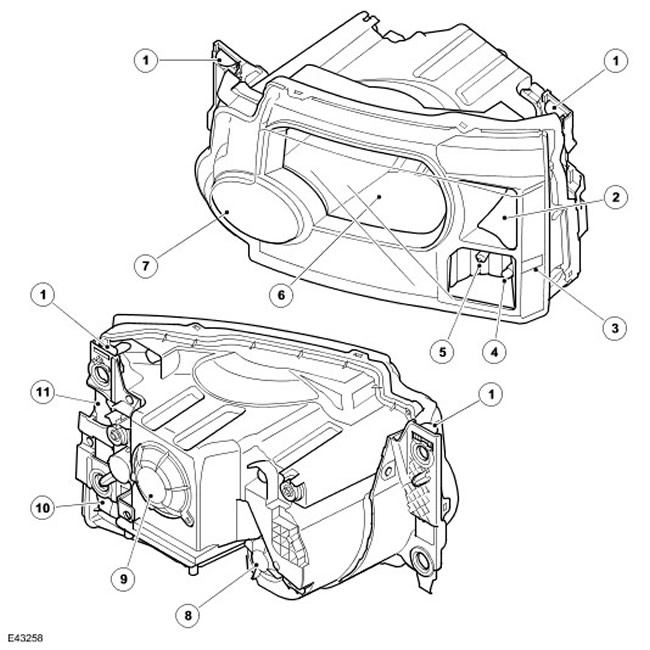
| Item name | Spare part catalog number | Description |
| 1 | - | Stop bar |
| 2 | - | Direction indicator |
| 3 | - | Side marker light (for USA only) |
| 4 | - | Clearance light |
| 5 | - | Side turning light (if any) |
| 6 | - | Low/high beam headlight |
| 7 | - | High beam headlight |
| 8 | - | High beam headlight service hatch cover |
| 9 | - | Service hatch cover for low/high beam headlights |
| 10 | - | Cover of the service hatch of the side light (not shown) |
| 11 | - | Turn signal service hatch cover (not shown) |
Halogen headlights use a complex-shaped reflector for the low and high beam headlights. The reflector is divided into two parabolic segments with different focal lengths. When driving in countries with opposite traffic, a special light-protective sticker must be glued to the outer surface of the halogen headlight diffuser to block part of the light beam.
The low and high beam headlights use halogen lamps with a quartz bulb with a power of 55 W. The lamps are attached to the headlight housing using regular wire clamps.
Xenon headlights
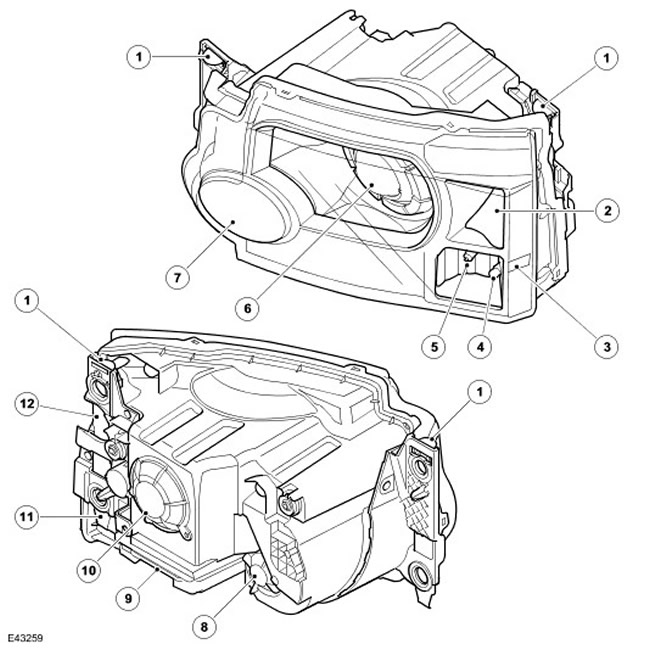
| Item name | Spare part catalog number | Description |
| 1 | - | Stop bar |
| 2 | - | Direction indicator |
| 3 | - | Side marker light (for USA only) |
| 4 | - | Side lights |
| 5 | - | Side turning light (if any) |
| 6 | - | Xenon low/high beam headlight |
| 7 | - | Halogen high beam headlight |
| 8 | - | High beam headlight service hatch cover |
| 9 | - | Xenon headlight controller |
| 10 | - | Service hatch cover for low/high beam headlights |
| 11 | - | Cover of the service hatch of the side light (not shown) |
| 12 | - | Turn signal service hatch cover (not shown) |
Precautionary measures
WARNING: The voltage in the xenon lamp power supply circuit reaches 28,000 V. Contact with such voltage can result in death. Before working on the headlights, they must be disconnected.
When working with a xenon lighting system, the following precautions must be observed:
- DO NOT perform any work on the xenon lighting system when the outside lighting is on.
- Work with D2S xenon lamps is only permitted with the use of personal protective equipment, such as gloves and glasses. Do not touch the glass bulb of the lamp.
- Disposal of xenon lamps must be carried out in accordance with the rules for disposal of hazardous waste.
- The lamp can only be turned on when it is in the working position, that is, in its socket.
The high beam headlight uses a halogen lamp with a quartz bulb with a power of 55 W. The lamps are attached to the headlight housing using ordinary wire clamps.
The xenon headlight is called a dual-mode xenon headlight and works as a low beam headlight and a high beam headlight. The xenon or high-intensity discharge (HID) headlight includes an electromagnetically controlled shutter that changes the high beam to a low beam and vice versa.
The article was taken from this resource: www.lrman.ru
NOTE: If the light switch is in the off position, the xenon high beam signaling is not possible. If the light switch is in the headlights on position or in the AUTO position and the low beam headlights are on, the low beam of the xenon headlights remains on when the high beam signaling is on.
The operation of the xenon headlights is controlled by the CJB unit, which is connected to the controllers of each headlight and to the discharge starter. The xenon headlight controller and the starter provide the xenon lamp with enough electricity to turn it on.
Comparison of xenon and halogen headlight illumination diagrams
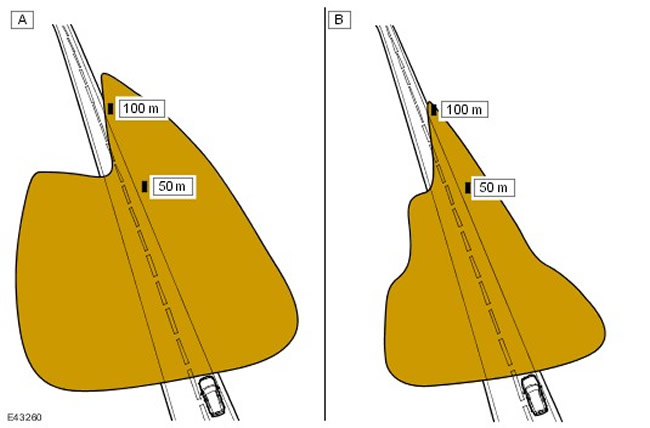
| Item name | Spare part catalog number | Description |
| A | - | Xenon dual-mode headlight |
| B | - | Halogen |
Xenon headlights use reflectors and diffusers made using the so-called ellipsoidal technology, which provide better illumination in the dark compared to halogen headlights. Compared to halogen headlights, xenon headlights provide the following advantages:
- Long service life of xenon lamps - approximately 3-5 times longer than halogen lamps
- Increased light output: the luminous flux of xenon headlights is 3-4 times higher than that of halogen headlights
- Blue/white light closer to natural daylight - Xenon lamps produce blue/white light compared to the yellow light produced by halogen lamps
- Better visibility when driving at night - xenon lamps create a wider and brighter light beam compared to conventional halogen lamps
- Lower heat generation
- Less power consumption
Construction of xenon headlights
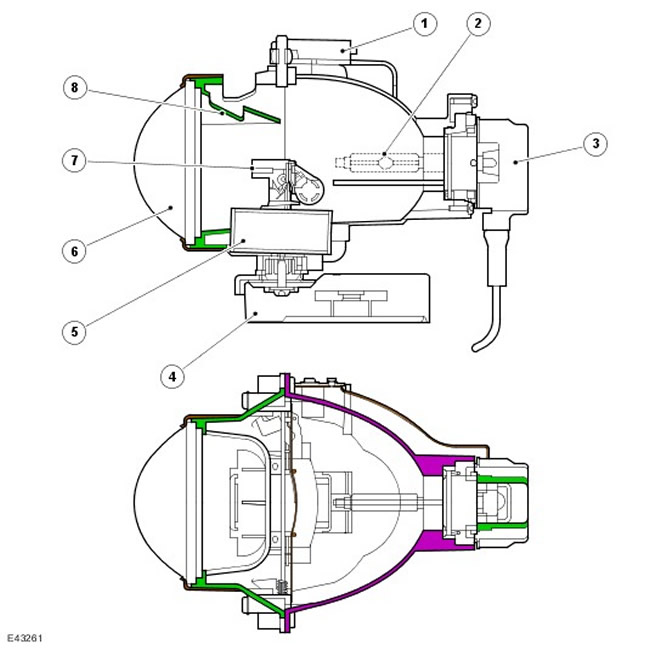
| Item name | Spare part catalog number | Description |
| 1 | - | Bracket |
| 2 | - | Xenon lamp DS2 |
| 3 | - | DS2 connector |
| 4 | - | Headlight course drive gear motor (only for adaptive headlights) |
| 5 | - | Electromagnet |
| 6 | - | Aspherical diffuser |
| 7 | - | Shader |
| 8 | - | Shader |
| 9 | - | Diffuser support |
The xenon headlight is an independent design element that is located in the headlight unit. This unit consists of a reflector, an adapter ring, a diffuser, a screen controller and a xenon lamp, and when assembled is called a spotlight.
The diffuser has a convex shape and ensures the xenon lamp is secured in it. The lamp is located in a groove to ensure correct alignment in the reflector and is secured by pressing and turning to the locking position. The lamp has a two-pin connector, which is also secured by pressing and turning to the locking position.
The screen drive is an electromagnet that controls the position of the screen using a lever mechanism. The screen is used to change the low beam to high beam and vice versa.
The lever mechanism is located on the right side of the spotlight. This mechanism controls the screen that blocks part of the light beam, which allows you to drive in countries with opposite traffic without using special stickers on the headlight lens. The beam pattern is changed by moving a small lever, which is located next to the lamp socket, on the side of the spotlight. Before removing the service hatch cover, be sure to turn off the headlights.
A xenon lamp begins to glow when an electric arc is formed by passing an electric current between two electrodes of the lamp. The sealed bulb of the lamp contains xenon gas, which reacts to electrical excitation and the heat produced by the current. As a result of the reaction to the regulated current between the electrodes, the xenon emits blue/white light.
The maximum level of continuous lamp glow is reached in three phases. These are the start-up phase, the warm-up phase, and the continuous operation phase.
In order for an electric arc to form, a starting pulse of 18,000-28,000 V must be supplied to the lamp during the starting phase. This voltage is provided by xenon lamp starters. After the electric arc has formed, the warm-up phase begins. The xenon headlight controller regulates the electric current in the lamp circuits so that the current strength is 2.6 A, which corresponds to a power of 75 W. During this phase, the xenon begins to glow brightly, and the lamp enters a steady-state mode with stable parameters of electric current flow between the electrodes. As soon as the warm-up is complete, the controller enters the continuous operation phase. The voltage supplied to the lamp electrodes decreases, and the power for maintaining the steady-state mode decreases to 35 W.
The operation of the xenon headlights is controlled by the CJB unit, two xenon headlight controllers and two starters. When the headlights are switched on, the CJB module supplies operating voltage to the xenon headlight controllers (one for each headlight). During the start-up phase, the controllers regulate the voltage level on the lamp electrodes.
Starters (one for each headlight) create the high initial voltage that is necessary to form an electric arc between the electrodes. The starter design includes coils that generate the high voltage pulses necessary for the lamp to start working. Once the lamp starts working, the starter forms a closed control loop, allowing the controller to regulate the voltage.
Turn signal lamp
The direction indicator lamp is built into the outer part of the headlight. The direction indicator is located above the side light/corner light when turning. The direction indicators use 27 W/7 W S8W bulbs with fastening in spring contacts of the socket. The lamp is fastened in the socket, which is connected by means of wires to the main connector on the headlight housing. The sockets are inserted into the hole of the headlight housing and turned until they lock. Access to the lamp is possible through a sealed cover on the rear wall of the headlight housing. The cover is fixed in the housing by turning clockwise until it locks. To gain access to the cover, it is necessary to remove the headlight unit from the front bearing panel and remove the outer locking strip from the headlight unit.
The direction indicators are activated by the left multifunction stalk or the hazard warning switch. The multifunction stalk only operates when the ignition switch is in position II (ignition on), the hazard warning switch operates in any circuit state. The direction indicators operate with an on/off cycle of 0.38 seconds.
If one of the turn signal lamps fails, the others will continue to operate at the same cycle. The turn signal indicators will operate at double the frequency, indicating a lamp failure.
Clearance light
The side light is located on the outside of the headlight unit, below the turn signal. The side light uses the same housing and reflector as the tilt-axis side light. (where is available).
The side light uses a baseless W5W bulb with a spring-loaded socket that is connected by wires to the main connector on the headlight housing. The socket is inserted into a socket in the headlight housing. The bulb can be accessed through a removable cover on the rear surface of the headlight housing. To access the cover, remove the headlight from the front support panel and partially remove the outer locking strip from the headlight.
The side lights are switched on by the light switch. The side lights can operate regardless of the ignition switch position. The side lights will also be switched on if the light switch is in the AUTO position and the central switching unit receives a signal from the rain/light sensor to switch on the outside lights.
Side turning light
NOTE: *US vehicles are not equipped with cornering lights.
Side turning lights are additional equipment that enables the road to be illuminated in the direction of travel when turning at low speed. The design of the diffusers allows the light beam to be deflected by approximately 45 degrees from the vehicle axis.
The side light is built into the outer part of the headlight unit and is located in the same housing as the reflector and side light.
The cornering side light uses a 35W H8 halogen bulb that fits into a socket connected to the headlight housing. The sockets are inserted into the opening in the headlight housing and turned until they lock. The bulb is accessible through a removable cover on the rear surface of the headlight housing.
The cornering lights are switched on by the left multifunction stalk when the light switch is set to the headlights position and the ignition switch is in position II. Current is supplied to the lamps from the ignition switch to eliminate the delay in switching them off when using the headlight timer. At vehicle speeds above 40 km/h, the cornering lights are deactivated when turning.
Only one side light can be on at a time. Subject to the above conditions (speed of movement and switch position), if the left turn signal is on, the left side light is turned on and vice versa. The side lights when turning are turned off when reverse gear is engaged.
Comments on this article