Depending on the vehicle's equipment, one of three types of light switches may be installed.
NOTE: Picture shows high end light switch
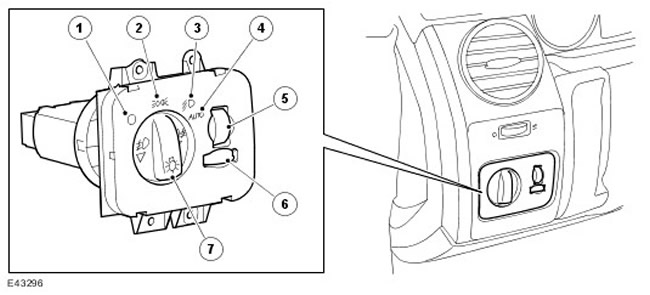
| Item name | Spare part catalog number | Description |
| 1 | - | Off position (OFF) |
| 2 | - | The side lights are on |
| 3 | - | Headlights are on |
| 4 | - | Automatic headlight control is enabled (if any) |
| 5 | - | Headlight leveling correction (if available - only for vehicles with coil spring suspension) |
| 6 | - | Instrument panel illumination adjustment rheostat |
| 7 | - | Rotary switch |
All output signals of the light switch, except for the output signals of the dimmer and headlight leveling rheostat (if any), are expressed by a voltage drop of approximately 200 mV when passing through the switch. Therefore, if the input voltage to the switch is 12 V, then the output voltage is 11.8 V.
Rotary switch
The rotary switch can be set to one of four positions: OFF, parking lights, headlights and automatic mode (AUTO). On cars that do not have an automatic mode, the switch has only three positions.
Three additional positions are provided (pulled switch) to control the fog lights: all fog lights off, only the front fog lights on, and both the front and rear fog lights on. If there are no fog lights, there is only a position to turn on the rear fog lights.
On vehicles equipped with front fog lights, they can be turned on by pulling the switch only when it is in the parking light or headlight position.
On vehicles not equipped with front fog lights, only the rear fog lights can be turned on by pulling the switch when it is in the headlights on position.
The fog lights turn off automatically when the rotary switch is turned to the off position or when it is pressed to the fog light off position.
Manual headlight leveling (if any)
The manual headlight leveling control is only installed on vehicles with coil spring suspension and is used to lower the headlights when there is a heavy load in the rear of the vehicle to change the orientation and angle of the headlights.
For regulation, a rotary handwheel is used, connected to a rheostat, which gives various signals to the stepper motors of the headlight tilt correction. Depending on the signal, the motors set the specified position of the headlights.
There are four marked positions on the regulator: 0 to 3. The rotary knob can be moved to 8 positions to provide more precise adjustment of the headlight range. The positions apply to the following vehicle load or driving conditions: Position 0 is the normal position for an unloaded vehicle. Positions 1-4 are used to compensate for the reduction in the rear suspension height of the vehicle.
- 0 = Only driver's seat or driver and front passenger seats occupied
- 0.5 = Driver, front passenger and third row seats occupied (for models with 7 seats) or all seats are occupied (for models with 5 seats)
- 1 = All seats occupied (for models with 7 seats)
- 1.5 = All seats occupied and maximum rear axle load
- 2 = Only driver's seat occupied and maximum rear axle load
- 3 and 4 = Can be used for certain driving conditions, such as off-road driving
(Data taken from the website: www.lrman.ru)
Adjusting the brightness of the lighting
The brightness of the instrument panel backlight and other control panel units is controlled using width-modulated signals. Illumination is controlled by turning a handwheel, which is connected to a rheostat and a switch in the high-level circuit.
A rheostat is a variable resistor that produces high or low resistance depending on its set position. The rheostat's voltage signal is sent to a switching capacitor or high-level switch. The high-level switch uses the rheostat's voltage output to set the frequency of the capacitor, which produces 8-12V PWM signals that determine the light level.
Comments on this article