Contents: Rotary light switch ⇩ Headlight leveling adjustment (rest…⇩ Adjusting the brightness of the…⇩ Fog lights ⇩ Automatic headlights ⇩
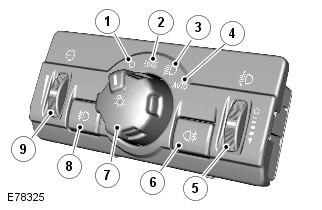
| Pos. | Spare part number | Name |
| 1 | - | The lights are off |
| 2 | - | Turning on the side lights |
| 3 | - | Turning on the headlights |
| 4 | - | Turning on the automatic headlight control system (if this function is available) |
| 5 | - | Rotary headlight range adjuster (halogen headlights only) |
| 6 | - | Rear fog light switch |
| 7 | - | Rotary light switch |
| 8 | - | Front fog light switch |
| 9 | - | Rotary control for interior lighting (dimmer) |
The light switch module is located on the driver's side of the instrument panel and allows the driver to select the appropriate operating mode for the external lighting systems. There are three versions of this module, depending on the vehicle's configuration and target market.
The light switch module detects all switching operations and sends messages via the LIN bus to the CJB.
Rotary light switch
The lighting control module is equipped with a central rotary switch that allows you to select the following modes:
- All external lights are off
- The side lights are on
- Headlights are on
- Automatic headlight mode is active
Headlight leveling adjustment (rest of the world, halogen headlights only)
NOTE: Headlamp leveling system is not available on North American vehicles with halogen headlamps.
The dimmer knob is located on the right side of the light switch module. The knob is connected to a rheostat that sends a variable output signal to the stepper motors that adjust the headlight beams. The motors respond to this output signal and adjust the headlight beams vertically as needed.
This knob has no fixed positions, it can be turned to the desired position to compensate for the reduction in the height of the rear of the car, so as not to blind other drivers with bright light.
Adjusting the brightness of the lighting
The rotary dimmer knob is located on the left side of the light switch module. The brightness of the instrument panel backlight and other control panel components is adjusted using pulse-width modulated signals.
The illumination is controlled by turning a handwheel, which is connected to a rheostat and a switch in the high-level circuit. The rheostat is a variable resistance. The voltage signal from the rheostat is transmitted to the switching capacitor. The high-level switch uses the voltage output from the rheostat to set the frequency of the capacitor, which generates 8-12 V pulse width modulated signals that determine the illumination level.
Fog lights
There are two switches to select the front and rear fog lights/lamps. The front fog light switch is only available on vehicles equipped with front fog lights.
The fog lamp/lamp switches are momentary switches which, when pressed, generate a LIN bus message from the lighting switch module to the CJB. The fog lamps/lamps remain active until the selection is deselected using the relevant fog lamp/lamp switch or headlamp off, or ignition power mode 6 is changed to power mode 0.
Automatic headlights
Automatic headlight control is designed to make the driver's job easier. The driver can override the system by turning on the sidelights or headlights themselves if natural light is insufficient and front and rear lighting is required.
The automatic headlamp control system uses a light sensor and a CJB unit connected to the sensor via a local LIN data bus.
The light sensor, combined with the rain sensor, is located on the inside of the windshield under the rearview mirror. The signals from the rain/light sensor are also used by the automatic windshield wiper control system. For more information, refer to the chapter: Windshield wipers and washers (501-16 Windshield wipers and washers, Description and operating principle).
The material was taken from the specified website: LRMAN.ru
The light sensor measures the vehicle's illumination level, both vertically and from the side to the front. During operation, the rain/light sensor uses information about the vehicle's speed, the position of the windshield wiper switch, and the "parking" position of the windshield wipers.
The automatic headlamp control mode uses a signal from the ambient light level, which is measured by a photodiode integrated into the rain sensor. The rain/light sensor, via the local LIN bus, sends a request to the CJB to turn the lights on or off, which responds to the request by turning on the low beam headlamps, front parking lamps, number plate lamps and tail lamps. The automatic headlamp control system is activated under the following conditions:
- Twilight
- Dark time of day
- Rain
- Tunnels
- Underground or multi-storey car parks
For automatic headlights to operate, the ignition must be on (power mode 6), the rotary light switch must be set to the 'AUTO' position and a request to turn on the lights must be received from the light sensor.
Comments on this article