Contents: Halogen headlights ⇩ Bi-xenon headlights ⇩
Depending on the model specification, three headlight options are available: halogen, dual-mode xenon headlights and dual-mode xenon headlights with Adaptive Front Lighting (AFS).
The headlights are sealed units with scratch-resistant polycarbonate lenses that are bonded to the headlight housing. Two sealed access covers and a sealed housing provide a waterproof environment for the internal elements of the headlights. To prevent fogging of the lens and to allow the headlight to 'breathe' in response to changes in internal temperature, a vent is provided on the outer rear surface of the headlight housing. The vent is covered with a waterproof Gortex membrane. This allows ventilation of the headlight while preventing water ingress.
The headlights can be quickly removed for bulb replacement thanks to the unique 'Rail Lock' system. Access to the headlight requires unscrewing the two bolts securing the headlight to the bonnet closing panel. The locking lever at the rear can then be lifted, releasing the locking element at the base of the headlight housing. The headlight can then be pulled forward along the guide and, after disconnecting the wiring harness connector, removed from the vehicle. The 'Rail Lock' system ensures that the headlight adjustment is not lost when removed.
Each headlight has two access covers at the rear. The large cover requires the release of the locking lever from its guide grooves to gain access. The cover can then be removed by releasing two tabs to replace the high and low beam bulbs. The round rubber cover fits snugly onto the rear of the headlight assembly. Removing the cover provides access to the side light and turn signal bulbs.
On NAS vehicles, the parking light has an orange lens. The lens of the parking light is designed so that the light from the parking light bulb also illuminates the orange reflector area on the side of the light without the need for an additional lamp.
Halogen headlights
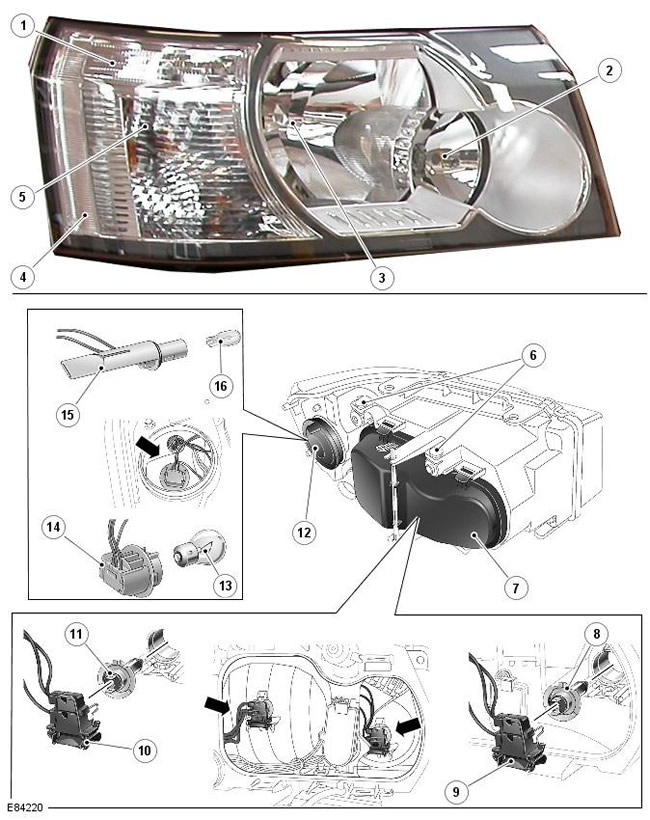
| Pos. | Spare part number | Name |
| 1 | - | Side marker light (and side marker light on NAS vehicles) |
| 2 | - | Halogen high beam headlight |
| 3 | - | Halogen low beam headlight |
| 4 | - | Side marker reflector (NAS vehicles only) |
| 5 | - | Direction indicator lamp |
| 6 | - | Manual headlight dimmers |
| 7 | - | Lid |
| 8 | - | Halogen high beam lamp |
| 9 | - | High beam lamp holder |
| 10 | - | Low beam lamp holder |
| 11 | - | Halogen low beam lamp |
| 12 | - | Lid |
| 13 | - | Turn signal lamp |
| 14 | - | Direction indicator lamp holder |
| 15 | - | Side light bulb socket |
| 16 | - | Side light bulb |
The halogen headlight of other countries vehicles has two H7 55W halogen bulbs for high and low beam. On NAS vehicles, the halogen low beam headlight uses an H11 55W halogen bulb.
Bi-xenon headlights
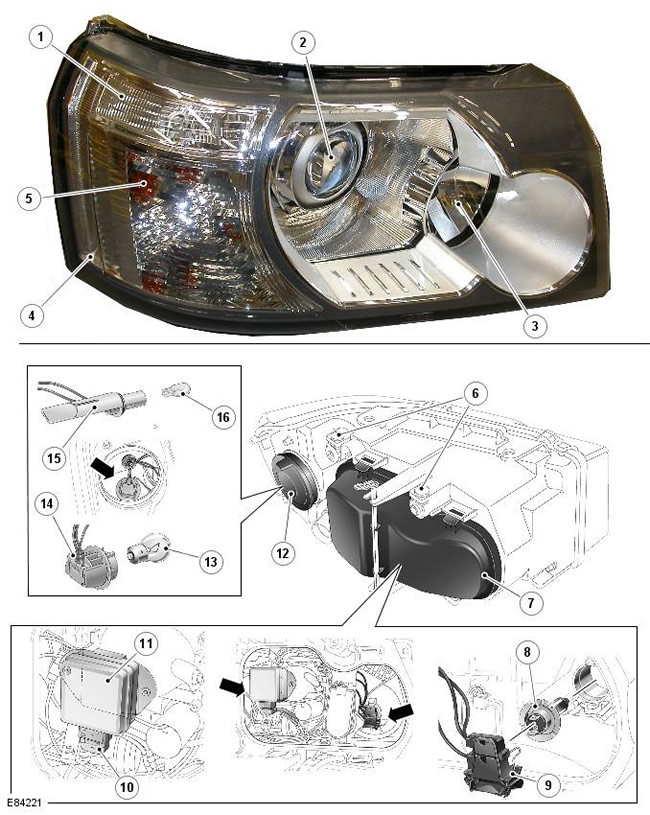
| Pos. | Spare part number | Name |
| 1 | - | Side marker light (and side marker light on NAS vehicles) |
| 2 | - | Bi-xenon headlights for low and high beam |
| 3 | - | Halogen high beam headlight |
| 4 | - | Side marker reflector (NAS vehicles only) |
| 5 | - | Direction indicator lamp |
| 6 | - | Manual headlight dimmers |
| 7 | - | Lid |
| 8 | - | Halogen high beam lamp |
| 9 | - | High beam lamp holder |
| 10 | - | Electrical connector for D1S bi-xenon lamp |
| 11 | - | Bi-xenon lamp D1S |
| 12 | - | Lid |
| 13 | - | Turn signal lamp |
| 14 | - | Direction indicator lamp holder |
| 15 | - | Side light bulb socket |
| 16 | - | Side light bulb |
The xenon headlight uses a reflector with a complex surface only for the halogen high beam lamp. It uses the same H7 55W halogen lamp as the halogen headlight. A bi-xenon module is installed for the low beam headlight, but it also works as a high beam.
Precautionary measures
When working with a xenon headlight system, the following precautions should be observed:
- It is PROHIBITED to carry out any work on xenon headlights with the lights on.
- Work with D1S xenon lamps is only permitted with the use of personal protective equipment such as gloves and glasses.
- Do not touch the glass bulb of the lamp.
- Disposal of xenon lamps must be carried out in accordance with the rules for disposal of hazardous waste.
- The lamp can only be turned on when it is in the installed position, in the reflector.
WARNING: The voltage in the xenon lamp power supply circuit reaches 28,000 V. Contact with such voltage can result in death. Before working on the headlights, they must be switched off.
Design and functionality of the headlight
A xenon or high-intensity discharge (HID) headlight includes an electromagnetically controlled shutter that changes the high-beam beam to the low-beam beam and vice versa.
NOTE: If the rotary switch of the lighting control module is in the off position, the xenon high beam headlamps cannot be signaled. If the rotary switch is in the headlamp on position or in the AUTO position and the low beam headlamps are on, the xenon low beam headlamps remain on when the high beam headlamps signal.
The operation of the xenon headlamps is controlled by the CJB, which is linked to the control modules of each headlamp and to the discharge starter. The control modules and starters provide the xenon lamps with sufficient electrical power to turn them on.
A xenon headlight is an independent design element that is located in the headlight assembly. The main elements of a xenon headlight are a reflector, a diffuser, a curtain controller, and a xenon lamp.
The reflector provides support for the xenon bulb, which is an integral part of the bulb starter. The starter is located in an opening at the rear of the reflector and is secured with two Torx screws to ensure proper alignment in the reflector.
The curtain is used to switch from low beam to high beam and vice versa. The curtain drive is an electromagnet that controls the position of the curtain using a lever mechanism. When the curtain is in the low beam position, it covers part of the light emitted by the reflector, providing a certain shutdown of the low beam.
The lever mechanism is located on the right side of the headlight. This mechanism controls a curtain that blocks part of the light beam, which allows you to drive on the "wrong" side of the road without using special stickers on the headlight lens. The beam of light is changed by moving the cover at the back of the headlight and moving a small lever, which is located on the side of the headlight.
A xenon lamp burns when an electric arc is formed inside the lamp when an electric current passes between two electrodes. The sealed bulb of the lamp contains xenon gas, which, under the influence of an electric discharge and heating, passes into an excited state and emits light in the white-blue part of the spectrum.
The maximum level of continuous lamp glow is reached in three phases. These are the ignition phase, the warm-up phase, and the continuous operation phase.
In order for an electric arc to form, an initial voltage of up to 30,000 V must be applied to the lamp during the ignition phase. This voltage is provided by the xenon lamp starters. After the electric arc has formed, the warm-up phase begins. The xenon headlight control modules regulate the electric current in the lamp circuits so that the current strength is 2.6 A, which corresponds to a power of 75 W. During this phase, the xenon begins to glow brightly, and the lamp enters a steady-state mode with stable parameters for the flow of electric current between the electrodes. As soon as the warm-up is complete, the control module enters the steady-state mode phase. The voltage applied to the lamp electrodes decreases, and the power to maintain the steady-state mode decreases to 35 W. The transition from the ignition phase to the steady-state mode phase takes a very short period of time.
The operation of the xenon headlamps is controlled by the CJB unit, two headlamp control modules and two starters. When the headlamps are switched on, the CJB module supplies electrical voltage to the control modules (one for each headlamp). During the ignition phase, the control modules regulate the voltage level on the lamp electrodes.
[The material was taken from the specified website: lrman.ru]
Starters (one for each headlight) create the high initial voltage needed to create an electric arc between the electrodes. The starters are designed with coils that generate the high voltage pulses needed to start the lamp. Once the lamp starts working, the starter forms a closed control loop, allowing the control module to regulate the supply voltage.
Comments on this article