Contents: Removal ⇩ Installation ⇩
CAUTION: The rear side panel must be MIG brazed to the internal bottom trim panel reinforcement which is DP600 steel (dual phase steel). MIG/spot welding should not be used in this area.
NOTE: The rear side panel is serviced as a separate weld-on panel.
NOTE: There are NVH elements inside this panel, they are not serviceable on the new panel. If damaged, a new element will be required.
Removal
1. In combination with the rear side panel, replaces:
- Rear bumper trim
- Back door
- Rear side window glass
- Ceiling upholstery
2. For additional information regarding this repair procedure, refer to: For additional information, refer to: Body and Frame (501-26 Body Repairs - Special Vehicle Information and Tolerance Checks, Description and Operation) / Standard Service Station Techniques (100-00 General Information, Description and Operation).
3. Remove the rear bumper trim. For more information, refer to the chapter: Rear Bumper (501-19 Bumpers, Removal and Installation).
4. Remove the rear door. For more information, refer to the chapter: Rear Door (501-03 Lockable Body Parts, Removal and Installation).
5. Remove the headlining. For more information, refer to the chapter: Upper trim - Vehicles not equipped with: Tilting sunroof (501-05 Interior trim, Removal and Installation) / Upper trim - Vehicles equipped with: Tilting sunroof (501-05 Interior trim, Removal and Installation).
6. Remove the rear door lock latch retainer from the C-pillar.
7. Remove the roof molding, front and rear sections.
8. Remove the side curtain airbag module. For additional information, refer to: Overhead Side Airbag Module (501-20B Supplemental Restraint System, Removal and Installation).
9. Remove the rear quarter window glass. For additional information, refer to the chapter: Rear quarter window glass (501-11 Glass, frames and mechanisms, Removal and installation).
10. Remove the front seat. For more information, refer to the chapter: Front Seat (501-10 Seat, Removal and Installation).
11. Remove the floor console. For more information, refer to the chapter: Floor Console (501-12 Instrument Panel and Console, Removal and Installation).
12. Remove the interior trim of the right and left lower trim panels.
13. Remove the rear seat cushion. For more information, refer to the chapter: Rear Seat Cushion (501-10 Seat, Removal and Installation).
14. Remove the rear carpet section.
15. Remove the rear seat belt retractor. For more information, refer to the chapter: Rear Seat Belt Retractor Mechanism (501-20A Seat Belt System, Removal and Installation).
16. Remove the tailgate opening seal.
17. Remove the exhaust grille.
18. Remove the rear wheel and tire assembly. For more information, refer to the chapter: Wheel and tire (204-04 Wheels and tires, Removal and installation).
19. Remove the lower trim panel outer molding.
20. Release and position aside the wiring harnesses running along the inside of the rear quarter panel and rear panel.
21. Release and place aside the insulation material from the rear side panel.
22. Right side: Drain the fuel from the fuel tank. For additional information, refer to: Draining the Fuel Tank (310-00 Fuel System - General Information, General Procedures).
23. Right side: Remove the fuel tank filler neck. For additional information, refer to the chapter: Fuel Tank Filler Neck (310-01A Fuel Tank and Fuel Lines - 3.2L NA - I6, Removal and Installation).
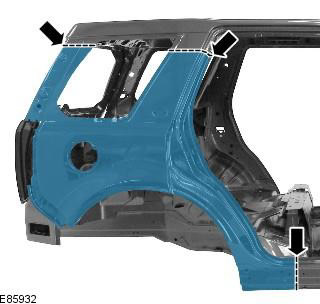
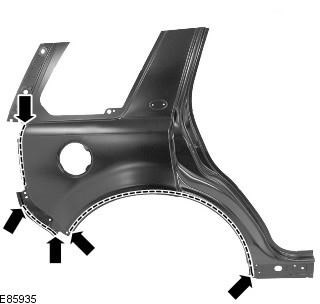
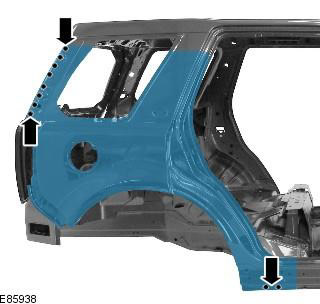
24. Cut the old panel at the points shown, using the new panel as a guide, making sure the new panel will overlap.
25. Mill out the weld spots.
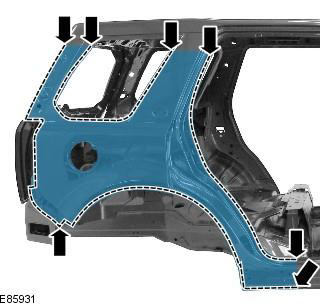
26. Separate the connections and remove the old panel, also disconnect the NVH element and the fuel tank filler pipe on the right side.
Installation
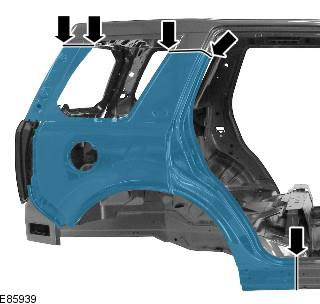
1. Place the new panel, align it and clamp it in place, overlapping the old panel. Cut through the new and old panels at the points where the MIG butt joints are to be made.
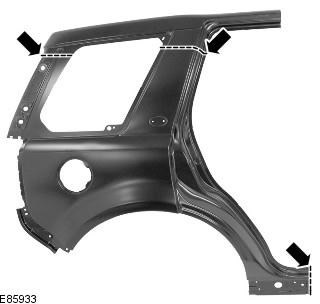
2. Remove the new panel and the remains of the old one.
3. Prepare the connecting surfaces of the old and new panels.
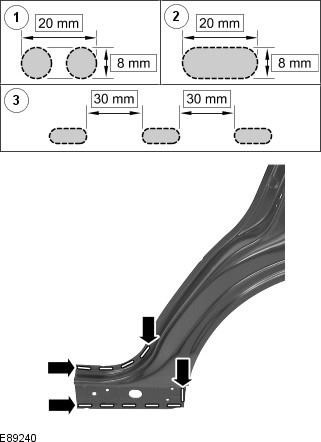
4. Drill holes in the new panel for MIG welding.
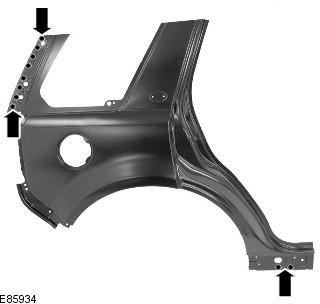
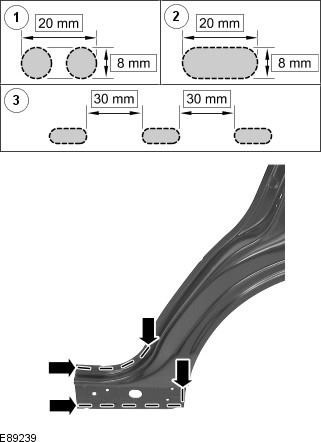
5. Cut holes in the new panel for MIG welding.
NOTE: Holes should be made for MIG brazing at the intervals shown in the illustration. Where this is not possible due to recesses in the panel, a hole should be made at the original weld location.
6. Apply the new panel and fix it in place. Check the alignment, if correct, proceed to the next step, if not, correct and check again before proceeding to the next step.
7. Remove the new panel.
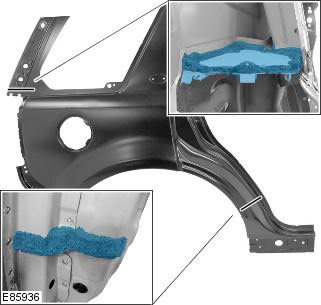
8. Apply glue to the areas shown.
9. Replace NVH element(s) if necessary.
10. Apply sealing adhesive to NVH elements.
11. Place the new panel and secure it in place.
(The original text was published on the website: «www.LRman.ru»)
12. Tack the butt joints.
13. Perform spot welding.
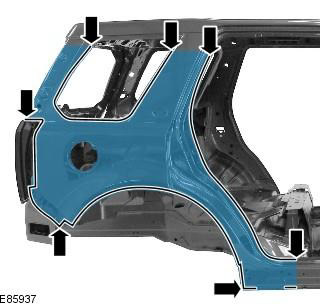
14. MIG welding.
15. Perform MIG welding.
16. Clean the tack welds.
17. Perform butt welding using MIG technology.
18. Clean all welded joints.
19. To install the relevant panels and mechanical components, perform the removal procedure in reverse order.
Comments on this article