Contents: With particulate filter ⇩ Without particulate filter ⇩ Front section ⇩ Rear section ⇩ Catalytic converter ⇩
With particulate filter
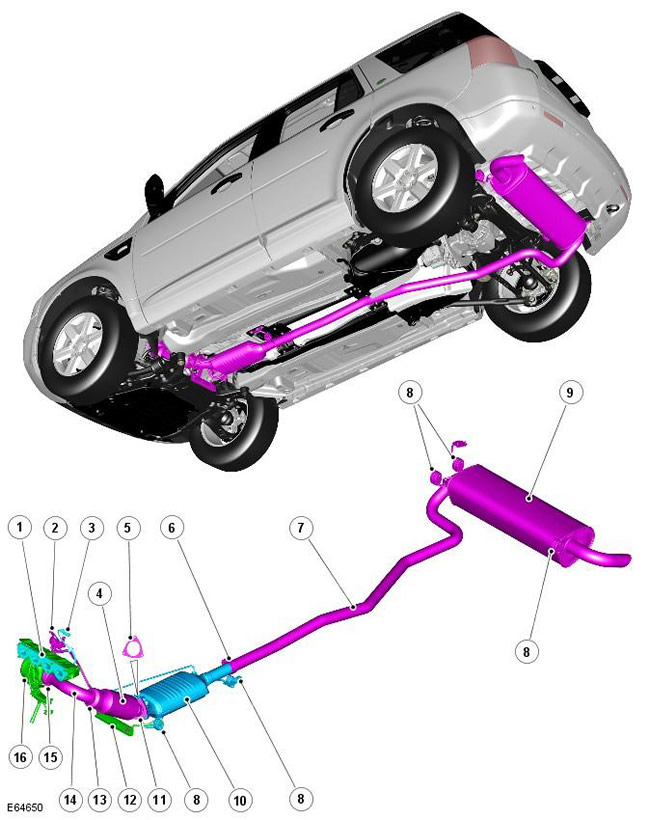
| Pos. | Spare part number | Name |
| 1 | - | Exhaust manifold (for reference only) |
| 2 | - | Differential pressure sensor |
| 3 | - | Heated Oxygen Sensor (HO2S) (Reference Only) |
| 4 | - | Catalytic converter |
| 5 | - | Pad |
| 6 | - | Clamp "Torca" |
| 7 | - | Connecting pipeline |
| 8 | - | Rubber support (6 pcs.) |
| 9 | - | Rear muffler |
| 10 | - | Diesel Fuel Product Filter (DPF) |
| 11 | - | Flange |
| 12 | - | Body suspension |
| 13 | - | Uncoupling device |
| 14 | - | Exhaust elbow |
| 15 | - | 'V' Clamp and Gasket |
| 16 | - | Turbocharger (for reference only) |
Without particulate filter
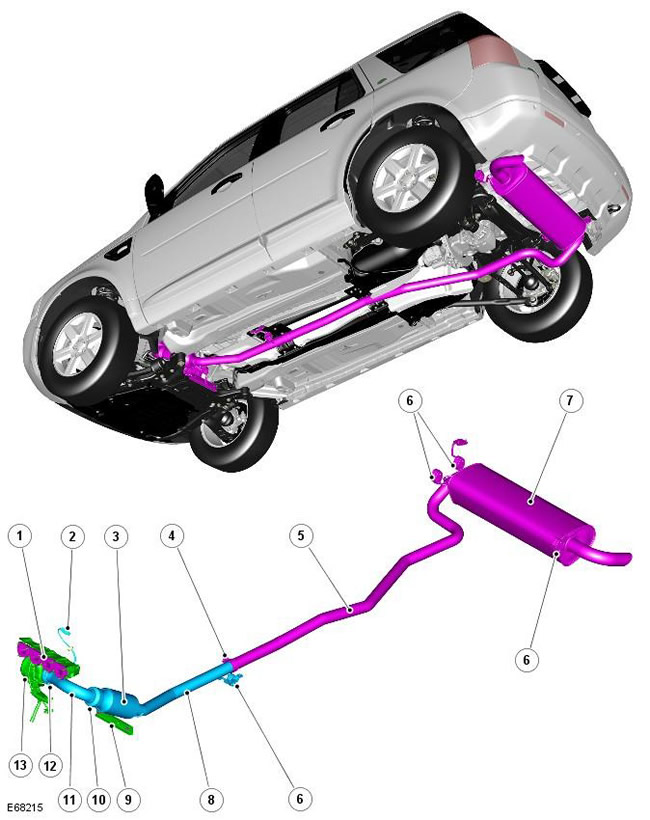
| Pos. | Spare part number | Name |
| 1 | - | Exhaust manifold (for reference only) |
| 2 | - | HO2S (for reference only) |
| 3 | - | Catalytic converter |
| 4 | - | Joint "Torca" |
| 5 | - | Rear connecting pipe |
| 6 | - | Rubber support (5 pcs.) |
| 7 | - | Rear muffler |
| 8 | - | Front connecting pipe |
| 9 | - | Body suspension |
| 10 | - | Uncoupling device |
| 11 | - | Exhaust elbow |
| 12 | - | "V" Clamp and Gasket |
| 13 | - | Turbocharger (for reference only) |
The 2.2L DW12 exhaust system is made of stainless steel and consists of 2 separate units; the front section houses the catalytic converter, and the rear section houses the rear muffler.
In some markets, the exhaust system is equipped with a diesel particulate filter (DPF), which enables the vehicle to exceed Euro IV emissions requirements.
The system is secured to the underbody by 6 rubber supports (in cars without DPF - 5 rubber supports), which are located on mild steel brackets welded to the system. The rubber supports serve to position the brackets, which are welded or bolted to the underbody.
[The text of the article was taken from the website www.lrman.ru]
Front section
The front section has a flared end that mates with the corresponding element of the turbocharger. The connection is secured with a "V"-shaped clamp and sealed with a gasket.
The prefabricated outlet elbow has a stamped flange and is welded to the uncoupler. The elbow has a threaded protrusion designed to accommodate the HO2S. The uncoupler, which provides a flexible joint, is welded to the catalytic converter housing.
Cars without DPF
A short section of the front connecting pipe from the catalytic converter mates with the rear connecting pipe of the system and is secured with a Torca joint. A rubber mount is located near the catalytic converter and is attached to the body hanger bracket.
Cars with DPF
The catalytic converter has a flange connection, sealed with a gasket and mating with the flange of the DPF. A short section of front connecting pipe comes out of the DPF outlet, which mates with the rear connecting pipe of the system and is secured with a flange connection. Two rubber mounts are located next to the catalytic converter and are attached to the body hanger bracket.
Rear section
The rear section has a long connecting pipe that mates with the front connecting pipe coming from the catalytic converter or DPF and is secured with a "Torca" joint. The pipe section runs along the bottom of the car and connects to the right side of the rear muffler.
The rear muffler is a single unit with a capacity of 29.3 liters. The muffler contains baffles and perforated tubes that reduce noise as exhaust gases pass through the muffler. Exhaust gases enter the muffler on the right side and exit through a pipe on the left side. The rear exhaust pipe faces the rear of the car and is curved downwards to direct exhaust gases away from the car.
Catalytic converter
The 2-liter oxidation catalytic converter is installed in the front section of the exhaust system, after the HO2S. The catalytic converter design is identical in both DPF and non-DPF vehicles.
The HO2S sensor monitors the composition of exhaust gases leaving the engine. The engine management system uses the information from the sensor to precisely dose the fuel supplied to the combustion chamber to ensure maximum fuel efficiency and minimize exhaust toxicity.
To further reduce the carbon monoxide and hydrocarbon content in the exhaust gases, a catalytic converter is integrated into the front exhaust manifold. In the catalytic converter, the exhaust gases pass through honeycomb ceramic elements with a special surface treatment ("washcoat").
Washcoat treatment increases the surface area of ceramic elements by approximately 7,000 times. A coating containing platinum is applied over the washcoat, an active component that serves to convert harmful exhaust gases into inert substances. Platinum adds oxygen to the carbon monoxide and hydrocarbons contained in the exhaust gases, converting them into carbon dioxide and water, respectively.
Comments on this article