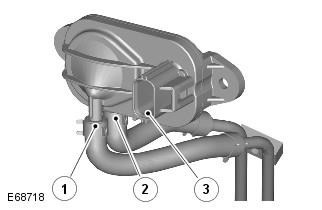
| Pos. | Spare part number | Name |
| 1 | - | High pressure pipe |
| 2 | - | Low pressure branch pipe |
| 3 | - | Electrical connector |
The differential pressure sensor is located in the engine compartment on the lower right side of the bulkhead. The sensor is mounted on two studs and secured with nuts.
The differential pressure sensor is used by the software to monitor the health of the DPF. Two ports on the sensor are connected by tubes to the inlet and outlet side of the DPF. The tubes allow the sensor to measure the DPF pressure at the inlet and outlet.
As the amount of particulate matter captured by the DPF increases, the pressure on the inlet side of the DPF increases compared to the outlet side. The DPF software uses this comparison in combination with other data to calculate the accumulated amount of particulate matter captured.
By measuring the pressure difference between the DPF inlet and outlet and the DPF temperature, the DPF software can determine if the DPF is clogged and requires regeneration.
(Data taken from the website: www.lrman.ru)
DPF Temperature Sensors
The DPF system uses two temperature sensors. One is located in the turbocharger outlet elbow, next to the HO2S sensor, and the second sensor is located on the DPF inlet.
The sensors measure the exhaust gas temperature at the turbocharger outlet and before passing through the DPF and provide the information needed to calculate the DPF temperature.
This information is used in combination with other data to calculate the amount of accumulated particulate matter and to control the DPF temperature.
Comments on this article