car logo Ford
car logo Volkswagen
car logo BMW
car logo Opel
car logo Audi
car logo Toyota
car logo Peugeot
English Русский
Български
Беларускі
Український
Српски
Hrvatski
Română
Polski
Slovenský
Magyar


Main
Freelander
Discovery
Range Rover
Defender
Contacts
Articles

Equipment for processing body cavities and processing methods (Freelander 1)

 
  • Main
  • Freelander
  • Freelander 1
  • Body and coating
  • Sealing and corrosion
  • Equipment for processing body cavities and processing methods
 
        0  
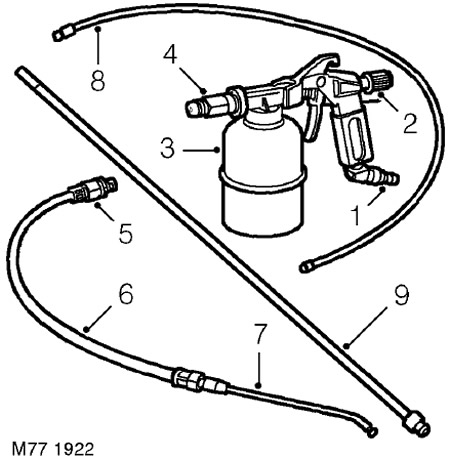
Equipment for processing body cavities and processing methods

  • 1 - Air inlet
  • 2 - Adjusting the spray pattern
  • 3 - Tank (1 l capacity). Maximum pressure 9.7 bar (9.84 kg/cm²)
  • 4 - Pistol nozzle
  • 5 - Nozzle nipple
  • 6 - Flexible tip
  • 7 - Rigid tip with a nozzle having a narrow spray cone
  • 8 - Flexible nylon hose with wide spray cone 360x
  • 9 - Rigid tip (1100 mm) with wide spray cone 360x

When re-treating cavities whose coating was damaged during repair, it is necessary to use a gun powered by a compressor with a tank designed for high pressure and a set of various removable tips.

When selecting a tip to be installed on a gun, depending on the working conditions, the following must be taken into account:
  • Use a rigid or flexible tip with a wide 360° spray cone to treat hidden cavities to ensure maximum surface area coverage.
  • If access to the cavity is difficult (when the entrance is narrow or the cavity is small), use a curved tip with a more directed spray.
  • Open surfaces of the bottom should be treated directly with a gun without tips, without interrupting the supply of liquid.

Flexible nylon tip 1100mm long
This tip is similar in design to the rigid tip, but allows better treatment of curved cavities or places with difficult access. Its main disadvantage is the lack of positioning accuracy inside a closed cavity.


Perform all treatment using the outer end of the tip. Pull the tip out of the cavity slowly to ensure sufficient surface treatment. Do not pull the tip out too quickly.

Make sure that the nylon hose of the tip does not touch the edges of the cavity inlet to avoid abrasion and prolong the life of the hose. Be careful that the spray stops before the tip nozzle exits the cavity inlet. To help this, paint the last 30 mm of the tip RED.

Curved end of flexible tip
The curved rigid end with a nozzle allows you to get a finely dispersed narrow conical stream, directed far forward and having good atomization characteristics. This combination allows you to treat short narrow cavities well, can be used for treating the inner panels of wheel arches and other similar places.

When working, position the flat surface of the tip end at 180 degrees to the direction of the jet from the nozzle. This will allow more precise direction of the jet when the nozzle is hidden in a cavity or in the opening of a cavity.

When general surface treatment, move the nozzle in an arc from side to side to ensure complete treatment.

Keep all surface treatment equipment clean. Clean all parts with white spirit immediately after finishing the coating.


This article is available at russian, bulgarian, belarusian, ukrainian, serbian, croatian, romanian, polish, slovak, hungarian
Article review: Konstantin Nazarov


Previous articles
Body sealing materials
Equipment for applying sealants

Current article
Equipment for processing body cavities and processing methods

Next articles
Covering hidden cavities with protective wax and holes — 3-door body
Openings for protection of the inner cavity of the threshold — 5-door body
Covering hidden cavities with protective wax and holes — 5-door body
Anti-corrosion treatment
Areas of the underbody treated with sealing materials
Adhesive materials for load-bearing body elements
Materials for sealing seams
Acoustic insulation with foaming material


Similar articles from Land Rover repair manuals:
• Equipment for troubleshooting Discovery 3 (2004-2009)
• Electrical equipment — specifications Discovery 1 (1989-1998)
• Equipment for processing body cavities and processing methods Range Rover 3 (2001-2012)
• Leak testing using emission testing equipment Defender 2007+ (2007-2016)

Comments on this article


No comments yet


How much will 50 + 37 =


Freelander 2 
  • General information
  • Using the manual
  • Repair technique
  • Precautionary measures
  • Road test
  • Fault codes
  • Identification codes
  • Jacking and lifting
  • Maintenance - Diesel
  • Maintenance - petrol
  • Chassis
  • Suspension
  • Front suspension
  • Rear suspension
  • Wheels and tires
  • Terrain response
  • Transmission system
  • Cardan shaft
  • Rear drive axle
  • Rear axle shafts
  • Front axle shafts
  • Brake system
  • Parking brake
  • Hydraulic brake
  • Brake booster
  • Anti-lock braking system
  • Exchange rate stability
  • Steering
  • Steering column
  • Power unit
  • Engine device
  • Engine repair
  • Description of the cooling system
  • Cooling system repair
  • Fuel supply
  • Drive units
  • Launch system
  • Ignition system
  • Exhaust toxicity
  • Air filtration
  • Fuel vapor control
  • Electronic control part
  • Automatic gearbox
  • Gearbox cooling
  • Automatic transmission controls
  • Mechanical transmission
  • Transfer case
  • Exhaust system
  • Fuel tank and lines
  • Speed control
  • Electrical equipment
  • Climate control system
  • Climate control
  • Additional climate control
  • Instrument panel
  • Sound signal
  • Information and messages
  • Assistance with parking
  • Battery and alternator
  • Information and entertainment
  • Outdoor Lighting
  • Interior lighting
  • Communication network
  • Wiring harnesses
  • Anti-theft system
  • Multifunctional modules
  • Body and coating
  • Body front panels
  • Lockable body parts
  • Interior trim
  • Rear view mirrors
  • Car seats
  • Glass, frames and mechanisms
  • Instrument panel and console
  • Handles, locks, latches
  • Windshield wipers and washers
  • Sunroof
  • Bumpers
  • Seat belt system
  • Restraint system
  • Body repairs
  • Front end repairs
  • Roof element repairs
  • Side panel repairs
  • Tailgate repairs
  • Subframe and mounts

Freelander 1 
  • General information
  • Using the manual
  • Precautionary measures
  • Technique
  • Specifications
  • Connection tightening torques
  • Maintenance
  • Power unit
  • Diesel engine Td4
  • Petrol engine K1.8
  • Piston group K1.8
  • KV6 petrol engine
  • Piston group KV6
  • Decreased toxicity
  • Motor control EDC
  • Engine management MEMS
  • Motor control Siemens
  • Fuel supply diesel Td4
  • Fuel supply for K1.8 engine
  • Fuel supply of KV6 engine
  • Cooling diesel Td4
  • Engine cooling K1.8
  • Engine cooling KV6
  • Exhaust system Td4
  • Exhaust system K1.8
  • Exhaust system KV6
  • Clutch
  • Mechanical transmission
  • Transfer case
  • Automatic gearbox
  • Chassis
  • Drive shafts
  • Rear axle and final drive
  • Steering
  • Front suspension
  • Rear suspension
  • Brake system
  • Body and coating
  • Passive safety
  • Doors, locks and glass
  • Exterior body parts
  • Interior trim details
  • Seats
  • Roof hatch
  • Roof
  • Body geometry
  • Body parts repair
  • Sealing and corrosion
  • Electrical equipment
  • Heating and ventilation
  • Air conditioning
  • Windshield wipers and washers
  • Starting engine and charging
  • Lighting and headlights
  • Control modules
  • Safety system
  • Window management
  • Entertainment systems
  • Wiring harnesses
  • Governing bodies
  • Devices


LRman.ru © 2013-2026 | Mobile version | Free Lander | Discovery | Range Rover | Defender | Contacts | | Sitemap |
Car repair and service instructions Land Rover: Freelander, Discovery, Range Rover, Defender
We use cookies to make pages load faster and provide a more user-friendly experience 🍪