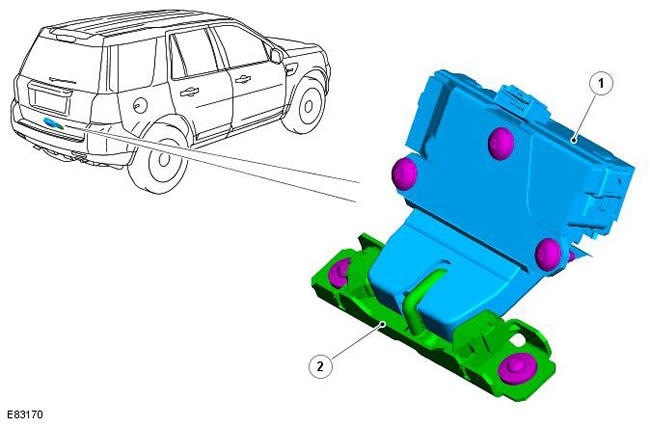
| Pos. | Spare part number | Name |
| 1 | - | Luggage compartment liftgate latch |
| 2 | - | Luggage compartment lift door lock latch |
The tailgate latch is mounted at the bottom centre of the inner tailgate panel and is a fully electric unit. The tailgate latch incorporates the locking motor and is powered via a hardwire connection from the CJB. The release microswitch is located within the touch pad located on the underside of the outer tailgate handle.
The CJB releases the tailgate latch when the vehicle is stationary and the remote control button or the outside handle touchpad is pressed. The tailgate latch will also be released if the central locking switches on the instrument panel are pressed simultaneously for three seconds (with the vehicle speed below 8 km/h (5 mph)).
Partial closing switch for the liftgate
the liftgate latch has a partial close switch which is hardwired to the CJB. When the ignition is in power mode 4 (accessory power) or 6 (ignition power) and the liftgate is opened or partially closed, the liftgate partial close switch disconnects the ground from the CJB. The CJB sends a message via the medium speed CAN data bus to the instrument cluster informing the driver that the liftgate is partially closed.
On vehicles with a low-level instrument cluster, the tailgate not fully closed symbol lights up. For more information, refer to the chapter: Instrument cluster (413-01 Instrument cluster, Description and operating principle).
On vehicles with a high-level instrument cluster, the tailgate not fully closed symbol lights up and a message is also displayed in the information centre display. For further information, refer to the chapter: Information and message centre (413-08 Information and message centre, Description and function).
The liftgate partial close switch is also integrated into the vehicle security system and is used as a vehicle intrusion detection device. For more information, refer to the chapter: Anti-theft alarm system - active (419-01A Anti-theft alarm system - active, Description and operating principle).
Comments on this article