Contents: Remote control ⇩ Radio frequency receiver ⇩ Central locking button on the front…⇩ Central locking switches on the…⇩
The central locking system allows the driver to control the locking and unlocking of the vehicle entry points from the inside or outside. Manual control of the central locking system is performed using the following elements:
- Remote control and RF receiver
- Central locking button on the front door
- Central locking switches on the instrument panel
Remote control
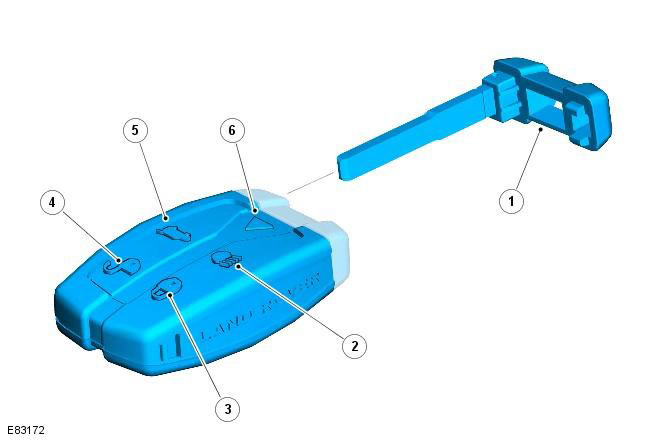
| Pos. | Spare part number | Name |
| 1 | - | Emergency access key |
| 2 | - | Headlight Delay Function Button |
| 3 | - | Car lock button |
| 4 | - | Car unlock button |
| 5 | - | Tailgate release button |
| 6 | - | Warning alarm button |
The remote control is a sealed, waterproof unit that contains a printed circuit board, a repeater (transponder) and a battery. The remote control battery is charged whenever it is in the starter control unit with the engine running.
The remote control has an emergency key hidden inside the remote control. The emergency key is used to gain access to the vehicle through the left front door if the central locking system malfunctions. The emergency key is also used to activate or deactivate the child-proof rear door locks and to deactivate the front passenger airbag. For more information, refer to the chapter: Supplemental Restraint System of the Air Bags and Seat Belt Tensioners (SRS) (501-20B Supplemental Restraint System, Description and Operation).
The remote control is the same for all vehicle specifications. The difference is in the preset frequency and power of the remote control. The remote control for each vehicle specification is identified by changing the final index in the base item number:
| Element Number End Index | Operating frequency | Vehicle specification |
| A# | 433 MHz | Europe and the rest of the world |
| B# | 315 MHz | North American Countries |
| C# | 315 MHz low power | Japan and Korea |
Each remote control has a unique identification code that is programmed into the built-in transponder. The radio frequency signal from the remote control contains a unique identification code as well as a variable code. During vehicle production, the unique identification codes of valid remote controls are entered into the CJB; variable codes are also synchronized with CJB.
When a button on the remote control is pressed, the CJB checks the unique identification and variable code. The CJB only responds to the radio frequency signal of a remote control valid for the vehicle. For more information, refer to the chapter: Anti-Theft - Passive (419-01 Anti-Theft - Passive, Description and Function).
The CJB software has 30 slots for replacement or additional remote controls. A Land Rover approved diagnostic system can be used by a workshop to communicate with the CJB to perform the following operations:
- Identification of the remote control registered in the CJB.
- Activating new remote controls.
- Deactivating existing remote controls.
- Reactivate previously deactivated remote controls.
If the remote control variable code loses synchronisation with the CJB, the remote control functions will not operate. Synchronisation between the remote control and the CJB can be restored by starting the engine with the faulty remote control and allowing it to run for at least 6 minutes.
The remote control has additional buttons that provide convenient control of the functions of opening the lifting tailgate, delayed switching off of the headlights and the warning alarm.
Radio frequency receiver
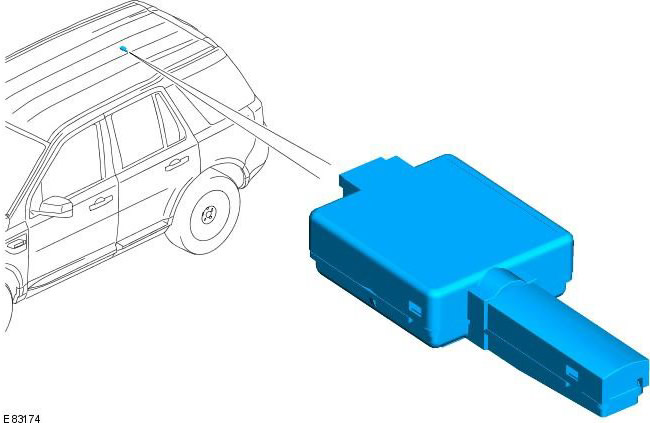
The radio frequency receiver is located above the headliner, next to the rear interior light. The receiver provides the remote central locking system and is also used by the tire pressure monitoring system and interior lighting system.
For more information, please refer to the chapter:
- Wheels and tires (204-04 Wheels and tires, Description and operating principle)
- Interior Lighting (417-02 Interior Lighting, Description and Operating Principle)
The RF receiver is the same for all vehicle specifications. The difference is in the preset frequency and receiver power. The RF receiver for each vehicle specification is identified by a change in the final index in the base item number:
| Element Number End Index | Operating frequency | Vehicle specification |
| A# | 433 MHz | Europe and the rest of the world |
| C# | 315 MHz | North American countries, Japan and Korea |
The remote control receiver converts the signals transmitted by the remote control into digital messages and then transmits them via the LIN bus to the CJB.
The CJB supplies constant power to the RF receiver.
Central locking button on the front door
Both central locking buttons on the front doors activate the central locking function. Pressing/releasing the central locking button on the front door centrally locks/unlocks all vehicle doors.
When the central locking button on the front door is pressed/released, the corresponding door control module sends a central locking/unlocking request to the CJB. The CJB then sends a central locking/unlocking command to all door control modules to lock/unlock all doors of the vehicle.
Central locking using the central locking button on the front door is inhibited if one of the front doors is not closed securely. If a front door is not closed securely when the central locking button is pressed, the doors will be locked and then unlocked immediately.
Central locking switches on the instrument panel
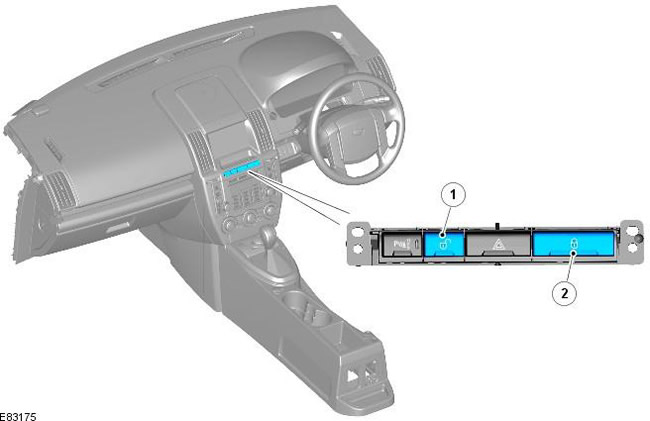
| Pos. | Spare part number | Name |
| 1 | - | CLS interior unlocking switch |
| 2 | - | CLS system interior locking switch |
The interior locking and unlocking switches are located on the instrument panel and are designed to manually control the vehicle's central locking system. The switches are non-locking and allow all access points to the vehicle to be centrally locked or unlocked from the vehicle's interior.
Pressing the lock or unlock switch on the instrument panel closes the circuit connecting the mass to the CJB unit, which activates the electric motors for locking or unlocking the door latches, the tailgate latches and the fuel filler cap actuator. Doors will only respond to the central locking/unlocking command if they are fully closed. Operation of the central locking system is prohibited if one of the doors is not tightly closed.
The tailgate latch will open if the central locking switches on the instrument panel are pressed simultaneously for three seconds (with the vehicle speed below 8 km/h (5 mph)).
Comments on this article