Contents: Rear door locks with child protection ⇩ Door partial closing switch ⇩ Emergency mechanical door lock ⇩
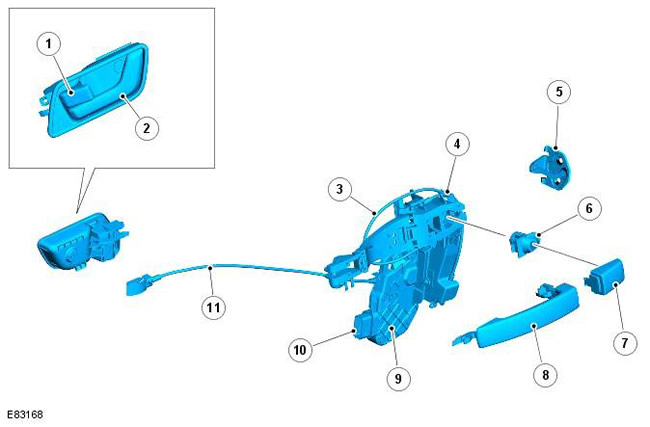
| Pos. | Spare part number | Name |
| 1 | - | Interior door lock/unlock button |
| 2 | - | Internal door opening handle |
| 3 | - | Mechanical door lock release cable (for left front door only) |
| 4 | - | External door lock cable |
| 5 | - | Lock retainer |
| 6 | - | Emergency mechanical door lock (for left front door only) |
| 7 | - | Outside door handle lock cover |
| 8 | - | External door handle |
| 9 | - | Door latch |
| 10 | - | Electrical connection to door control module |
| 11 | - | Internal door lock cable |
The door latches are mounted on the rear ends of the doors, and each of them engages with the corresponding latch on the "B" and "C" pillars. Each inner and outer door handle is connected to the corresponding door latch by means of a cable. In the left front door there is a third cable that connects the door latch to the secret emergency mechanical door lock.
Each door latch is a sealed unit consisting of the following elements:
- Locking motor.
- Double locking motor (for all models except those intended for North America, Japan and the Gulf of Mexico).
- Door soft close switch.
Electrical connectors in each door latch provide interface to the door control module, CJB and AJB. The front door control modules are connected to the CJB via the medium speed CAN bus; the rear door control modules are connected via the LAN bus to the front door control modules. Power for the door lock latches and double lock motors is supplied by the AJB.
The door locking and double locking motors control the operation of the door latches, allowing the vehicle to be locked and unlocked using cables. When the vehicle doors are locked, the door locking motors disconnect the outside handle cables from the door latches. When the vehicle is double locked, the double locking motor also disconnects the inside handle cables from the door latches. When the vehicle is subsequently unlocked, the inside and outside handle cables are reconnected to the door latches.
All interior door handles have a locking button. When the central locking button on the front door is pressed/released, all vehicle doors are centrally locked/unlocked. When the locking button on the rear door is pressed/released, only the corresponding rear door is locked/unlocked.
When the door lock button is pressed, pressure on the inside door handle cable causes the outside door handle cable to disconnect from the door latch. Pressing the lock button on the rear doors also causes the inside door handle cable to disconnect.
When the door lock button is released, the inside door handle reconnects to its cable. Once the inside door handle cable is connected, the cable is pulled out, causing the door latch to connect to the outside door handle cable.
Rear door locks with child protection
The publication was copied from a web resource [www.lrman.ru]
The rear door latches include child-resistant locks to enhance safety for rear seat passengers. The child-resistant locks are manually operated using the emergency access key inside the remote control. When the child-resistant locks are set to the locked position, the interior door handle cable will be disconnected from the door latch, preventing the interior handle from opening the rear door.
For more information on child-resistant locks, please refer to the Operating Manual.
Door partial closing switch
Each door latch has a partial closure switch which is hardwired to the CJB. When the ignition is in power mode 4 (accessory power) or 6 (ignition power) and a door is opened or partially closed, the relevant partial closure switch disconnects the ground from the CJB. The CJB sends a message via the medium speed CAN data bus to the instrument cluster informing the driver that the door is partially closed.
On vehicles with a low-level instrument cluster, the door ajar symbol lights up. For more information, refer to the chapter: Instrument cluster (413-01 Instrument cluster, Description and operating principle).
On vehicles with a high-level instrument cluster, the door ajar symbol lights up and a message is also displayed in the information centre display. For further information, refer to the chapter: Information and message centre (413-08 Information and message centre, Description and function).
The door ajar switch is also integrated into the vehicle security system and is used as a vehicle intrusion detection device. For more information, refer to the chapter: Anti-Theft System - Active (419-01A Anti-Theft System - Active, Description and Function).
Emergency mechanical door lock
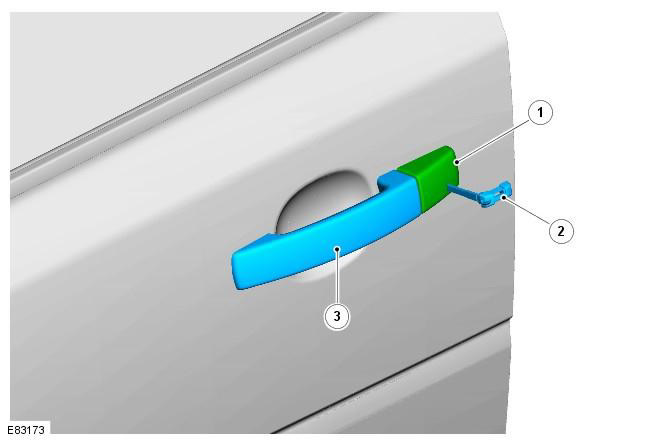
| Pos. | Spare part number | Name |
| 1 | - | Hidden mechanical lock |
| 2 | - | Emergency access key |
| 3 | - | Left front door handle |
The remote control has an emergency key hidden inside the remote control. The mechanical door lock is located in the outer handle of the left front door under a removable plastic cover. The door lock allows the left front door to be mechanically unlocked and locked using the emergency key in the event of a malfunction of the remote central locking function or a power failure in the vehicle.
When using the mechanical lock, the central locking system does not work and if the car's anti-theft system is activated, an audible alarm will sound when the door is opened. The emergency access key cannot be used to double lock the car or activate the anti-theft alarm.
Comments on this article