car logo Ford
car logo Volkswagen
car logo BMW
car logo Opel
car logo Audi
car logo Toyota
car logo Peugeot
English Русский
Български
Беларускі
Український
Српски
Hrvatski
Română
Polski
Slovenský
Magyar


Main
Freelander
Discovery
Range Rover
Defender
Contacts
Articles

Repair methods (Freelander 2)

 
  • Main
  • Freelander
  • Freelander 2
  • Electrical equipment
  • Wiring harnesses
  • Repair methods
 
        0  
Contents: Comparison table ⇩ Removal contacts from electrical…⇩
CAUTION: The same electrical connector housing may contain contacts of different sizes and types.


It is necessary to determine:
  • Wire cross-section in a faulty wiring harness
  • The area with the electrical connector from which the damaged wiring harness needs to be removed
  • Contact type

Using the recommended diagnostic tool makes identifying electrical connectors and faulty contacts much easier and faster.

You can also refer to the vehicle's electrical diagrams (available from dealers) to identify wire harnesses and electrical connectors.

The comparison table can be used to determine the wire size in a wire harness for a suitable harness with insulation color termination. It can also be used to determine the correct insulation trim length on a wire harness.

Comparison table


CABLE RANGEPLACE OF JOINTINGSTRIP LENGTH
from 0.35 to 1.50 mm²REDfrom 6.00 to 7.00 mm
from 1.00 to 2.50 mm²BLUEfrom 6.00 to 7.00 mm
from 4.00 to 6.00 mm²YELLOWfrom 9.00 to 9.50 mm

Removal contacts from electrical connectors


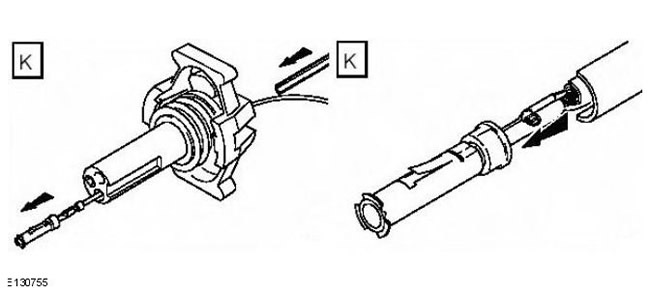
It should be noted that some electrical connectors are equipped with locks that prevent the contacts from being removed from the connector. The following illustrations show examples of such connectors. Before removing a contact from an electrical connector, it is necessary to disconnect the lock. Some locks require a special tip (included in the kit) to disconnect. Most locks can be disconnected with a suitable small screwdriver.


Some types of electrical connectors have internal or external seals to prevent moisture from getting in. It is not usually necessary to remove these seals, but check for them when connecting electrical connectors.

The illustrations show examples of each tip used for various types of electrical connectors. There are many different types of electrical connectors, so only one example of each tip is shown. The technician should use experience and common sense to select a tip for electrical connectors not shown. Care should be taken to avoid causing additional damage when removing contacts from the electrical connector.

NOTE: Examples of tips for extracting contacts and disconnecting retainers.
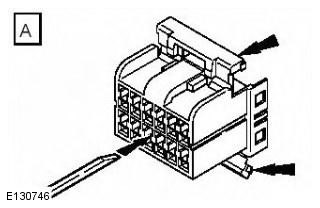

NOTE: Examples of tips for extracting contacts and disconnecting retainers.
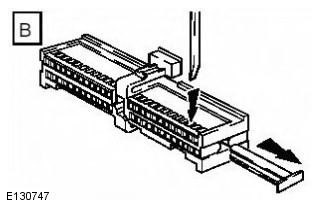

NOTE: Examples of tips for extracting contacts and disconnecting retainers.
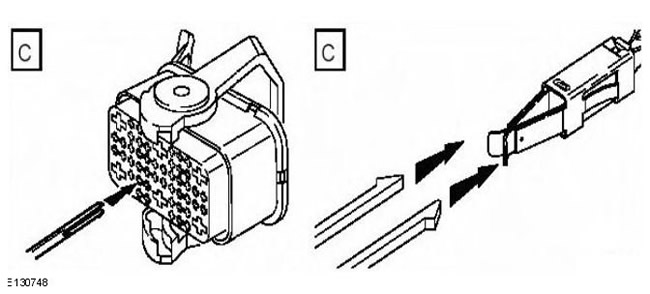

NOTE: Examples of tips for extracting contacts and disconnecting retainers.
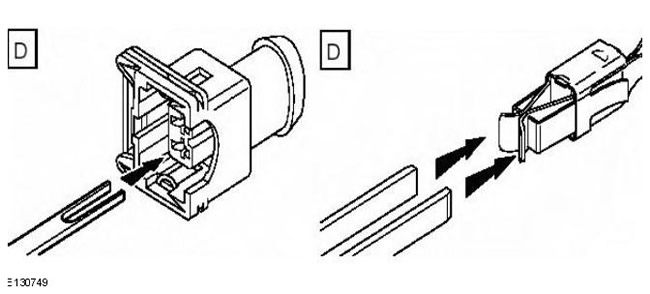

NOTE: Examples of tips for extracting contacts and disconnecting retainers.
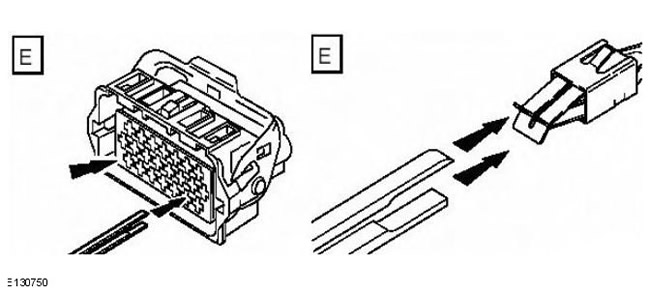

NOTE: Examples of tips for extracting contacts and disconnecting retainers.
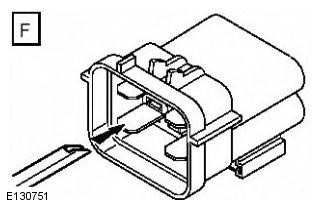

NOTE: Examples of tips for extracting contacts and disconnecting retainers.
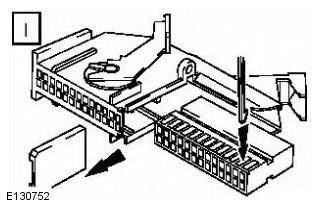

NOTE: Examples of tips for extracting contacts and disconnecting retainers.
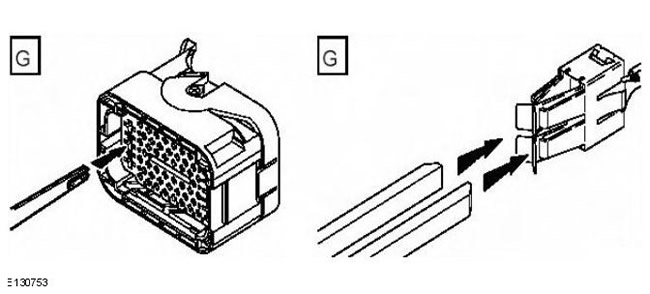

NOTE: Examples of tips for extracting contacts and disconnecting retainers.


[See the source on the website LRman.ru]
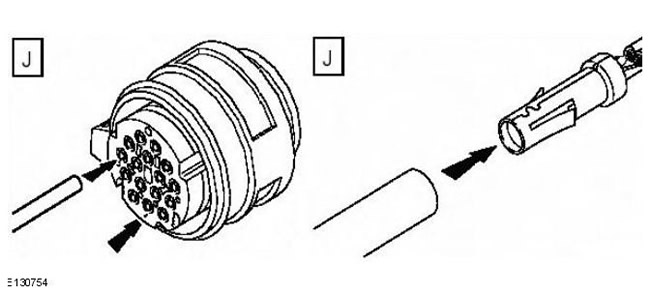


NOTE: Examples of tips for extracting contacts and disconnecting retainers.


NOTE: Examples of tips for extracting contacts and disconnecting retainers.


NOTE: The diagram shows the electrical connector types, contacts/sockets, contact extraction tip, and retainer release tip.


Type of contact in an electrical connectorPin or socketExtraction tipRetainer release tip
Mulitlock 040 SeriesDA
Mulitlock 040 SeriesBA
Mulitlock 070 SeriesBB
Mulitlock 040 SeriesDB
Econoseal III 070 SeriesDB
Econoseal III 070 SeriesBB
Econoseal III J2DB
Econoseal III 250 SeriesBF
Econoseal III 250 SeriesDB
Econoseal III 250 SeriesBF
Econoseal III 250 SeriesDB
Microtimer II 1.5 mmDC
Microtimer II 1.5 mmBC
Standard Power Timer 4.8 flatDG
Standard Power Timer 5.8 flatBD
Standard Power Timer 2.8 flatDD
Standard Power Timer 4.8 flatDG
Standard Power Timer 5.8 flatBD
Ford 2.8 flatDEH
Mulitlock 070 SeriesDB
Mulitlock 070 SeriesBB
Junior power timer 2.8 flatDD
Sumitomo TS90 connectorBBH
Modu IV gold platedDB
Mulitlock 040 series gold platedDA
Micro qualockDI
EECVDB
EECVDB
Kostal series diam. 1.50DJ
AMP 6.3 flatDB
Junior power timer 2.8 flatDD
Series 2.8DBI
Sumitomo TS90 connectorDBH
Ducon 0.60 gold platedDK
AMP 6.3 flatDD
Econoseal III 250 SeriesBF


This article is available at russian, bulgarian, belarusian, ukrainian, serbian, croatian, romanian, polish, slovak, hungarian
Article review: Roman Mitrofanov


Previous articles
Introduction
Repair kit
Pre-terminated wire harnesses and butt connectors
Handle and tips of the contact extraction tool
Wire Stripper
List of spare parts

Current article
Repair methods

Next articles
Repair procedure
Engine Wiring Harness


Similar articles from Land Rover repair manuals:
• Structure of the repair manual Discovery 3 (2004-2009)
• Repair — Fuel Level Sensor Discovery 1 (1989-1998)
• Repair and restoration work and replacement of components Range Rover 3 (2001-2012)

Comments on this article


No comments yet


How much will 20 + 24 =


Freelander 2 
  • General information
  • Using the manual
  • Repair technique
  • Precautionary measures
  • Road test
  • Fault codes
  • Identification codes
  • Jacking and lifting
  • Maintenance - Diesel
  • Maintenance - petrol
  • Chassis
  • Suspension
  • Front suspension
  • Rear suspension
  • Wheels and tires
  • Terrain response
  • Transmission system
  • Cardan shaft
  • Rear drive axle
  • Rear axle shafts
  • Front axle shafts
  • Brake system
  • Parking brake
  • Hydraulic brake
  • Brake booster
  • Anti-lock braking system
  • Exchange rate stability
  • Steering
  • Steering column
  • Power unit
  • Engine device
  • Engine repair
  • Description of the cooling system
  • Cooling system repair
  • Fuel supply
  • Drive units
  • Launch system
  • Ignition system
  • Exhaust toxicity
  • Air filtration
  • Fuel vapor control
  • Electronic control part
  • Automatic gearbox
  • Gearbox cooling
  • Automatic transmission controls
  • Mechanical transmission
  • Transfer case
  • Exhaust system
  • Fuel tank and lines
  • Speed control
  • Electrical equipment
  • Climate control system
  • Climate control
  • Additional climate control
  • Instrument panel
  • Sound signal
  • Information and messages
  • Assistance with parking
  • Battery and alternator
  • Information and entertainment
  • Outdoor Lighting
  • Interior lighting
  • Communication network
  • Wiring harnesses
  • Anti-theft system
  • Multifunctional modules
  • Body and coating
  • Body front panels
  • Lockable body parts
  • Interior trim
  • Rear view mirrors
  • Car seats
  • Glass, frames and mechanisms
  • Instrument panel and console
  • Handles, locks, latches
  • Windshield wipers and washers
  • Sunroof
  • Bumpers
  • Seat belt system
  • Restraint system
  • Body repairs
  • Front end repairs
  • Roof element repairs
  • Side panel repairs
  • Tailgate repairs
  • Subframe and mounts

Freelander 1 
  • General information
  • Using the manual
  • Precautionary measures
  • Technique
  • Specifications
  • Connection tightening torques
  • Maintenance
  • Power unit
  • Diesel engine Td4
  • Petrol engine K1.8
  • Piston group K1.8
  • KV6 petrol engine
  • Piston group KV6
  • Decreased toxicity
  • Motor control EDC
  • Engine management MEMS
  • Motor control Siemens
  • Fuel supply diesel Td4
  • Fuel supply for K1.8 engine
  • Fuel supply of KV6 engine
  • Cooling diesel Td4
  • Engine cooling K1.8
  • Engine cooling KV6
  • Exhaust system Td4
  • Exhaust system K1.8
  • Exhaust system KV6
  • Clutch
  • Mechanical transmission
  • Transfer case
  • Automatic gearbox
  • Chassis
  • Drive shafts
  • Rear axle and final drive
  • Steering
  • Front suspension
  • Rear suspension
  • Brake system
  • Body and coating
  • Passive safety
  • Doors, locks and glass
  • Exterior body parts
  • Interior trim details
  • Seats
  • Roof hatch
  • Roof
  • Body geometry
  • Body parts repair
  • Sealing and corrosion
  • Electrical equipment
  • Heating and ventilation
  • Air conditioning
  • Windshield wipers and washers
  • Starting engine and charging
  • Lighting and headlights
  • Control modules
  • Safety system
  • Window management
  • Entertainment systems
  • Wiring harnesses
  • Governing bodies
  • Devices


LRman.ru © 2013-2026 | Mobile version | Free Lander | Discovery | Range Rover | Defender | Contacts | | Sitemap |
Car repair and service instructions Land Rover: Freelander, Discovery, Range Rover, Defender
We use cookies to make pages load faster and provide a more user-friendly experience 🍪