car logo Ford
car logo Volkswagen
car logo BMW
car logo Opel
car logo Audi
car logo Toyota
car logo Peugeot
English Русский
Български
Беларускі
Український
Српски
Hrvatski
Română
Polski
Slovenský
Magyar


Main
Freelander
Discovery
Range Rover
Defender
Contacts
Articles

Description of mobile phone (Freelander 2)

 
  • Main
  • Freelander
  • Freelander 2
  • Electrical equipment
  • Information and entertainment
  • Description of mobile phone
 
        0  
Contents: Phone module ⇩ Microphone ⇩ Control system switches ⇩ Voice control of the phone ⇩ Operating principles ⇩
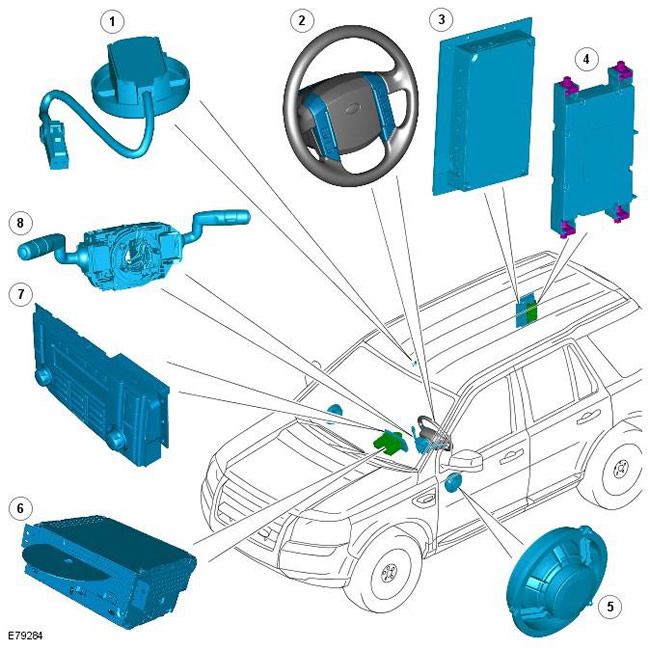
Description of mobile phone

Pos.Spare part numberName
1-Microphone
2-Steering wheel switches
3-Sound amplifier
4-Phone control module
5-Speakers
6-Integrated Audio Module (IAM)
7-Infotainment Control Module (ICM)
8-Clock spring

This system allows the driver to use a Bluetooth-enabled cell phone through the vehicle's on-board infotainment system.

NOTE: There is no physical connection (holder) between the handset and the phone control module. Communication between these two elements is supported exclusively via Bluetooth. Depending on the phone model, this may limit the range of available functions.


The cellular telephone system includes the following elements:
  • Phone control module
  • Microphone

To dial numbers, use one of the following methods:

[The material was taken from a website: lrman.ru]
  • Typing with ICP keyboard
  • Selecting a number from the handset directory using ICM
  • Selecting from the handset call log using ICM

The telephone control module is connected to the infotainment system via the MOST loop. This allows audio and control signals to pass through the telephone control system. The telephone control module has an integrated Bluetooth antenna.


Before the handsets can be used with the vehicle system, they must be paired with the telephone system control unit. Up to five mobile phones can be connected to the vehicle, but only one can be used at a time.

Phone module
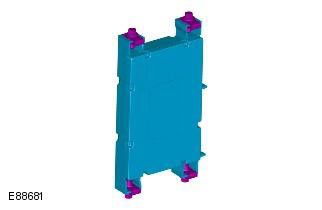

Phone module


The telephone control unit is located in the rear right-hand part of the luggage compartment. The telephone module is connected via the MOST bus to other modules of the multimedia system.

Microphone
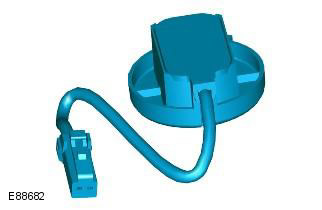

Microphone


The microphone is located on the overhead console next to the front interior light. The microphone has a wired connection to the integrated audio module (IAM).

Control system switches
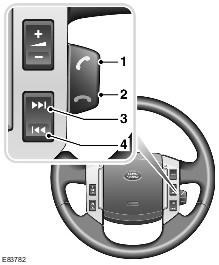

Control system switches


Pos.Spare part numberName
1-Call and dial switch
2-Call End and Reject Switch
3-Forward Menu Button
4-Menu button Back


The steering wheel mounted telephone control switches are located on the right side of the steering wheel. The switches are of the resistive multi-link type and return different voltage signals to the ICM depending on the buttons pressed. For more information, refer to the chapter: Steering Column Switches (211-05 Steering Column Switches, Description and Operation).

The following table lists the functions of the cellular phone control switches located on the steering wheel.

SwitchFunctions
ModeChanges the audio source without displaying it on the display. (Also changes the ICM display according to the selected source)
|<< >>|Scroll the phone book down/up (if the display is in Phone mode)
Start talk keyLast 10 dialed numbers, call, call reception (if the display is in Phone mode)

ICM Control Switches


ICM Control Switches


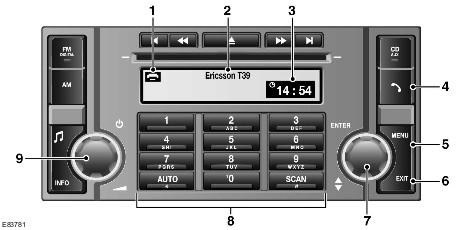
Pos.Spare part numberName
1-Call status icon
2-Paired phone name
3-Time
4-Telephone mode button
5-MENU button
6-EXIT button
7-ENTER button
8-Keyboard
9-On/off/volume control button

Access to a mobile phone via ICM provides the user with a variety of functions (depending on the Bluetooth version of the phone).


Voice control of the phone


The car system supports all voice tags stored in the phone. The cell phone system does not support voice dialing.

The voice dialing function is accessed by long pressing the right rotary ENTER button. The ICM displays the voice dialing process and the phone control module issues a voice prompt. After the prompt, the handset waits for a few seconds for a voice command.

Operating principles


The telephone system is controlled by the ICM and/or the steering wheel switches. The control signals from the steering wheel switches are transmitted via the sliding contact group and the steering wheel module to the ICM. The ICM sends the control signals via the MOST bus to the telephone control module. The audio is transmitted via the MOST bus to the audio amplifier and output through the vehicle speakers.


This article is available at russian, bulgarian, belarusian, ukrainian, serbian, croatian, romanian, polish, slovak, hungarian
Article review: Roman Mitrofanov


Previous articles
Inspection and verification
Table of signs of malfunctions of the navigation system
DTC Trouble Code Index
Pinpoint tests
Navigation system fault localization tests
Bolt tightening torques
Description and principle of operation
Low Series Audio System

Current article
Description of mobile phone

Next articles
Mobile phone control diagram
Navigation system
Navigation system control diagram
Principles of operation of the navigation system
Removal and installation the audio unit
Acoustic speaker in the front door
Acoustic speaker in the rear door
Removal and installation the video system display


Similar articles from Land Rover repair manuals:
• Cellular Phone System (prior to 2009 model year) Discovery 3 (2004-2009)

Comments on this article


No comments yet


How much will 46 + 38 =


Freelander 2 
  • General information
  • Using the manual
  • Repair technique
  • Precautionary measures
  • Road test
  • Fault codes
  • Identification codes
  • Jacking and lifting
  • Maintenance - Diesel
  • Maintenance - petrol
  • Chassis
  • Suspension
  • Front suspension
  • Rear suspension
  • Wheels and tires
  • Terrain response
  • Transmission system
  • Cardan shaft
  • Rear drive axle
  • Rear axle shafts
  • Front axle shafts
  • Brake system
  • Parking brake
  • Hydraulic brake
  • Brake booster
  • Anti-lock braking system
  • Exchange rate stability
  • Steering
  • Steering column
  • Power unit
  • Engine device
  • Engine repair
  • Description of the cooling system
  • Cooling system repair
  • Fuel supply
  • Drive units
  • Launch system
  • Ignition system
  • Exhaust toxicity
  • Air filtration
  • Fuel vapor control
  • Electronic control part
  • Automatic gearbox
  • Gearbox cooling
  • Automatic transmission controls
  • Mechanical transmission
  • Transfer case
  • Exhaust system
  • Fuel tank and lines
  • Speed control
  • Electrical equipment
  • Climate control system
  • Climate control
  • Additional climate control
  • Instrument panel
  • Sound signal
  • Information and messages
  • Assistance with parking
  • Battery and alternator
  • Information and entertainment
  • Outdoor Lighting
  • Interior lighting
  • Communication network
  • Wiring harnesses
  • Anti-theft system
  • Multifunctional modules
  • Body and coating
  • Body front panels
  • Lockable body parts
  • Interior trim
  • Rear view mirrors
  • Car seats
  • Glass, frames and mechanisms
  • Instrument panel and console
  • Handles, locks, latches
  • Windshield wipers and washers
  • Sunroof
  • Bumpers
  • Seat belt system
  • Restraint system
  • Body repairs
  • Front end repairs
  • Roof element repairs
  • Side panel repairs
  • Tailgate repairs
  • Subframe and mounts

Freelander 1 
  • General information
  • Using the manual
  • Precautionary measures
  • Technique
  • Specifications
  • Connection tightening torques
  • Maintenance
  • Power unit
  • Diesel engine Td4
  • Petrol engine K1.8
  • Piston group K1.8
  • KV6 petrol engine
  • Piston group KV6
  • Decreased toxicity
  • Motor control EDC
  • Engine management MEMS
  • Motor control Siemens
  • Fuel supply diesel Td4
  • Fuel supply for K1.8 engine
  • Fuel supply of KV6 engine
  • Cooling diesel Td4
  • Engine cooling K1.8
  • Engine cooling KV6
  • Exhaust system Td4
  • Exhaust system K1.8
  • Exhaust system KV6
  • Clutch
  • Mechanical transmission
  • Transfer case
  • Automatic gearbox
  • Chassis
  • Drive shafts
  • Rear axle and final drive
  • Steering
  • Front suspension
  • Rear suspension
  • Brake system
  • Body and coating
  • Passive safety
  • Doors, locks and glass
  • Exterior body parts
  • Interior trim details
  • Seats
  • Roof hatch
  • Roof
  • Body geometry
  • Body parts repair
  • Sealing and corrosion
  • Electrical equipment
  • Heating and ventilation
  • Air conditioning
  • Windshield wipers and washers
  • Starting engine and charging
  • Lighting and headlights
  • Control modules
  • Safety system
  • Window management
  • Entertainment systems
  • Wiring harnesses
  • Governing bodies
  • Devices


LRman.ru © 2013-2026 | Mobile version | Free Lander | Discovery | Range Rover | Defender | Contacts | | Sitemap |
Car repair and service instructions Land Rover: Freelander, Discovery, Range Rover, Defender
We use cookies to make pages load faster and provide a more user-friendly experience 🍪