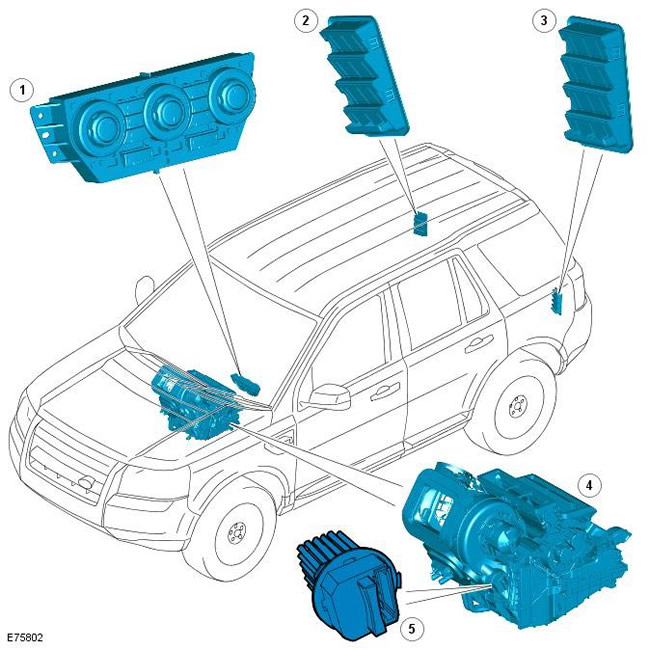
| Pos. | Spare part number | Name |
| 1 | - | Temperature Control Module (ATC) |
| 2 | - | Right air vent |
| 3 | - | Left air vent |
| 4 | - | Heater assembly |
| 5 | - | Blower Motor Control Module |
There are two options for the heating and ventilation system. High-end vehicles are equipped with a dual-zone automatic system, which allows you to set different temperature settings for the left and right sides of the cabin. The dual-zone system can also be equipped with a pollution sensor, which monitors the air quality in the cabin.
In vehicles with a lower level of equipment, a single-zone system is used, which is manually controlled.
In both systems, the heater assembly is installed along the vehicle's axis, between the instrument panel and the engine compartment bulkhead.
The ATC module controls the operation of the blower fan motor via the appropriate control module, which is mounted on the engine compartment bulkhead on the heater housing assembly side. For more information, refer to chapter: (412-01 Climate Control):
- Air distribution and purification (Description and operating principle)
- Air Conditioning (Description and Operating Principle)
- Control Components (Description and Operating Principle)
- Some vehicles are also equipped with an additional heater. For more information, refer to the chapter: (412-02 Additional climate control).
- Auxiliary electric heater (Description and operating principle)
- Auxiliary fuel heater (Description and operating principle)
Automatic temperature control module
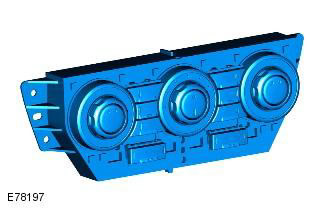
The air distribution and temperature are controlled by the Automatic Temperature Control (ATC) module, which is integrated into the control panel. Based on commands from the control panel, the ATC module controls the operation of a 3-step (in a single-zone system) or 5-step (in a dual-zone system) electric motor, which is mounted on the heater assembly housing. For more information, refer to the chapter: Control Components (412-01 Climate Control, Description and Operating Principle).
Heater assembly
[The original article is located on the website: LRman.ru]
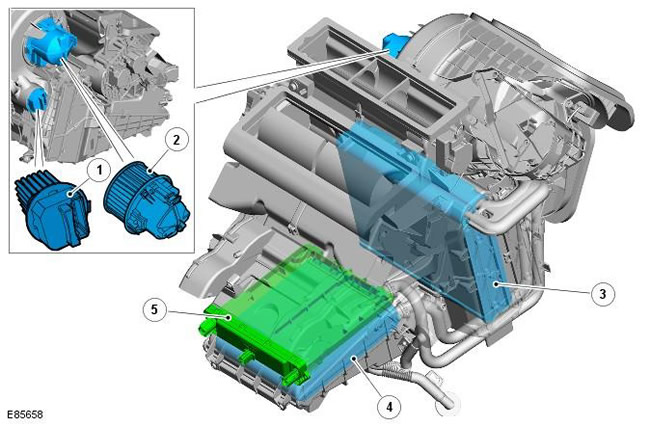
| Pos. | Spare part number | Name |
| 1 | - | Blower Motor Control Module |
| 2 | - | Electric blower fan |
| 3 | - | Air Conditioning (A/C) Evaporator |
| 4 | - | Heater radiator |
| 5 | - | Electric additional heater |
The heater assembly controls the temperature of the air supplied to the air distribution ducts in accordance with the instructions of the ATC module. The heater assembly is installed along the vehicle axis and includes the following components:
- Electric blower fan
- Heater radiator
- Cabin air filter. For more information, see chapter: Air distribution and cleaning (412-01 Climate control, Description and operating principle).
- A/C Evaporator For more information, refer to the chapter: Air Conditioning (412-01 Climate Control, Description and Operation).
- Air intake damper and stepper motor. For further information, refer to chapter: Control components (412-01 Climate control, Description and operating principle).
- Air distribution dampers and stepper motors. For further information, refer to chapter: Control components (412-01 Climate control, Description and principle of operation).
- Temperature mixing dampers and associated stepper motors. For further information, refer to chapter: Control components (412-01 Climate control, Description and operating principle).
- Additional electric heater (if equipped). For more information, see chapter: Electric Booster Heater (412-02 Auxiliary Climate Control, Description and Function).
Electric blower fan
The blower fan is a centrifugal fan driven by an electric motor. The blower fan is controlled by the ATC module together with the blower fan control module. The ATC module supplies the blower fan control module with a pulse width modulated (PWM) signal based on the desired fan speed. The blower fan control module interprets the PWM signal as fan speed and controls the voltage supplied to the blower fan accordingly. For more information, refer to the chapter: Control Components (412-01 Climate Control, Description and Function).
Heater radiator
The heater radiator heats the air supplied to the passenger compartment. The heater radiator is an aluminum two-pass heat exchanger made of finned pipes, installed across the heater. The heater radiator is connected to the engine cooling system by two aluminum pipes passing through the bulkhead of the engine compartment. When the engine is running, the cooling system pump constantly pumps coolant through the heater radiator. For more information, refer to the chapter:
- Engine Cooling (303-03A Engine Cooling - 3.2L NA - I6, Description and Operation)
- Engine Cooling (303-03B Engine Cooling - 2.2L Duratorq - Td4, Description and Operating Principle)
Exhaust vents
The air vents allow air to flow freely through the vehicle's interior. The outlets are located on the left and right rear side panels of the vehicle body behind the rear lights.
The ventilation nozzles consist of a grille covered with a soft rubber flap, which functions as a check valve. The rubber flap automatically takes the required position depending on the difference in pressure in the cabin and outside.
Comments on this article