Contents: Vibration of the gearbox when…⇩ Vibration of the gearbox when…⇩ Increased effort when shifting…⇩ Noise in the gearbox when driving in…⇩
Vibration of the gearbox when operating in forward gears
1. Check the condition of the transmission and engine mounts.
2. Check the gearshift lever adjustment.
3. Check the fastening of the leash on the fork stem, both bushings on the stem and the ball - retainer with spring.
Next, check the internal components.
4. Check the operation of the power plugs.
5. Check the condition of the synchronizer teeth and gears.
6. Check the axial play of the shafts.
7. Check the condition of all components and the permissible clearances.
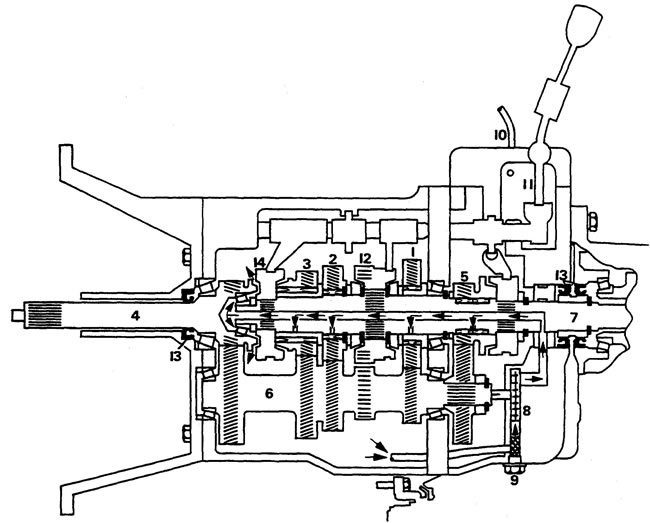
1 - 1st gear pinion of secondary shaft, 2 - 2nd gear pinion of secondary shaft, 3 - 3rd gear pinion of secondary shaft, 4 - primary shaft, 5 - 5th gear pinion of secondary shaft, 6 - intermediate shaft, 7 - secondary shaft, 8 - oil pump, 9 - mesh filter, 10 - ventilation tube, 11 - gear shift fork rod and lever, 12 - 1/2 gear synchronizer, 13 - oil seals, 14 - 3/4 gear synchronizer, 15 - 5th gear synchronizer.
Vibration of the gearbox when working in reverse gear
1. Check the condition of the transmission and engine mounts.
2. Check the gearshift lever adjustment.
3. Check the fastening of the leash on the fork stem, both bushings on the stem and the retainer ball with the spring. Next, check the internal components.
4. Check the operation of the reverse gear lever.
5. Check the condition of the reverse gear teeth, shaft bearings and shaft.
6. The presence of shavings indicates wear of the synchronizers/gears.
Increased effort when shifting gears, whether the vehicle is moving or stationary
1. Check the oil brand and level; if it is low, top up for now.
2. If possible, lubricate the shift mechanism and check the operation of the mechanism.
3. Check the fastening of the leash on the fork stem, both bushings on the stem and the retainer ball with the spring.
4. Drain the oil from the gearbox and check for the presence of shavings.
The presence of shavings indicates wear on the synchronizers or locking rings.
Noise in the gearbox when the car is moving.
1. Make sure the clutch is working properly.
2. Determine in which gear the noise occurs.
3. Check the oil brand and level; if it is low, do not top up yet.
4. Drain the oil from the gearbox and check for the presence of shavings.
The presence of shavings indicates wear on the synchronizers.
5. Check the condition of the synchronizers and gear teeth.
6. Check the condition of all components and the permissible clearances.
Noise in the gearbox when the lever is in neutral, which disappears when the clutch pedal is depressed
1. Check the oil brand and level; if it is low, do not top up yet.
2. Drain the oil from the gearbox and check for the presence of shavings.
The presence of chips indicates wear of the intermediate shaft bearings, primary or secondary shaft front bearing.
Noise in the gearbox when driving in any gear
1. Check the oil brand and level; if it is low, do not top up yet.
2. Drain the oil from the gearbox and check for the presence of shavings.
The presence of shavings indicates wear on the secondary shaft gear needle bearings.
Comments on this article