


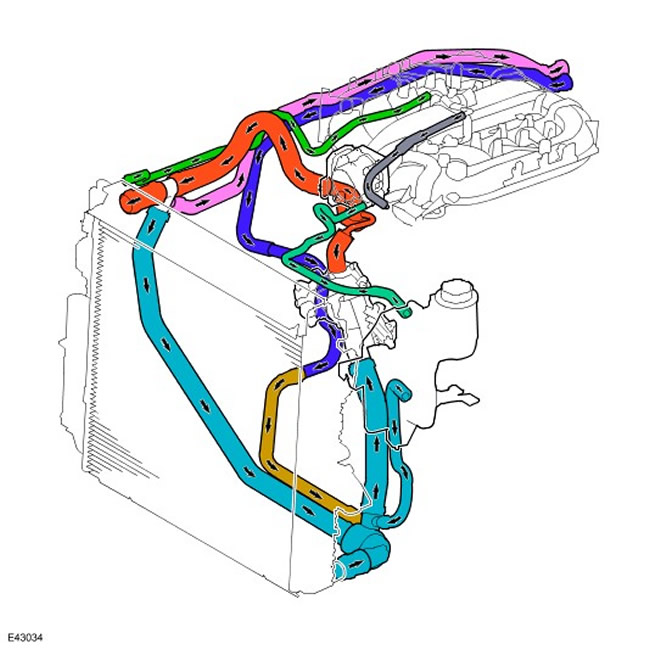
Coolant flow through the system for vehicles without an engine oil cooler
Coolant flow through the system for vehicles with engine oil cooler
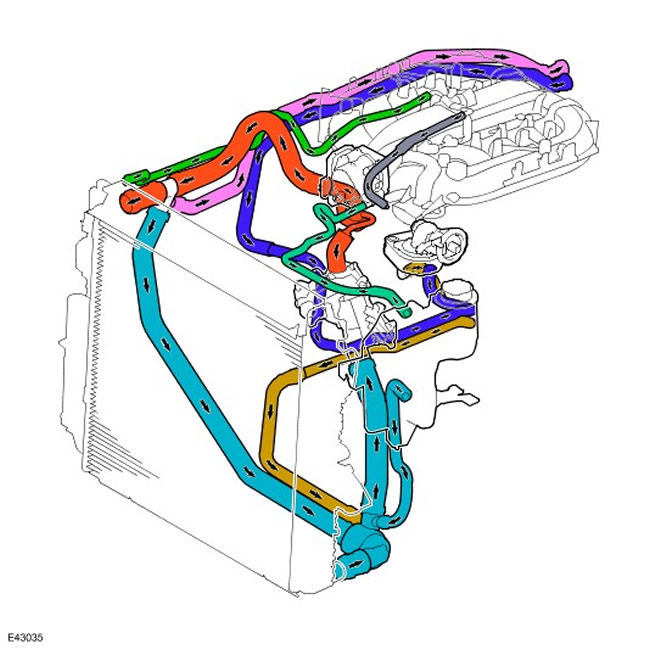
When the engine is running, the water pump pulley is driven by the accessory drive belt. This circulates coolant through the engine water jacket, heater, and EOC while the thermostat and bypass valve are closed. As the coolant temperature increases, the bypass valve opens and coolant begins to circulate through it. When the temperature reaches 82°C (180°F), the main thermostat opens, allowing coolant to circulate through the main radiator. As the main thermostat gradually opens (fully open at 95°C (203°F)) the bypass valve gradually closes, allowing all of the coolant to circulate through the heater or radiator. As coolant begins to circulate through the radiator, it also begins to flow into the transmission fluid cooler.
Excess coolant volume caused by thermal expansion enters the expansion tank through a hose from the top of the radiator. The expansion tank has a drain hose connected to the cooling system circuit. This hose returns coolant to the system when the engine cools down.
The text of the article was taken from the website [www.LRman.ru]
Coolant flows through the radiator from the top of the right reservoir to the bottom of the left reservoir and is cooled by air passing through the radiator core. The temperature of the coolant is monitored by the engine control module (ECM) using the coolant temperature (ECT) sensor located in the cylinder head. The ECM uses signals from this sensor to adjust fuel delivery according to engine temperature. For more information, refer to Electronic Engine Controls (303-14A Electronic Engine Controls - 4.0L)
The ECM controls the cooling fan via a pulse width modulated signal that is sent to the fan control module integrated into the engine control module. The frequency of the pulse width modulated signal is used by the fan control module to determine the supply voltage to the fan motor.
The Engine Control Module (ECM) varies the duty cycle of the pulse-width modulated pulse train within the range of 0-100%, thereby regulating the fan speed. If the signal from the ECM goes beyond the range of 0-100%, the fan control module perceives this as an open circuit or short circuit and turns the fan on at maximum speed to prevent overheating of the engine and transmission.
In addition, the fan speed depends on the vehicle speed. The ECM regulates the cooling fan speed to compensate for the oncoming air flow. The vehicle speed signal is transmitted via the CAN bus from the anti-lock brake system control unit.
Pressure Regulating Thermostat (PRT)
One side of the thermostat contains 85% hot coolant coming from the engine and the other side contains 15% cold coolant returning from the lower radiator hose. This allows the thermostat to respond to changing ambient conditions, providing coolant temperature control in both winter and summer. Hot coolant coming from the engine passes through openings in a bypass valve inside a tube that surrounds 85% of the thermostat's active surface area. Cold coolant from the radiator passes through the remaining 15% of the thermostat's active surface area. In cold ambient temperatures, the engine's operating temperature is increased by approximately 10°C (50°F) to compensate for the heat loss from contact with the 15% cold coolant returning from the lower hose. This improves heater performance and speeds up engine warm-up.
The bypass valve is held closed by a light spring and provides additional assistance when warming up the engine and heating the heater. When the main valve is closed and the engine is idling, the coolant pump does not provide enough flow and pressure to overcome the spring and open the valve. As a result, the valve does not allow coolant to circulate through the bypass channel and directs it only through the heater core. This allows more coolant to flow through the heater core, which improves passenger comfort in cold temperatures.
As engine speed increases above idle, the coolant pump delivers more flow and pressure than the heater circuit is designed for. The increasing pressure acts on the valve, overcomes the spring, and opens the valve, releasing pressure from the heater circuit. The valve then adjusts its opening to provide maximum coolant flow through the heater core and bypasses excess coolant to ensure engine cooling at high speeds. The thermostat then regulates the flow through the radiator, maintaining optimum engine temperature. Maximum thermostat opening, and therefore maximum flow through the radiator, corresponds to a coolant temperature of 95°C (203°F).
Comments on this article